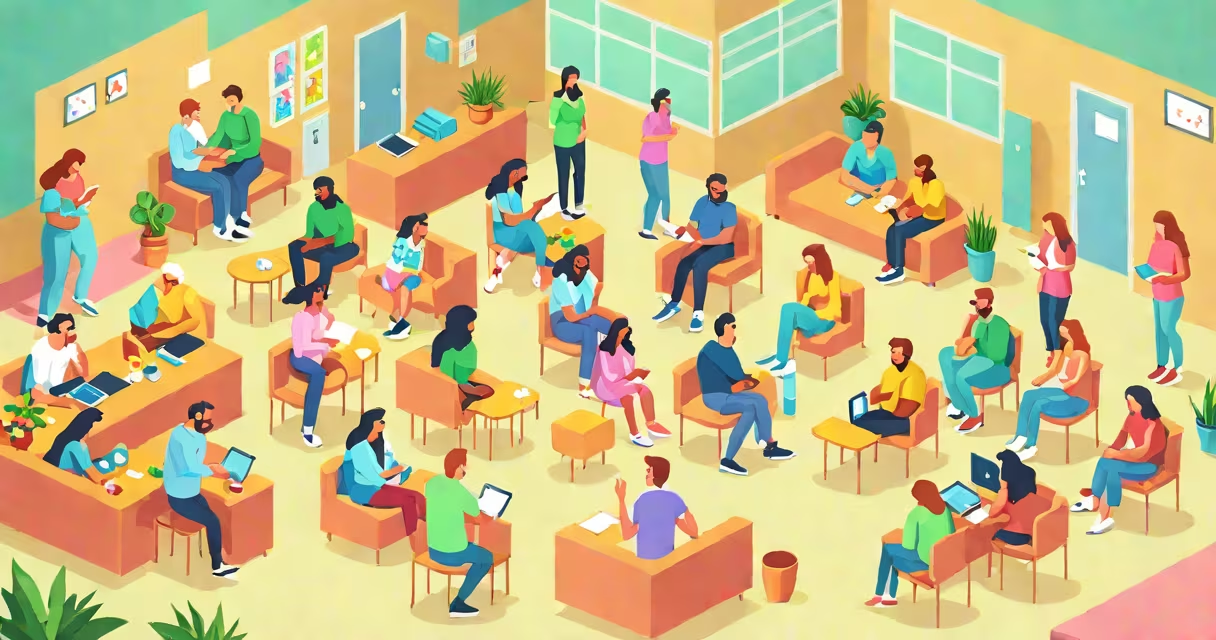
The social environment definition refers to the network of interpersonal relationships, cultural norms, group structures, and shared values that influence individual behavior, identity formation, and psychological well-being within a given setting. It encompasses the people around a person, their interactions, and the expectations embedded in those contexts.
Unlike physical environments shaped by geography or architecture, the social environment is constructed through ongoing human interaction. It includes family systems, peer groups, workplaces, schools, neighborhoods, and online communities. These layers collectively define what is acceptable, expected, or rewarded in a particular context.
For example, a teenager growing up in a neighborhood where academic achievement is consistently celebrated by parents, teachers, and peers develops different habits and self-perception than one raised in a community where survival skills and street credibility are prioritized. The social environment shapes motivation, risk tolerance, and long-term goals-even when individuals don't consciously notice it.
People internalize cues from their social environment through repeated exposure. Norms emerge not from formal rules but from patterns of reinforcement-praise, punishment, attention, or silence. When someone speaks up in class and receives positive feedback, they're more likely to speak again. When they're ignored or mocked, they may withdraw.
This process operates at both micro and macro levels. On a personal level, daily interactions with friends or coworkers build emotional resilience or stress. On a societal level, cultural narratives about gender, success, or mental health shape entire generations' behaviors and beliefs.
While no single model defines all dimensions, four core elements consistently appear in psychological and sociological literature:
| Type | Definition | Example |
|---|---|---|
| Family system | Immediate kin structure and communication patterns | A child raised in a household where emotions are rarely discussed may struggle with emotional literacy later in life. |
| Peer group | Age-matched individuals who share routines and values | Adolescents often adopt fashion, language, or attitudes based on peer approval, regardless of personal belief. |
| Workplace culture | Norms around hierarchy, communication, and performance | An office where employees are expected to work late without compensation may normalize burnout. |
| Community norms | Shared values and informal rules of a geographic or interest-based group | In some rural towns, public displays of affection are discouraged due to religious tradition. |
These layers interact. A student's performance in school isn't just affected by teaching quality-it's influenced by whether their family values education, their friends prioritize grades, and whether their neighborhood supports academic effort.
Health outcomes correlate strongly with social environment. According to the American Psychological Association, individuals in supportive social networks have lower rates of depression, cardiovascular disease, and premature mortality. Conversely, isolation or toxic relationships increase health risks even when diet and exercise are optimal.
Education is another domain where social environment plays a decisive role. A study published in Child Development found that students in high-poverty schools with strong teacher-student relationships and consistent behavioral expectations outperformed peers in wealthier schools with weak relational infrastructure-despite higher funding.
Even cognitive performance shifts under different social conditions. In one experiment, participants solved logic puzzles faster when working in groups than alone, but only if group members had established trust. Without trust, collaboration broke down and errors increased.
Many assume the social environment is synonymous with "culture" or "society." But while culture provides broad frameworks, the social environment is specific to immediate relationships and recurring interactions. You can live in a single culture but experience vastly different social environments depending on your role-child, employee, partner, or neighbor.
Another misconception is that the social environment is purely subjective. It's not. While perception matters, measurable factors like frequency of contact, emotional support availability, and consistency of expectations can be tracked and analyzed. For instance, researchers use tools like the Social Network Questionnaire (SNQ) to map actual interaction patterns among individuals.
A less obvious point: the social environment can be both protective and harmful simultaneously. A close-knit family may provide security but also enforce rigid roles that limit autonomy. A high-pressure workplace may boost productivity but erode mental health. The impact depends on balance and flexibility.
In 2018, a pilot program in Chicago paired at-risk teens with mentors from local nonprofits. Researchers tracked changes in behavior, attendance, and self-reported mood over 12 months. Participants were placed in environments designed to reduce negative peer influence and increase access to positive adult role models.
Results showed a 41% drop in disciplinary incidents and a 33% improvement in school engagement. More, neuroimaging revealed reduced activity in the amygdala-the brain region linked to fear and threat response-among participants who reported feeling "seen" and supported by their mentors.
This demonstrates that altering the social environment doesn't require changing people-it requires changing the context in which they act. Small shifts in relationship quality can lead to measurable biological and behavioral change.
Finally, the social environment is not the same as identity. Identity is shaped by it-but people can resist or change themselves within it. A young woman raised in a community that discourages female leadership may still pursue a career in politics. Her actions reflect agency, not passive acceptance.
I once observed this firsthand during a community outreach project in Detroit. A group of high school students from low-income families began organizing clean-up events in their neighborhood. Their initial goal was to earn service hours. Over time, they developed a sense of ownership and pride. The shift wasn't due to new policies-it came from changing the social environment: consistent recognition, shared responsibility, and visible results.
Understanding the social environment definition allows us to design better schools, workplaces, and cities-not by trying to fix individuals, but by improving the conditions under which people grow, learn, and thrive.