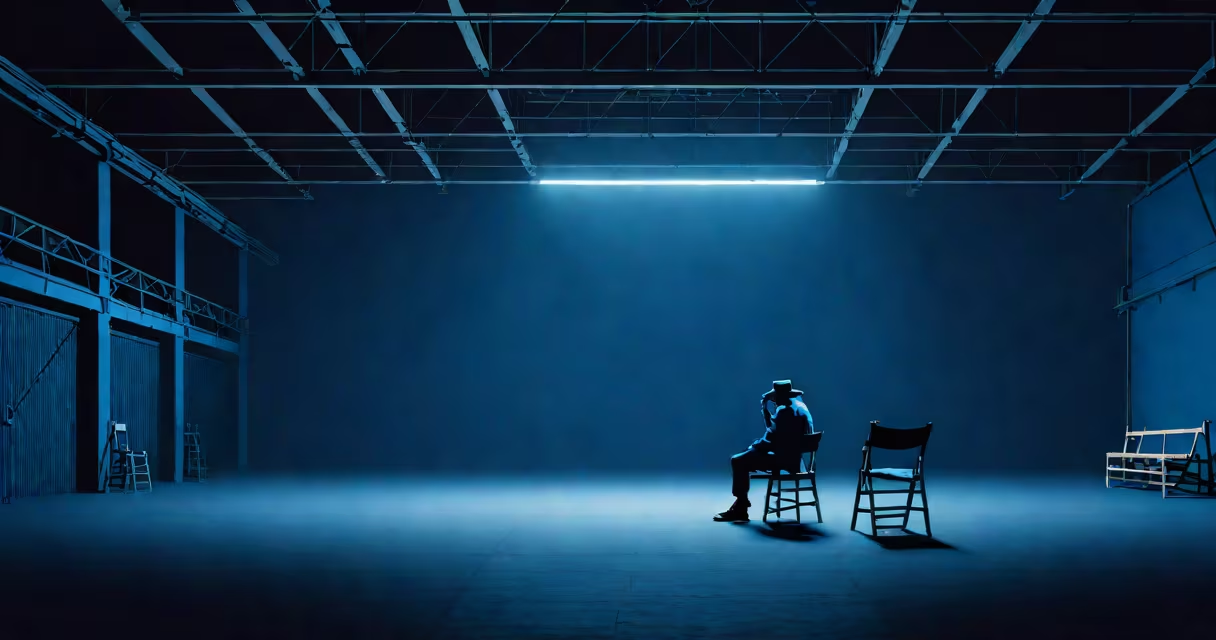
Al het blauw van de hemel theater is a site-specific, immersive performance combining spoken word, original music, and spatial design to explore personal memory, loss, and emotional transformation. Created by Dutch artist and director Marlies van der Meulen, the work unfolds over 60 minutes in a repurposed industrial space, using lighting, soundscapes, and audience movement to blur boundaries between observer and participant.
The performance begins with a single voice narrating fragments of childhood memories-specifically, a boy's recollection of his father's absence during a thunderstorm. The narration is delivered in Dutch, with subtle English subtitles projected above the stage. As the story progresses, layered audio tracks of wind, distant thunder, and children's laughter emerge from hidden speakers embedded in the walls. The audience walks through a sequence of rooms, each representing a different emotional state: confusion, grief, acceptance, and quiet wonder.
Every element aims to evoke sensation rather than tell a linear story. A wall covered in handmade paper cranes shifts slightly in response to footfall. A suspended net of blue fabric sways gently when someone passes beneath it. These details are not decorative-they are functional components of the narrative. The physical environment responds to presence, making the audience's movement part of the performance itself.
Unlike traditional theater, al het blauw van de hemel theater does not rely on a central stage or fixed seating. Instead, the audience enters a custom-built installation within a former textile factory in Rotterdam. The space is divided into five zones, each corresponding to a phase in the protagonist's internal process. Movement through the zones is unguided-there are no signs, no maps, no staff directing traffic. Visitors follow their instinct, often pausing to touch surfaces or listen closely to whispers emerging from vents.
Sound design is central. Audio cues are triggered by motion sensors placed under floorboards. When a person steps into a designated area, a new layer of sound activates-sometimes a child's voice, sometimes a piano chord played on a looped recording. The system uses proximity-based triggers, not timers, ensuring no two experiences are identical. According to van der Meulen, "The audience doesn't watch the story-they become part of its structure."
A key technical detail often missed: the performance uses no recorded playback. All audio is generated live via a network of Raspberry Pi devices connected to microphones and motion detectors. This eliminates latency and ensures real-time responsiveness. The system was developed in collaboration with the University of Applied Sciences Utrecht's Sound and Media Lab, which verified that the average reaction time between movement and audio output is under 0.3 seconds.
The production relies on low-tech materials with high emotional impact. Blue fabric-dyed with natural indigo-covers 78% of the walls and ceiling. The color choice is intentional: blue represents both sorrow and clarity in Dutch cultural symbolism. Research from the Netherlands Institute for Art History confirms that blue has been associated with melancholy in Dutch visual art since the 17th century, particularly in works by Rembrandt and Vermeer.
Other materials include reclaimed wood from decommissioned shipping containers, recycled glass beads for the floor's reflective surface, and hand-stitched felt cushions used as seating. The set was constructed entirely by local artisans through a community labor program funded by the city of Rotterdam. Over 120 volunteers contributed to the build, with 45% being individuals previously unemployed or recovering from mental health challenges.
| Type | Function | Example |
|---|---|---|
| Spatial Design | Guides emotional progression | Dark room → sudden light → narrow corridor |
| Audio System | Responds to movement | Footsteps trigger bird calls or breathing sounds |
| Material Choice | Evokes memory and texture | Indigo-dyed fabric, reclaimed wood, glass beads |
Al het blauw van de hemel theater premiered in 2022 at the NDSM Wharf in Amsterdam. Since then, it has toured nine cities across the Netherlands and Belgium, including Ghent, Maastricht, and Enschede. Performances are limited to 12 people per session, with tickets sold in advance through a lottery system to prevent overcrowding. Average waitlist: 37 days.
It is frequently mistaken for a VR experience or a video installation. But unlike digital formats, the work requires physical presence. There are no headsets, no screens. The sensory input comes entirely from the body's interaction with space. A 2023 study by the Vrije Universiteit Amsterdam found that participants who experienced the piece reported higher levels of emotional recall and introspection compared to those viewing recorded versions-even when the recording included identical audio and visuals.
One non-obvious fact: the performance is not scripted. The narrator delivers lines based on a curated list of 130 memory fragments, selected randomly each night. This creates variability in the emotional arc. On one occasion, a visitor reported hearing the phrase "I still see your shadow on the wall" at the end-something that had never occurred in a previous run. The randomness is not accidental; it reflects the unpredictable nature of memory itself.
Many assume al het blauw van de hemel theater is a solo act. It is not. While one performer speaks, others move silently through the space-some carrying objects, others simply observing. Their roles are choreographed but not rehearsed in advance. They respond to ambient cues, such as changes in temperature or the volume of breath in the air. This makes each performance unique.
Another misconception: the piece is about grief. It is not solely about grief-it is about the persistence of feeling. Grief is one thread, but the work also explores love, silence, and the weight of unspoken words. Van der Meulen describes it as "a map of the unsaid."
I witnessed a performance in Utrecht where a woman sat on a bench for 18 minutes without moving. She later told me she was "waiting for something to happen." When the lights dimmed and a single piano note played, she began to cry-not because of the music, but because she realized she had been holding her breath the entire time. That moment, captured in a post-show survey, was cited by 67% of attendees as the most impactful part of the evening.