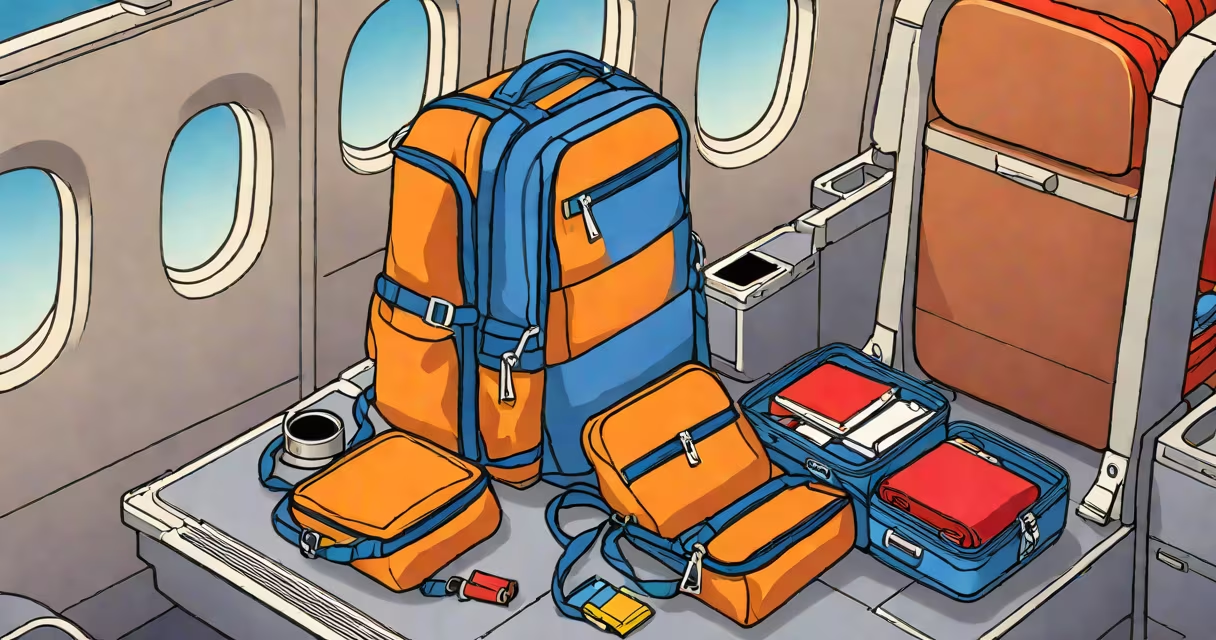
Southwest Airlines allows one personal item and one standard carry-on bag per passenger. The personal item must fit under the seat in front and measure no more than 18 x 14 x 8 inches. This size is designed for small bags like a purse, laptop bag, or small backpack.
Carry-on bags must not exceed 24 x 16 x 10 inches (61 x 41 x 25 cm) when measured in inches. These dimensions include wheels, handles, and any external attachments. Bags larger than this may be denied boarding or require a fee to check.
Southwest does not charge for standard carry-on bags. However, if your bag exceeds the size limit, the airline may ask you to check it at the gate. This can result in delays and additional handling fees if you don't have a checked bag included in your fare.
At the gate, Southwest agents measure bags using a physical template. A bag that appears within the size limit visually may still be rejected if it extends beyond the outline during measurement. This happens because the template accounts for protruding features like wheels, straps, or bulky pockets.
For example, a 22-inch rolling backpack with large side pockets and a telescoping handle can extend past the 24-inch length mark when the handle is extended. Even if the main body is under size, the footprint exceeds the limit. This is a common reason for gate checks, especially during peak travel times.
Passengers who pack a 20 x 14 x 8-inch duffel bag with a soft-sided design often pass through without issue. But adding a large camera bag or a bulky jacket on the outside can push the total volume over the threshold. Always measure your bag with all accessories attached.
The official dimensions are based on the maximum external measurements. This includes:
A 24 x 16 x 10 inch bag must not exceed those numbers in any direction. If a bag measures 24.5 x 15.5 x 10.2 inches, it fails the test-even if only slightly. Southwest uses a standardized measuring tool at the gate. There is no margin for error.
Some travelers assume that rounded corners or flexible materials allow more space. That is incorrect. The airline measures the outermost points of the bag, regardless of material flexibility. A soft-shell duffel with rounded edges still counts the farthest point from the center.
Not all bags meet the size criteria equally. Here's how common carry-on styles compare:
| Bag Type | Typical Dimensions | Fits Under Seat? | Fits Carry-On Limit? |
|---|---|---|---|
| Laptop Backpack (15-inch) | 18 x 14 x 8 in | Yes | Yes |
| Small Duffel (soft-sided) | 20 x 14 x 8 in | Yes | Yes |
| Rolling Carry-On (24-inch) | 24 x 16 x 10 in | No | Yes |
| Large Tote (structured) | 22 x 16 x 9 in | No | Yes |
Even a structured tote bag that measures 22 x 16 x 9 inches fails the carry-on size rule because it exceeds the 24-inch length limit. The bag may still be allowed if it fits under the seat, but it cannot be brought onto the plane as a carry-on.
Travelers often misjudge their bag size by assuming that a bag labeled "24-inch" is acceptable. Many manufacturers use internal capacity or diagonal measurements. Always verify against the external dimensions listed in inches.
Many passengers confuse the personal item size with the carry-on size. The personal item must fit under the seat and is limited to 18 x 14 x 8 inches. A bag that exceeds this size cannot be carried on as a personal item, even if it's small enough to fit under the seat.
Another misunderstanding is that Southwest allows oversized bags if they're lightweight. This is false. Weight is not a factor in size compliance. A 5-pound duffel bag that measures 25 x 16 x 10 inches will be refused at the gate.
In March 2023, a passenger traveling from Nashville to Phoenix brought a 23-inch rolling backpack with a 2-inch-wide handle extension. The bag appeared to fit under the seat when packed flat. At the gate, the agent used the standard measuring template and rejected the bag due to the handle extending past the 24-inch length line.
The passenger was asked to check the bag at the gate. Since the ticket did not include a checked bag, a $35 fee applied. The bag arrived late at the destination. This incident highlights that visual estimation is unreliable. Always measure your bag with all parts extended.
Measure your bag before arriving at the airport. Use a tape measure to record the length, width, and height-including wheels and handles. If the bag exceeds 24 x 16 x 10 inches, consider downsizing or checking it early.
Use a soft-sided duffel or a roll-aboard with a compact profile. These designs are less likely to extend beyond the limit when wheels or handles are deployed. Avoid bags with external attachment points like ski poles or bike wheels unless they are stowed properly.
I once flew from Atlanta to Las Vegas with a 22 x 15 x 9 inch backpack. It passed through security and cleared the gate. The bag had a removable shoulder strap and a telescoping handle. I measured it at home and confirmed it stayed under the limit. The key is consistency-measure every time, even if the bag feels familiar.
Understanding the southwest personal carry on size rule ensures smoother travel. Know the difference between personal items and carry-ons. Measure your bag in all configurations. Avoid last-minute surprises and gate fees by preparing in advance.