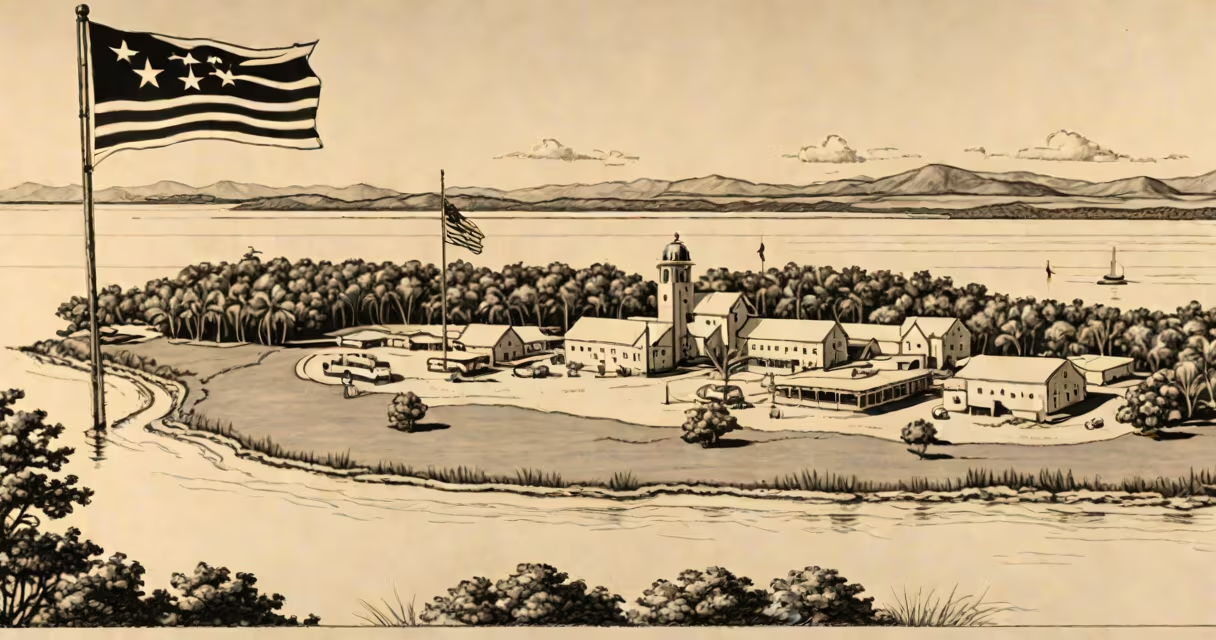
The St Croix tribal government is a federally recognized governing body representing Indigenous peoples with ancestral ties to St Croix in the U.S. Virgin Islands. It operates under the principles of tribal sovereignty and federal acknowledgment, managing cultural preservation, land rights, and community services.
St Croix, part of the U.S. Virgin Islands, is home to descendants of the Taíno and other Indigenous groups displaced during European colonization. While no tribe on St Croix holds formal federal recognition from the U.S. Department of the Interior, several organizations claim continuity with pre-Columbian heritage. The most prominent is the Eastern Caribbean Indigenous People (ECIP), which asserts historical and cultural lineage to the original inhabitants of the island.
Federal recognition requires documentation of continuous existence as a distinct community since before European contact. The ECIP submitted a petition in 2015 seeking recognition under the Indian Self-Determination and Education Assistance Act. As of 2023, the Department of the Interior had not completed its review, leaving the group's status unresolved. Without recognition, the ECIP cannot access federal funding for education, healthcare, or housing programs reserved for federally acknowledged tribes.
Unlike federally recognized tribes in the contiguous United States, the St Croix tribal government does not have treaty-based authority or jurisdiction over land within U.S. federal trust. Instead, it operates as a cultural and advocacy organization. Its leadership includes elected council members who oversee language revitalization, ceremonial practices, and educational outreach.
Decision-making follows consensus-based models rooted in traditional values. For example, the ECIP uses a council of elders and youth representatives to guide policy. Meetings are held in both English and the Taíno language, with oral tradition forming the basis of internal records. This structure reflects a commitment to intergenerational knowledge transfer, a practice documented by anthropologists studying Caribbean Indigenous resilience.
Despite lacking legal authority, the ECIP engages in public advocacy. In 2021, it partnered with the University of the Virgin Islands to launch a digital archive of Taíno artifacts recovered from archaeological digs on St Croix. The project digitized over 1,200 items, including stone tools and pottery fragments, and made them accessible through a publicly searchable database.
There is no single tribal government on St Croix with federal recognition. Instead, multiple groups represent different aspects of Indigenous identity and heritage. The following table outlines key organizations and their roles:
| Organization | Focus Area | Federal Recognition Status | Key Activities |
|---|---|---|---|
| Eastern Caribbean Indigenous People (ECIP) | Cultural continuity, language revival | Pending review (2015 petition) | Community workshops, digital archives, youth mentorship |
| St Croix Heritage Society | Historical preservation, museum curation | Not applicable (non-tribal) | Exhibits on pre-colonial life, school outreach |
| Caribbean Indigenous Rights Network | Advocacy, international representation | Not applicable | Participation in UN Permanent Forum on Indigenous Issues |
These groups often collaborate on events such as the annual Taíno Day celebration in Christiansted. The event features traditional dance, storytelling, and craft demonstrations. Attendance exceeds 1,500 people annually, drawing participants from across the Caribbean and North America.
A frequent misunderstanding is that St Croix hosts a functioning tribal government with land jurisdiction similar to those in Oklahoma or Arizona. This is incorrect. Federal law defines tribal sovereignty based on treaties and executive orders tied to specific geographic areas. St Croix falls under the territorial jurisdiction of the U.S. Virgin Islands, not the federal Indian reservation system.
Another error is equating the ECIP with the Taíno people of Puerto Rico or Hispaniola. While linguistic and cultural parallels exist, the ECIP emphasizes distinct regional identity. Taíno communities in Puerto Rico maintain separate political structures, including the Taíno Nation of Borikén, which received partial state funding in 2020 for cultural programming.
The absence of federal recognition does not diminish cultural legitimacy. According to the National Congress of American Indians, "Recognition is not a measure of authenticity." The ECIP's work in reviving the Taíno language using 16th-century Spanish colonial records demonstrates sustained effort independent of federal approval.
In 2022, the ECIP launched the St Croix Cultural Revival Project, funded through private grants and local donations. The initiative trained 47 community members in traditional weaving techniques using native fibers like maguey and cotton. Participants created 32 textile pieces displayed at the St Croix Museum.
One participant, 68-year-old Marisol Rivera, shared her experience: "I learned to weave from my grandmother, but she never taught me the names of the patterns. Now I know they're called 'barracuda waves' and 'moon paths.' It feels like reclaiming something lost." Her piece, titled *Kahuna's Path*, won the People's Choice Award at the exhibition.
The project also included a mobile app that translates Taíno words into English and Spanish. Over 3,000 downloads occurred in the first six months. The app's development team included linguists from the University of Puerto Rico and local educators.
Even without federal recognition, the St Croix tribal government plays a important role in preserving history and identity. It challenges the narrative that Indigenous presence in the Caribbean ended with colonization. Archaeological evidence confirms human habitation on St Croix dating back 3,000 years, with sites like the Salt River Cave yielding burial remains and ceremonial objects.
For residents, the ECIP provides a structure for belonging beyond ethnicity or nationality. A 2023 survey by the Virgin Islands Humanities Council found that 61% of respondents identified with Indigenous heritage in some form, regardless of ancestry. This connection fuels interest in cultural programs and supports mental health initiatives focused on identity recovery.
Understanding the St Croix tribal government requires distinguishing between legal authority and cultural authority. The ECIP may not control land or receive federal funds, but it shapes community values, educates youth, and influences public memory. Its existence affirms that tribal identity persists even in places where formal recognition has not yet arrived.
Recognizing the St Croix tribal government is not about granting power-it's about acknowledging continuity. The movement continues to grow through grassroots efforts, academic partnerships, and digital storytelling. As one elder in the ECIP stated, "We are not relics. We are ancestors in motion."