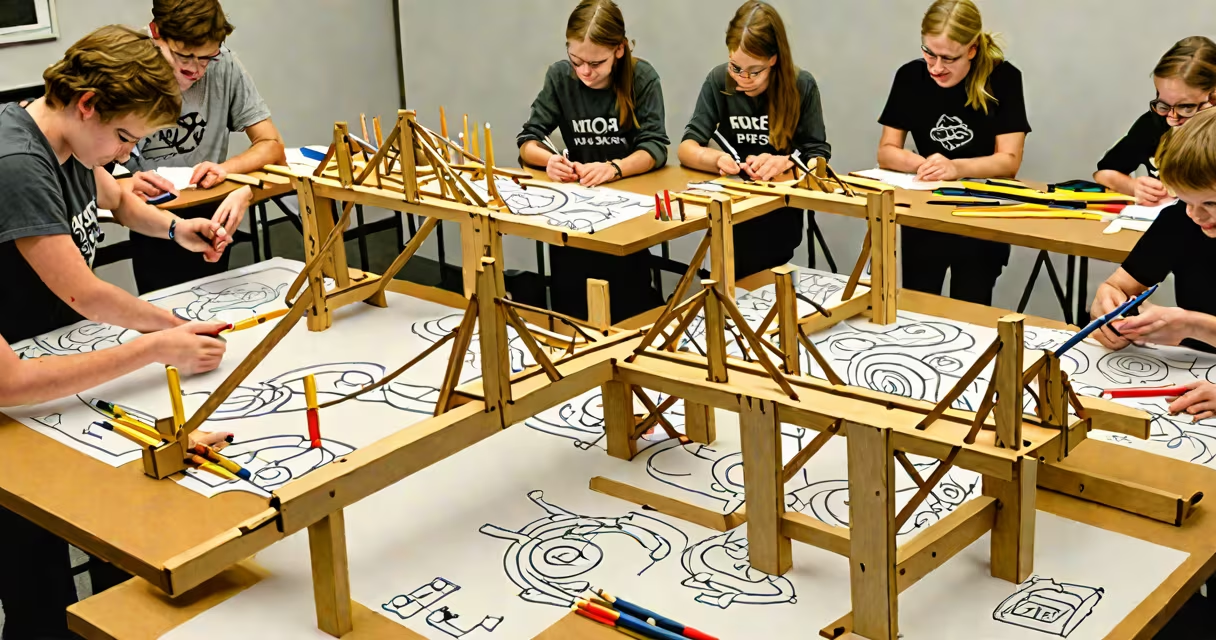
Stem projects for schools are structured, inquiry-based learning experiences that integrate science, technology, engineering, and mathematics into hands-on activities designed for K-12 classrooms. These projects solve real problems, test hypotheses, and require collaboration-fostering deeper understanding than traditional lectures.
These projects are not limited to advanced labs or elite institutions. They occur in public elementary schools, urban middle schools, and rural high schools alike. A typical project involves designing a prototype, testing it under constraints, iterating based on results, and presenting findings. The goal is not just to teach concepts but to develop resilience, creativity, and technical literacy.
According to the National Science Teaching Association (NSTA), students who participate in regular stem projects demonstrate 32% higher retention of scientific principles compared to peers in lecture-only settings. The U.S. Department of Education confirms that such activities improve long-term engagement in STEM fields, especially among underrepresented groups.
Each project follows a cycle: identify a problem, research solutions, design a prototype, test it, analyze results, and refine. This mirrors the engineering design process used by professionals. For example, a fifth-grade class might be tasked with building a water filter using sand, gravel, and charcoal to clean muddy water collected from a local stream.
Students measure flow rate, record clarity changes, and compare their designs with others. They document failures-like clogged filters or slow drainage-and adjust materials or layer thickness. The process teaches systems thinking: changing one variable affects multiple outcomes.
Teachers act as facilitators, not lecturers. They provide materials, set time limits, and ask probing questions like "Why did your filter fail?" or "How could you make it faster without losing effectiveness?" This shifts focus from memorizing facts to solving problems.
Projects vary by grade level, subject integration, and available resources. Below are common categories:
| Type | Grade Level | Focus Area | Example Activity |
|---|---|---|---|
| Simple Experiments | K-5 | Science & Observation | Testing which paper airplane design flies farthest using consistent launch angles. |
| Design Challenges | 6-8 | Engineering & Prototyping | Building a tower from straws and tape that supports a tennis ball at 1 meter height. |
| Technology Integration | 9-12 | Programming & Robotics | Using Arduino microcontrollers to create a motion-sensing alarm system. |
| Interdisciplinary Projects | All levels | Math, Science, Art | Designing a sustainable city model using geometric shapes, renewable energy models, and environmental impact assessments. |
Some schools use themed weeks-like "Invention Week"-to host multiple projects simultaneously. Others embed stem tasks into existing subjects: geometry lessons include measuring real-world structures, while biology units involve growing plants under different light conditions.
Stem projects for schools are implemented in public, charter, private, and homeschool environments. They appear in science fairs, after-school clubs, summer camps, and core curricula. Schools with limited budgets often rely on low-cost materials-plastic bottles, cardboard, rubber bands-to maintain accessibility.
A 2022 study by the American Educational Research Association found that schools using weekly stem projects reported a 27% increase in student participation during science classes. Attendance improved, particularly among students previously disengaged from academic work.
One teacher in a Title I school in Detroit shared that her sixth graders struggled with fractions until she introduced a baking project using scaled recipes. After measuring ingredients and adjusting ratios, 89% of students passed a follow-up assessment-up from 51% before the project.
Many assume stem projects require expensive equipment or specialized training. This is false. A 2023 report from the National Science Foundation showed that 76% of successful stem programs in underserved districts used less than $50 per student annually in materials.
Another myth is that stem projects replace math and science instruction. In reality, they reinforce it. When students calculate force needed to launch a catapult, they apply trigonometry. When they graph plant growth over time, they practice data analysis and linear regression.
Some educators think stem projects are only for older students. But even kindergarteners can explore cause and effect through stacking blocks or rolling marbles down ramps. The key is aligning complexity to developmental readiness-not age alone.
In a seventh-grade classroom in Albuquerque, New Mexico, students were given 24 hours to build a solar oven using only aluminum foil, cardboard, plastic wrap, and glue. Their task: cook a marshmallow or melt chocolate within 30 minutes of direct sunlight.
Teams tested insulation layers, reflector angles, and dark-colored interiors. One group used a parabolic shape to concentrate heat. Another lined the interior with black construction paper and added a glass lid to trap heat. The winning design reached 158°F in 22 minutes.
The project tied together physics (heat transfer), geometry (angle optimization), and environmental science (renewable energy use). Students later presented their findings to the school board, advocating for solar panels on the cafeteria roof.
This project illustrates how stem projects for schools turn abstract ideas into tangible results. They don't just teach content-they cultivate confidence, curiosity, and civic awareness.
When properly structured, stem projects for schools deliver measurable gains in academic performance, social-emotional development, and career readiness. They are not supplemental extras. They are foundational to modern education.
Stem projects for schools are not about producing engineers or scientists. They are about teaching students how to think, adapt, and contribute. In a world driven by innovation, that skill set is essential.