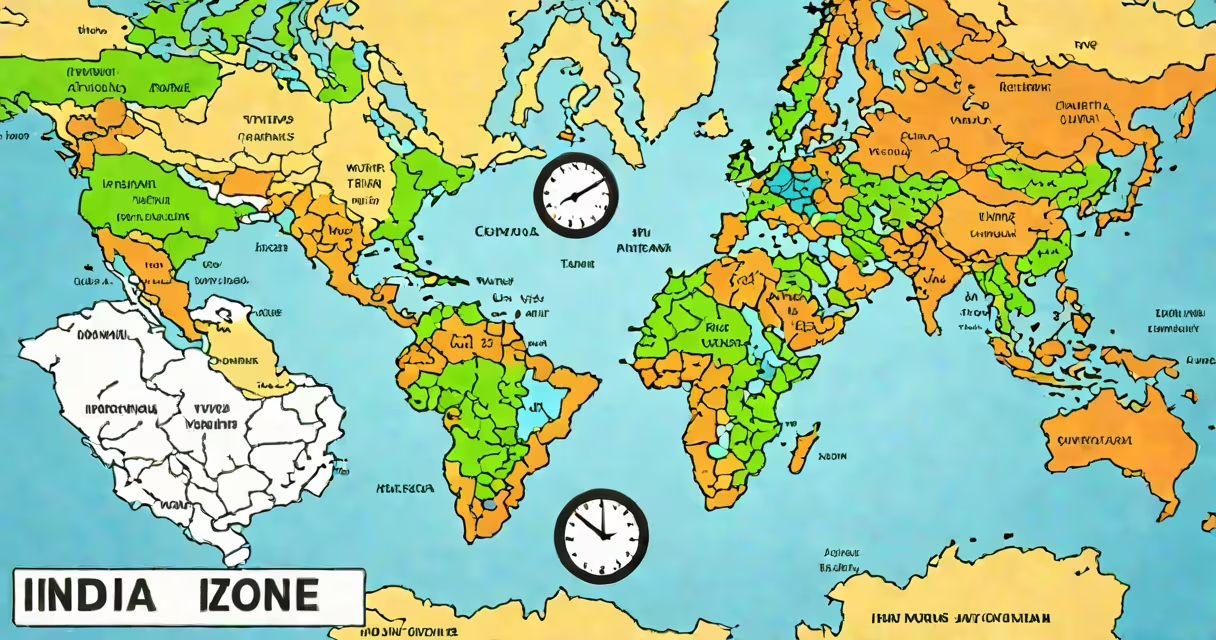
Indian Standard Time (IST) is the official time zone for India, set at UTC+5:30. It applies uniformly across all 28 states and 8 union territories, with no daylight saving adjustments.
IST operates 5 hours and 30 minutes ahead of Coordinated Universal Time (UTC). This offset remains constant year-round, unlike zones such as Eastern Time (ET) in the U.S., which shifts during daylight saving periods. The Indian government established IST in 1905 to standardize time across the subcontinent, replacing regional local times used before British colonial rule.
India spans approximately 30 degrees of longitude, covering a physical distance of about 3,000 kilometers from west to east. Without a standardized time zone, cities like Mumbai and Guwahati would differ by nearly two hours in local solar time. IST resolves this by fixing a single reference time for the entire nation.
IST is calculated as UTC+5:30. For example, when it is 12:00 PM UTC, it is 5:30 PM in IST. This offset is consistent across all Indian cities, including Delhi, Bangalore, Kolkata, and Chennai.
Time zone conversions rely on accurate UTC offsets. A common mistake is assuming IST aligns with other Asian zones. For instance, Japan Standard Time (JST) is UTC+9, making it 3 hours and 30 minutes ahead of IST. China Standard Time (CST) is UTC+8, so it's 2 hours and 30 minutes ahead of IST.
When converting from another time zone to IST, subtract the difference from the source time. For example, 7 AM Pacific Time (PT) is UTC−8. Adding 13 hours (to reach UTC+5:30) results in 8 PM IST. This conversion is essential for scheduling international meetings or coordinating live events across continents.
IST is a single, uniform time zone. There are no sub-zones or regional variations within India. Unlike countries such as the United States, which have multiple time zones (e.g., Eastern, Central, Mountain, Pacific), India uses one national time zone.
IST is used in all official contexts: government operations, railway schedules, air traffic control, broadcasting, and financial markets. The Indian stock exchanges-Bombay Stock Exchange (BSE) and National Stock Exchange (NSE)-operate from 9:15 AM to 3:30 PM IST, Monday through Friday.
Businesses with global teams often use IST as a reference point. For example, a software team based in San Francisco may schedule daily stand-ups at 9:00 AM PT, which translates to 6:30 PM IST. This ensures participation from both locations without requiring extreme hours.
| Source Time Zone | Offset from UTC | Time in IST (for 12:00 PM) |
|---|---|---|
| Pacific Time (PT) | UTC−8 | 8:30 PM IST |
| Eastern Time (ET) | UTC−5 | 5:30 PM IST |
| GMT | UTC+0 | 5:30 PM IST |
| Japan Standard Time (JST) | UTC+9 | 1:00 AM next day IST |
IST is frequently mistaken for other South Asian time zones. For example, Sri Lanka Standard Time (SLST) is UTC+5:30, matching IST exactly. However, Sri Lanka observes daylight saving in rare cases, while India does not. This makes direct comparisons misleading during seasonal transitions.
A key distinction: IST is not the same as "Indian Time" in informal usage. Some people refer to IST as "India time," but this can cause confusion when discussing historical or regional time references. For example, in 1947, India adopted IST officially, but prior to that, different regions used local mean time based on their longitude.
Another error is assuming IST shifts with seasons. Unlike Europe or North America, India does not observe daylight saving time. The clocks do not move forward or backward. This stability simplifies long-term planning for businesses and travelers.
Consider a video call between a team in New York (EDT, UTC−4) and a partner in Hyderabad (IST, UTC+5:30). When it is 8:00 AM EDT in New York, it is 5:30 PM IST in Hyderabad. This creates a 9.5-hour gap between the two locations.
To find a workable meeting window, both parties must agree on a time that avoids late-night or early-morning hours. A viable option is 10:00 AM EDT (which is 7:30 PM IST), allowing the Indian team to attend after work hours and the U.S. team during standard business hours.
I once coordinated a cross-border project involving developers in Seattle, managers in Mumbai, and clients in London. We settled on 10:00 AM IST as the daily sync time. This was 8:30 PM in Seattle (PT), 1:30 PM in London (BST), and 10:00 AM in Mumbai. The consistency of IST helped maintain alignment across all teams.
Accurate time zone conversion requires trusted sources. The International Earth Rotation and Reference Systems Service (IERS) defines UTC offsets, while the IANA Time Zone Database maintains official time zone rules. These systems ensure that IST remains correctly aligned with global standards.
When working with APIs or databases, always store timestamps in UTC and apply IST offset at display time. This prevents errors during daylight saving transitions in other zones and ensures data integrity across systems.
Understanding IST is critical for anyone managing international operations, travel, or communication. Its fixed offset and nationwide application make it one of the most stable time zones in Asia.