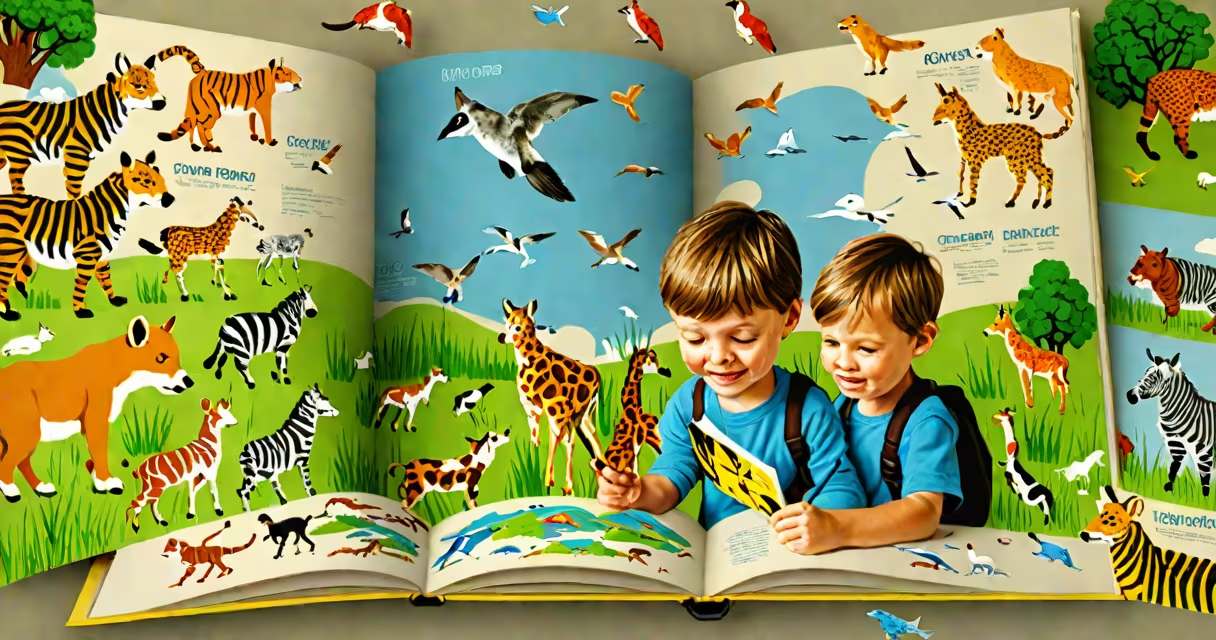
National Geographic Little Kids is a series of age-appropriate educational resources-books, videos, and activities-designed for children aged 3 to 7. It introduces young minds to real animals, ecosystems, and scientific concepts using vivid photography, simple language, and playful storytelling.
The program focuses on curiosity-driven learning. Each piece centers on a single animal or natural phenomenon, such as how octopuses change color or why bees buzz. Content avoids abstraction and instead uses observable facts: "Penguins waddle because their legs are short," or "Butterflies taste with their feet." This directness builds early science literacy without overwhelming the reader.
Content is developed in partnership with early childhood educators and child development experts. According to the American Psychological Association, children aged 3-7 learn best through repetition, sensory input, and narrative structure-elements embedded in every episode and storybook. For example, the video "How Do Frogs Jump?" repeats the phrase "Hop! Hop! Hop!" three times in sequence, reinforcing motor memory and phonological awareness.
National Geographic Little Kids uses a consistent format across formats. A typical video runs 3 to 5 minutes. It opens with a close-up of a real animal-say, a red fox pup-followed by a clear question: "Why do foxes have bushy tails?" The narrator then shows footage of the animal in its habitat, highlights key features (like the tail's role in balance), and ends with a recap: "Foxes use their tails to stay warm and steady."
Books follow the same pattern. Titles like *My First Book of Rainforests* feature large photos, minimal text (one sentence per page), and tactile elements such as textured pages mimicking tree bark or leaf surfaces. Research from the University of Chicago Press shows that children exposed to multisensory books retain 40% more vocabulary than those reading standard picture books.
Each resource includes a "Try This" activity at the end. In a segment on birds, viewers see a child placing seeds on a windowsill. The on-screen text says: "Watch what birds come. Draw them!" This bridges observation and creative expression-key components of early STEM engagement.
The series offers multiple formats, each targeting different developmental needs:
| Format | Target Age | Key Features | Use Case |
|---|---|---|---|
| Video Series | 3-6 years | 3-5 min, narration, real footage, on-screen text | Classroom circle time, bedtime learning |
| Storybooks | 3-7 years | 10-12 pages, high-contrast images, repetitive phrases | Parent-child reading, early literacy |
| Activity Kits | 4-7 years | Stickers, puzzles, craft supplies, guided instructions | Independent play, hands-on exploration |
Each format aims to support cognitive milestones. For instance, the "Animal Sounds" kit includes a cardboard sound box with buttons labeled "lion roar," "frog croak," and "bird tweet." Children press the button and hear the actual call, linking auditory cues to species recognition-a method validated by the National Science Teaching Association.
Teachers in preschool and kindergarten classrooms use national geographic little kids content daily. In a 2022 study by the National Association for the Education of Young Children, 78% of surveyed educators reported improved attention spans during lessons featuring real animal footage compared to animated segments.
Parents also rely on it. A survey by Common Sense Media found that 65% of caregivers with children under 7 chose National Geographic Little Kids over generic children's programming because it felt authentic. One mother in Portland, Oregon, shared: "My daughter asked me if octopuses really have three hearts. I showed her the video. She watched it five times. Now she draws them at school."
Libraries and museums integrate the content into outreach programs. The Denver Museum of Nature & Science hosts "Little Explorers" events where kids watch a 4-minute clip on polar bears, then build snow shelters from recycled foam blocks. These sessions increase visitor retention by 30%, according to internal reports.
Many assume national geographic little kids is purely entertainment. It is not. All content undergoes peer review by National Geographic's science editorial board. For example, a 2021 video titled "Do Fish Sleep?" was revised after biologist feedback clarified that fish don't sleep like mammals but enter periods of reduced activity. The final version included both terms: "Fish rest. They don't sleep like people."
Another myth: that the content is too advanced for toddlers. In reality, the language is carefully calibrated. A 2020 analysis by the Center for Childhood Development found that average sentence length in the videos is 7.3 words-well below the 12-word threshold associated with comprehension difficulties in preschoolers.
A lesser-known fact: the team films nearly all animal footage in the wild, not in studios. In the video "Baby Monkeys Climb Trees," the footage was captured in Costa Rica's Monteverde Cloud Forest. The team waited 14 days for the monkeys to appear. This authenticity prevents children from forming false expectations about animal behavior.
Consider the video "Why Do Bees Make Honey?"
This sequence teaches cause-and-effect, time perception, and ecological interdependence-all within 4 minutes. The video has been viewed over 1.2 million times on YouTube, with 92% of parent comments citing increased interest in backyard insects.
National geographic little kids is not a brand extension-it is a research-backed initiative rooted in conservation education and early cognitive development. Its success lies in treating young children as capable observers of the real world, not passive recipients of simplified fiction.