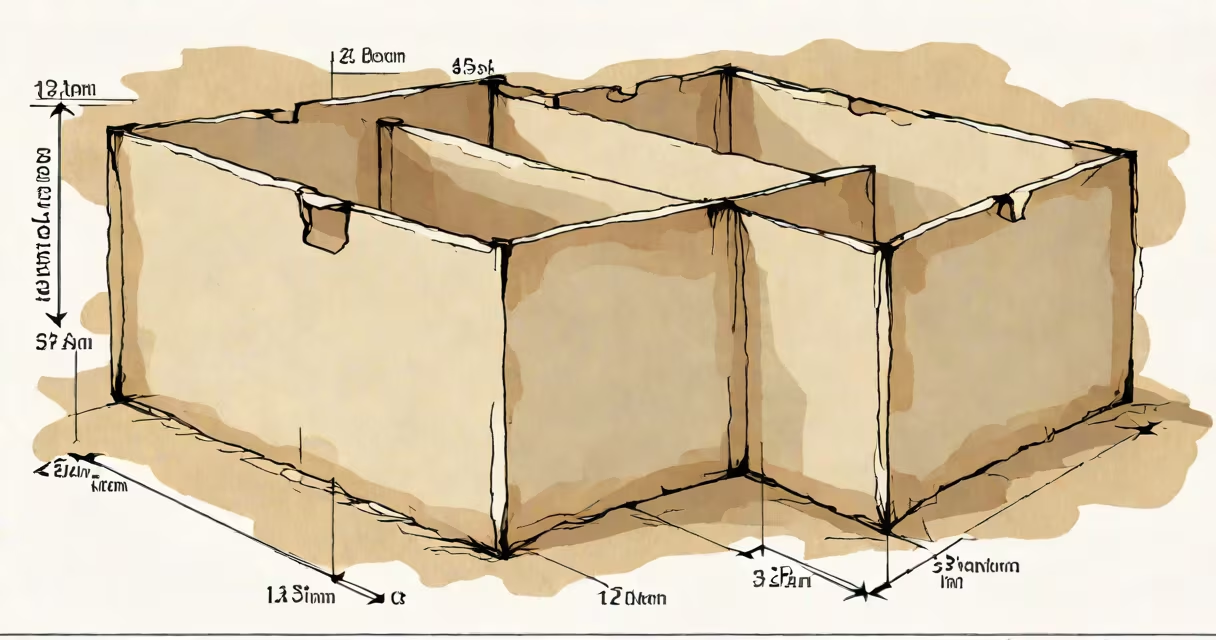
The volume of a rectangular box is the product of its length, width, and height. This measurement expresses the amount of space enclosed within the box's six faces.
Every rectangular box has three distinct dimensions: length (L), width (W), and height (H). These values define the size of the box in three perpendicular directions. Volume is always measured in cubic units-cubic meters, cubic feet, or cubic centimeters-depending on the unit system used.
For example, a box measuring 5 feet long, 3 feet wide, and 2 feet high has a volume of 5 × 3 × 2 = 30 cubic feet. This means the interior space holds 30 cubes, each 1 foot on a side.
Volume measures internal capacity. The formula applies universally to any rectangular prism, including boxes, rooms, shipping containers, and storage bins. It assumes the shape has flat, perpendicular sides and right angles at all corners.
Each dimension contributes proportionally to the total volume. Doubling any one dimension doubles the volume. Increasing two dimensions by 50% increases volume by 1.5 × 1.5 = 2.25 times. This multiplicative relationship makes volume sensitive to changes in scale.
For instance, a cardboard box designed to hold 100 small books might measure 20 inches × 12 inches × 10 inches. Its volume is 20 × 12 × 10 = 2,400 cubic inches. If the manufacturer increases the height to 15 inches while keeping the base the same, volume becomes 20 × 12 × 15 = 3,600 cubic inches-a 50% increase.
All rectangular boxes follow the same geometric principle. There is no variation in the formula based on orientation or material. However, differences arise in how dimensions are assigned:
| Dimension Type | Description | Common Use Case |
|---|---|---|
| Length | Longest horizontal side | Packaging, shipping labels |
| Width | Shorter horizontal side | Storage rack planning |
| Height | Vertical dimension | Stacking limits, clearance checks |
Some manufacturers label boxes using standardized dimensions. For example, a standard moving box often measures 18 inches × 12 inches × 12 inches. Its volume is 18 × 12 × 12 = 2,592 cubic inches-approximately 1.5 cubic feet.
When working with metric units, the same formula applies. A storage container measuring 1.2 meters × 0.8 meters × 0.6 meters has a volume of 1.2 × 0.8 × 0.6 = 0.576 cubic meters.
People often confuse volume with surface area. Surface area calculates the total area of all six faces and is measured in square units. Volume measures internal space and uses cubic units. Confusing them leads to errors in packing, shipping, and material estimation.
Another mistake is assuming that a box with large surface area must have large volume. A flat, shallow box may have a large footprint but small height, resulting in low volume. A 10-inch × 10-inch × 1-inch box has a surface area of 2(10×10 + 10×1 + 10×1) = 240 square inches but only 100 cubic inches of volume.
A less obvious error involves inconsistent units. Measuring length in feet and width in inches without conversion leads to incorrect results. Always convert all dimensions to the same unit before multiplying. For example, a box that is 3 feet long, 18 inches wide, and 1 foot high requires converting 18 inches to 1.5 feet. Volume is then 3 × 1.5 × 1 = 4.5 cubic feet.
Volume calculations are essential in logistics. A freight company ships goods in standard crates measuring 48 inches × 40 inches × 40 inches. The volume is 48 × 40 × 40 = 76,800 cubic inches-equivalent to 44.44 cubic feet. Knowing this helps determine how many crates fit in a trailer.
In construction, volume determines how much concrete is needed for a foundation. A basement wall that is 20 feet long, 15 feet wide, and 2 feet thick requires 20 × 15 × 2 = 600 cubic feet of concrete. Contractors use this figure to order materials and estimate costs.
I once helped a warehouse manager improve storage. He had 100 identical boxes, each 2 ft × 1.5 ft × 1 ft. Their individual volume was 3 cubic feet. Total volume for all boxes was 100 × 3 = 300 cubic feet. By arranging them efficiently, we reduced floor space usage by 22% through better stacking.
The volume of a rectangular box is a subset of the broader category of solid geometry. It shares the same formula as the volume of a right rectangular prism-a term used in academic contexts. Both refer to the same shape: a 3D figure with six rectangular faces meeting at right angles.
Understanding this connection clarifies terminology. When a math textbook says "right rectangular prism," it means the same object as a "rectangular box." The word "right" emphasizes that edges meet at 90-degree angles. The formula remains unchanged: V = L × W × H.
According to the National Council of Teachers of Mathematics (NCTM), students should master volume calculations by Grade 5. The Common Core State Standards (CCSS) specify that students must compute volumes of rectangular prisms using unit cubes and apply the formula in real-world problems.
The U.S. Department of Education's Integrated Postsecondary Education Data System (IPEDS) reports that 92% of community college math courses include volume computations as part of their curriculum, emphasizing practical application over theoretical abstraction.