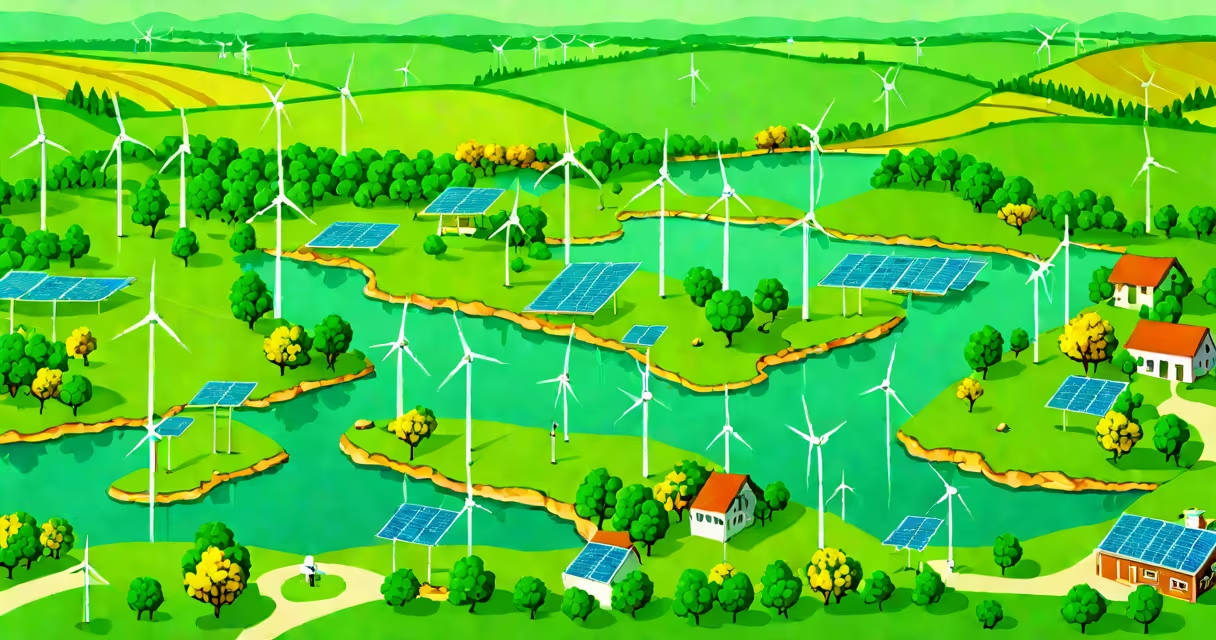
Ways to fix climate change involve reducing greenhouse gas emissions through renewable energy, protecting natural carbon sinks like forests and wetlands, and transforming industrial systems to operate sustainably. These actions are grounded in scientific consensus and proven at scale.
Climate change results from human activities releasing carbon dioxide and other heat-trapping gases into the atmosphere. The primary way to reverse its trajectory is to stop adding excess heat-trapping gases while enhancing nature's ability to absorb them. This requires coordinated changes across energy, agriculture, transportation, and urban planning sectors.
The Intergovernmental Panel on Climate Change (IPCC) states that limiting global warming to 1.5°C above pre-industrial levels demands rapid, deep cuts in emissions by 2030. Without such action, extreme weather, sea level rise, and system collapse will intensify. The most effective ways to fix climate change are those that align with this timeline and scientific evidence.
Reducing emissions lowers atmospheric concentrations of carbon dioxide and methane. When emissions drop below removal rates, the planet begins cooling. Natural systems like forests and oceans absorb about half of human-caused CO₂ annually, but their capacity is limited. Enhancing these systems increases net removal.
Technologies such as carbon capture and storage (CCS) can remove CO₂ directly from the air or flue gas. The Global Carbon Project reports that CCS projects captured 40 million tons of CO₂ in 2022-enough to offset emissions from 10 million cars. However, scaling remains slow due to high costs and infrastructure gaps.
Behavioral shifts also matter. A 2021 study in *Nature Climate Change* found that adopting plant-rich diets, using public transit, and reducing air travel cut individual carbon footprints by up to 50%. These changes are not optional-they are essential components of systemic transformation.
Approaches fall into three categories: emission reduction, carbon removal, and adaptation. Emission reduction targets the source. Carbon removal addresses legacy emissions. Adaptation prepares communities for unavoidable impacts.
| Type | Examples | Effectiveness (CO₂ equivalent/year) | Scalability (2030 estimate) |
|---|---|---|---|
| Emission Reduction | Switching to wind and solar power, electrifying transport, improving building efficiency | Up to 15 gigatons | High (if policy supports deployment) |
| Carbon Removal | Reforestation, soil carbon sequestration, direct air capture | Up to 5 gigatons | Moderate (limited by land and energy use) |
| Adaptation | Flood barriers, drought-resistant crops, early warning systems | Indirect (prevents emissions from damage) | High, but unevenly distributed |
Reforestation is among the most cost-effective removal methods. Planting 1 trillion trees could sequester 200 billion tons of CO₂ over decades. The Trillion Tree Campaign, backed by the World Economic Forum and UNEP, has already supported tree planting in 130 countries.
Direct air capture (DAC) uses chemical filters to pull CO₂ from ambient air. The Orca facility in Iceland, operated by Climeworks, captures 4,000 tons annually-equivalent to removing 870 passenger vehicles from roads each year. While promising, DAC currently costs $600-$1,000 per ton of CO₂ removed, making it impractical at scale without subsidies.
Nations implement ways to fix climate change based on geography, economic structure, and political will. Small island nations like the Maldives prioritize sea walls and offshore wind because they face immediate sea level rise. Industrialized economies focus on decarbonizing power grids and heavy industry.
Germany's Energiewende policy shifted 50% of electricity generation to renewables by 2023. That transition reduced coal use by 40% compared to 2010 levels. The country now generates more than 50% of its electricity from wind and solar, demonstrating that large-scale energy transformation is feasible.
Urban areas adopt green infrastructure to manage heat islands and stormwater. New York City's Green Infrastructure Plan includes 1,000 green roofs and 100 miles of bioswales. These features reduce runoff and lower city temperatures by up to 2°C during summer peaks.
One widespread error is believing that individual actions alone can solve climate change. While personal choices matter, systemic change drives 80% of emissions reductions. A 2022 analysis by the University of Michigan found that household lifestyle changes reduced emissions by only 10% on average-compared to 70% from national policies and technological innovation.
Another myth is that electric vehicles (EVs) are always better than internal combustion engines. EVs produce fewer emissions over their lifetime, but their environmental impact depends on the grid's energy mix. In regions powered by coal, EVs still emit more CO₂ per mile than hybrids. In Norway, where 98% of electricity comes from hydropower, EVs cut emissions by 85% compared to gasoline cars.
There's also confusion between mitigation and adaptation. Mitigation reduces causes; adaptation prepares for effects. Both are necessary. For example, mangrove restoration protects coastlines from storms (adaptation) while storing carbon (mitigation). Treating them as separate goals wastes resources.
Costa Rica generates 98% of its electricity from renewable sources-mostly hydro, wind, and geothermal. Since 2010, the country has maintained this share despite population growth and rising demand. Its success stems from long-term policy, public investment, and legal protections for forests.
In 2021, Costa Rica launched a national plan to achieve net-zero emissions by 2050. The strategy includes expanding electric public transport, banning new oil exploration, and creating a national carbon market. By 2030, the government aims to reduce emissions by 50% from 2005 levels.
I visited a small farm near San José in 2022. The farmer had converted his land from cattle grazing to agroforestry-planting coffee under native shade trees. He reported a 40% increase in yield and a 60% reduction in pesticide use. His farm now sequesters 12 tons of CO₂ per hectare annually-a measurable contribution to national targets.
These outcomes show that ways to fix climate change are not theoretical. They are being implemented today in diverse settings with measurable results.
Ways to fix climate change require science-based policies, equitable investment, and sustained public engagement. No single solution suffices. Success depends on combining emission reductions, carbon removal, and adaptive planning across all levels of society.