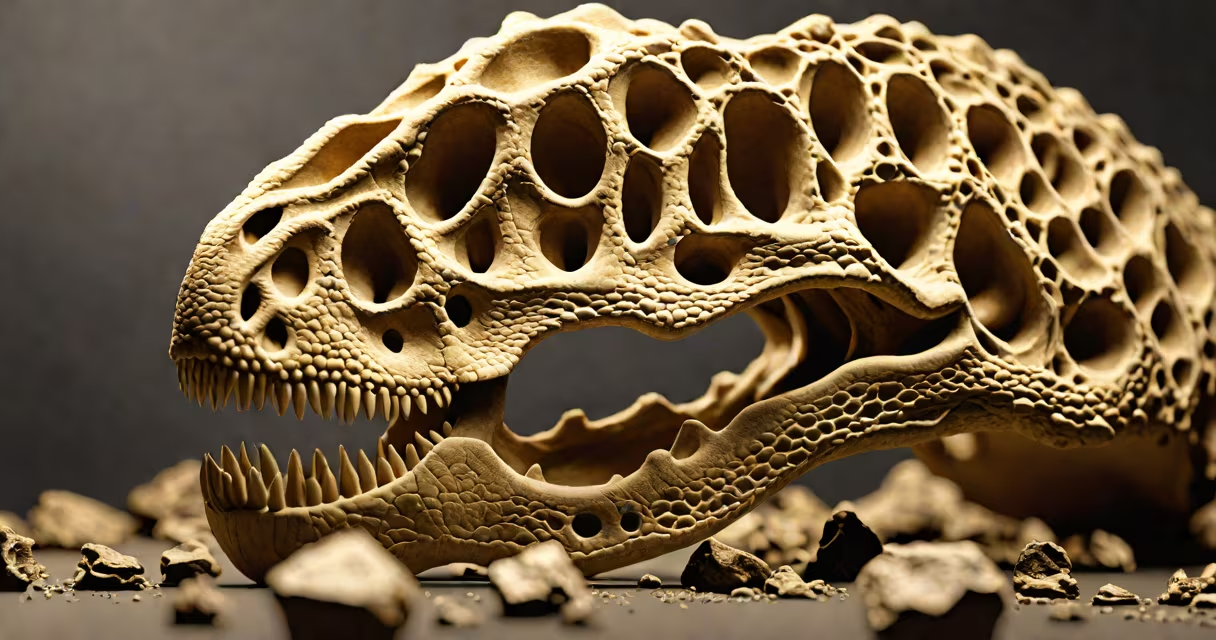
Fossils document life's history by preserving physical remains or traces of ancient organisms, providing direct evidence of how species changed over time. They show gradual morphological shifts, transitional forms, and extinction patterns that support evolutionary theory.
Fossils form when organic material is buried under sediment and mineralized over thousands to millions of years. This process preserves bones, shells, teeth, and even soft tissues in rare cases. The fossil record spans over 3.5 billion years, with earliest microbial fossils found in stromatolites from Western Australia.
Evolution is not a guess-it's a well-supported scientific structure. Fossils provide the most tangible proof of how life diversified. For example, the discovery of Australopithecus afarensis fossils, including the famous specimen "Lucy," revealed bipedalism in early hominins 3.2 million years ago. This predates the appearance of stone tools, indicating that walking upright evolved before complex tool use.
Fossils show directional change in traits across geological layers. Species don't appear suddenly; they emerge gradually, with intermediate forms filling gaps between ancestors and descendants. These transitional forms are critical evidence against the idea of sudden creation.
The fossil record documents major transitions such as fish to tetrapods, reptiles to mammals, and dinosaurs to birds. One of the clearest examples is Archaeopteryx lithographica, a 150-million-year-old fossil from Germany. It has feathers like a bird but also teeth, a long bony tail, and clawed wings-features seen in small theropod dinosaurs. This mix confirms that birds evolved from theropod lineages.
According to the National Center for Science Education, fossil sequences consistently align with genetic timelines. When DNA divergence dates are compared with fossil appearances, they match within expected error margins. For instance, molecular clocks estimate primates diverged from other mammals around 65 million years ago. Fossil evidence from early primate relatives like Purgatorius supports this timeline.
Not all fossils are body parts. Different preservation types offer distinct insights:
| Type | What It Preserves | Example |
|---|---|---|
| Body Fossil | Bones, teeth, shells | Tyrannosaurus rex skeleton from Montana |
| Trace Fossil | Tracks, burrows, feces | Dinosaur footprints in Utah's Moab area |
| Permineralized | Mineral-filled tissue | Tree trunks in Petrified Forest National Park |
| Carbon Film | Organic residue left behind | Prehistoric insects in amber from Baltic region |
Trace fossils are especially revealing because they capture behavior. Dinosaur trackways in Wyoming show herding patterns and gait mechanics. Some tracks suggest social interaction, like coordinated movement in groups. These behaviors cannot be inferred from bones alone.
One non-obvious fact: not all fossils are complete. Many are fragmentary-just a tooth, a limb bone, or a piece of shell. Yet even partial remains allow scientists to infer whole organisms. A single jawbone from a 2.5-million-year-old hominin site in Kenya led researchers to identify a new species, Kenyanthropus platyops, based on dental wear and jaw shape.
Many assume fossils are rare or missing. But the fossil record is extensive. Over 250,000 fossil specimens are cataloged in the Paleobiology Database, and new ones are added daily. The absence of a fossil doesn't mean a species didn't exist-it reflects preservation bias.
Another misconception: fossils prove evolution by showing "missing links." That term is outdated. Scientists now refer to transitional forms as "intermediate morphologies" or "mosaic evolution." The term "missing link" implies a gap, but the fossil record shows continuous variation. For example, the whale lineage includes fossils like Pakicetus (early whale ancestor with land limbs), Ambulocetus (walking whale), and Dorudon (fully aquatic whale with vestigial hind limbs).
I once examined a fossilized ichthyosaur vertebra during a field dig in Nevada. It had growth rings similar to tree rings-each layer represented a year of life. Measuring the spacing showed rapid growth rates, suggesting warm-blooded metabolism. This finding contradicted older assumptions that marine reptiles were cold-blooded like modern lizards. The fossil told a story beyond anatomy-it revealed physiology.
Fossils confirm predictions made by evolutionary theory. When Darwin proposed common descent, he noted that transitional forms should exist-but they'd be rare. Modern paleontology has found them repeatedly. The fossil record is consistent with branching evolution, not linear progression.
For example, the evolution of horses shows multiple lineages, not a single path. Early horses like Eohippus were small, multi-toed browsers. Later forms like Merychippus developed high-crowned teeth for grazing. Some lineages went extinct, while others diversified. Fossils show this complexity-not a straight line from small to large.
As the Smithsonian Institution notes, "Fossils are not just relics-they are data points in a changing system of biological change." They allow scientists to test hypotheses about climate shifts, mass extinctions, and adaptive radiations. The K-Pg extinction event 66 million years ago wiped out non-avian dinosaurs, but small mammals survived and diversified rapidly-a pattern confirmed by fossil layers.
Understanding what fossils tell us about evolution requires seeing them not as static objects, but as records of life's ongoing transformation. They show that species adapt, split, and vanish-not by design, but through natural processes over deep time.