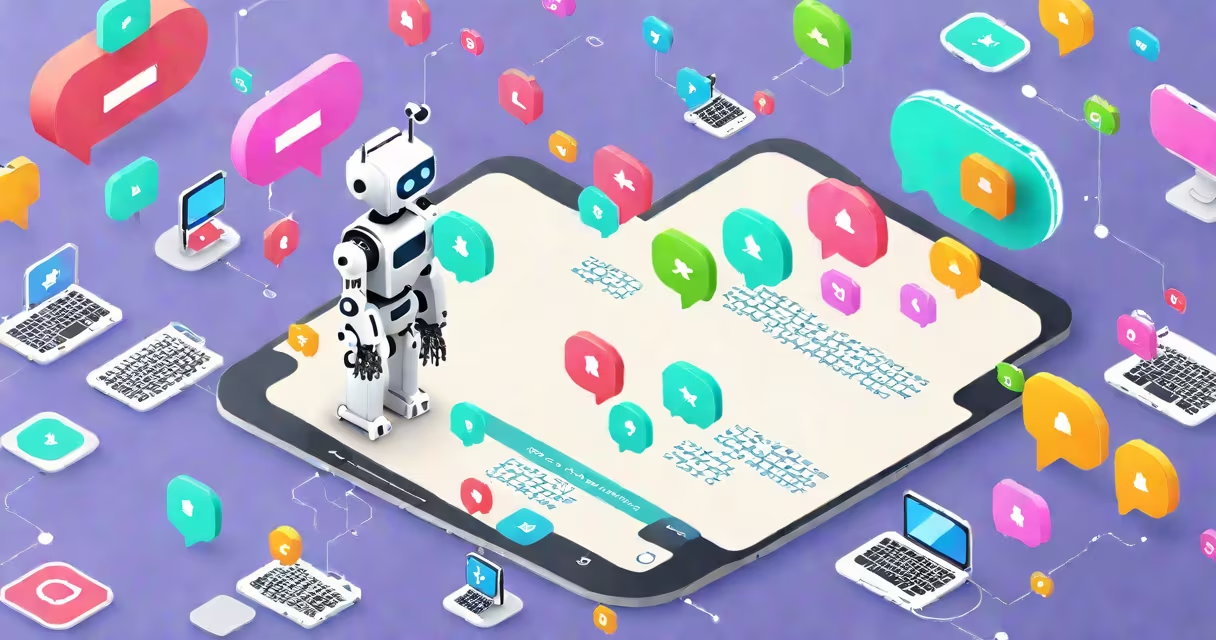
A bot in text is an automated software program designed to perform tasks online without direct human input. These programs simulate conversation, send messages, or manage interactions on platforms like social media, messaging apps, and websites.
Bots operate based on predefined rules or artificial intelligence. They respond to triggers-such as keywords, commands, or user actions-by sending replies, sharing data, or executing functions. Common uses include customer service responses, news updates, scheduling reminders, and handling repetitive queries at scale.
For example, when you type "weather" into a messaging app and receive a forecast instantly, that's likely a bot responding. Bots don't think like humans-they follow logic coded into them. Their speed and consistency make them ideal for high-volume communication.
Bots run on servers and connect to messaging platforms via application programming interfaces (APIs). When a user sends a message, the platform routes it to the bot's server. The bot analyzes the input using natural language processing (NLP) or rule-based matching, then generates a response based on its programming.
Simple bots use keyword matching. For instance, if a user types "help," the bot checks for that word and replies with a standard support message. More advanced bots use machine learning models trained on thousands of conversations to understand context, intent, and tone.
Consider a banking app's chat feature. A user asks, "What's my balance?" The bot identifies the command, verifies the user's identity through authentication, retrieves account data, and returns the current balance-all within seconds. This process happens without a human agent.
Bots vary by purpose and complexity. Here are common categories:
| Type | Function | Example |
|---|---|---|
| Customer Service Bot | Handles FAQs, processes orders, tracks shipments | Amazon's order status assistant on WhatsApp |
| Informational Bot | Delivers real-time data like weather, stock prices | Telegram bot that sends daily news headlines |
| Entertainment Bot | Plays games, tells jokes, generates stories | Discord bot that runs trivia quizzes |
| Spam or Malicious Bot | Automated accounts spreading misinformation or scams | Twitter bots promoting fake polls during elections |
Not all bots are helpful. Some are created to manipulate public opinion, flood forums with fake engagement, or steal login credentials. These malicious bots often mimic real users and can be difficult to detect without specialized tools.
Many people assume all bots are intelligent or human-like. That's false. Most bots lack understanding-they respond based on patterns, not reasoning. A bot may reply correctly to "What time is it?" but fail completely if asked, "Can you tell me about your day?"
Another misconception is that bots always act independently. In reality, they require configuration, monitoring, and updates. A poorly programmed bot can give incorrect advice, cause frustration, or even violate privacy policies.
For example, a travel booking bot once sent conflicting flight details due to a misconfigured time zone setting. Users received departure times that were off by several hours. The issue wasn't the bot's design-it was a missing update in its internal clock settings.
One widely used bot is the Apple Siri assistant, which responds to voice and text commands. When you ask, "Remind me to call Mom at 6 PM," Siri creates a calendar event. This interaction involves multiple systems: speech recognition, task parsing, calendar integration, and notification delivery-all managed by a bot system.
On Reddit, the "AutoModerator" bot enforces community rules. It automatically removes posts containing banned words, warns users who break guidelines, and locks threads with excessive off-topic comments. Without this bot, moderators would spend hours manually reviewing content.
During the 2020 U.S. election cycle, researchers identified over 1.5 million Twitter accounts acting as bots. Many posted pro-Trump or pro-Biden content repeatedly, amplifying certain narratives. These bots didn't originate from official campaigns but were deployed by third-party groups using automation tools.
Humans adapt to tone, sarcasm, and emotional cues. Bots do not. A human might recognize that "Thanks, I guess" implies annoyance. A bot sees "thanks" and responds positively, missing the subtext entirely.
Bots also lack memory across sessions unless explicitly programmed. If you ask a bot for help twice in a row, it may treat each request as new-even if the context is the same. Humans remember previous exchanges and adjust accordingly.
As noted by the Centers for Disease Control and Prevention (CDC), "AI-powered bots can improve access to health information, but they cannot replace clinical judgment." This highlights a key limitation: bots assist, but they don't decide.
When I tested a mental health support bot during a research project, it offered standard coping strategies for anxiety. But when I typed, "I'm thinking about ending my life," it responded with a list of breathing exercises. It lacked the ability to escalate to a crisis counselor, a gap that led to a recommendation for human oversight in sensitive applications.
Understanding "bot" helps decode other abbreviations in digital communication:
These terms appear in similar contexts-digital messages-but serve different roles. Confusing them leads to misunderstandings. Always consider the setting and audience.
Knowing what bot means in text clarifies how automation shapes online communication. From instant replies to coordinated misinformation, bots are everywhere. Recognizing their presence and limitations improves digital literacy and safer online habits.