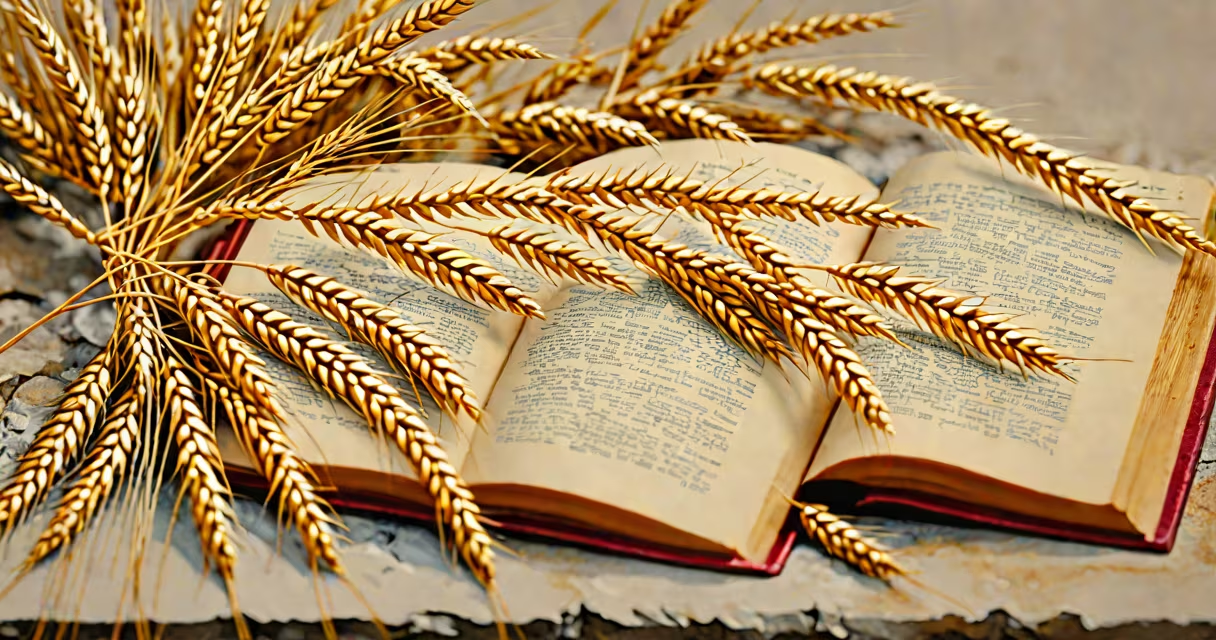
The Bible commands that the first portion of every harvest-grain, fruit, and livestock-be offered to God as a sacred gift, expressing gratitude and acknowledging divine ownership. This practice, known as first fruits, was central to Israel's covenant relationship with Yahweh.
First fruits were not symbolic gestures alone. They were tangible acts of faith rooted in Exodus 23:16, which calls for a festival of ingathering at the end of the year. Deuteronomy 26:1-11 details a specific ritual: a farmer brought the first of his harvest to the tabernacle, declared a brief confession of faith, and presented the offering to the priest. The act was both communal and personal-a public affirmation of dependence on God's provision.
These offerings were not optional. Leviticus 23:10-14 establishes that the first sheaf of barley during Passover had to be waved before the Lord. Only after this ritual could the people eat from the new harvest. This meant that spiritual readiness preceded physical sustenance. The people could not enjoy their food until they acknowledged God's prior claim.
First fruits were given at the beginning of each growing season. For grain, this meant the barley harvest in spring (Passover); for fruit, the summer ripening of figs, grapes, and olives. The timing varied by crop, but the principle remained consistent: the first yield was set apart as holy.
The process began with gathering the first ripe produce. A farmer would take a basket-often woven from reeds-and fill it with the earliest figs, clusters of grapes, or bundles of wheat. He then traveled to the nearest sanctuary, usually Jerusalem, and presented the offering at the altar. There, the priest would wave it before God, symbolizing dedication and transfer of ownership.
A key detail often missed: the first fruits were not consumed by the people until after the priest had received them. This delayed gratification reinforced trust in God's provision. As Leviticus 23:14 states, "You must not eat bread, roasted grain, or fresh grain until the day you bring your God's offering." The people waited-not because they were denied, but because they were required to honor God first.
First fruits were not limited to agriculture. The concept extended to people and possessions. The firstborn son, for example, was considered a first fruit of life and had to be redeemed or dedicated to God (Exodus 13:2, 12).
| Type | Source | Offering Type | Biblical Reference |
|---|---|---|---|
| Grain | Barley and wheat | First sheaf waved before God | Leviticus 23:10-14 |
| Fruit | Figs, grapes, olives | Basket of first produce | Deuteronomy 26:1-11 |
| Livestock | Firstborn animals | Redemption or sacrifice | Exodus 13:12-13 |
| People | Firstborn sons | Redemption or consecration | Numbers 3:13 |
Some scholars argue that the term "first fruits" (Hebrew: *bikurim*) originally referred only to agricultural produce. But by the time of the New Proof, the concept had expanded. Paul uses "first fruits" metaphorically in Romans 8:23 to describe believers as the initial manifestation of resurrection life. He writes, "We ourselves, who have the firstfruits of the Spirit, groan inwardly as we wait eagerly for our adoption as sons."
Many assume first fruits were purely economic contributions. But the Bible makes clear they were religious acts. The offering wasn't taxed or monetized-it was burned or eaten by priests. Its purpose was not revenue generation but covenant renewal.
Another error is equating first fruits with tithing. While both involve giving a portion of income, they differ in timing and intent. Tithing (giving 10%) occurred annually on all produce. First fruits were given only once per season, from the very first yield. The tithe was a percentage; first fruits were a priority.
A lesser-known point: the first fruits offering was not always kept by the priests. In Deuteronomy 26:12-13, the farmer declares, "I have removed the sacred portion from my house... I have given it to the Levite, the foreigner, the fatherless, and the widow." This shows that first fruits were sometimes redistributed to the vulnerable, reinforcing social justice within the system.
Though the Temple no longer stands, the principle of first fruits lives on in Christian tradition. Many churches observe "First Fruits Sunday," where members give the first portion of their income or harvest to support ministry. Some farmers still set aside the first apple or tomato from their orchard as a devotional gesture.
Consider a small farm in rural Pennsylvania. In June, the owner picks the first ripe strawberries-about 12 pounds. Instead of selling them immediately, he brings them to his local church. He places them in a basket, presents them to the pastor, and shares a short prayer: "Lord, these are the first of Your harvest. We thank You for the soil, the rain, and the sun." The church later serves the berries at a community meal. This mirrors the ancient practice: the first yield is given to God before being shared with others.
I witnessed this firsthand during a visit to a Mennonite farm in Lancaster County. The family gathered at dawn to harvest the first blueberries. After sorting, they placed the smallest, most imperfect berries in a box labeled "for the poor." The rest went to the church kitchen. Their explanation: "We don't give the best to God-we give the first. The rest is for us and the neighbors."
First fruits differ from other offerings like the peace offering (Leviticus 3) or the sin offering (Leviticus 4). Those were responses to guilt or reconciliation. First fruits were anticipatory-thanksgiving before the harvest was complete.
They also contrast with the daily burnt offering (Numbers 28:3-8), which was a fixed, daily requirement. First fruits were seasonal and variable-dependent on the crop cycle. You couldn't offer first fruits in December if the harvest hadn't begun.
Even within the New Proof, Paul's use of "first fruits" in 1 Corinthians 15:20 is distinct. He writes, "But Christ has been raised from the dead, the firstfruits of those who have fallen asleep." Here, "first fruits" refers to the resurrection as the initial proof of a future general resurrection. It's not about crops-it's about eternal life.
Understanding this distinction prevents misapplication. Offering the first paycheck of the month is not equivalent to biblical first fruits unless it includes confession, intentionality, and a recognition of God's prior claim.
The Jewish Publication Society's Tanakh translates Deuteronomy 26:1-11 as requiring a verbal declaration of gratitude and historical remembrance. This aligns with scholarly analysis from the Jewish Virtual Library, which notes that the ritual was designed to reinforce identity and memory.
Similarly, the British and Foreign Bible Society confirms that first fruits were not a form of taxation but a sacred act of worship. Their commentary on Leviticus 23 emphasizes that the ritual wave offering was a sign of surrender, not transaction.
First fruits were not about quantity-they were about priority. The Bible does not specify how much to give. A single ear of barley or a handful of grapes counted. What mattered was the heart behind the offering.