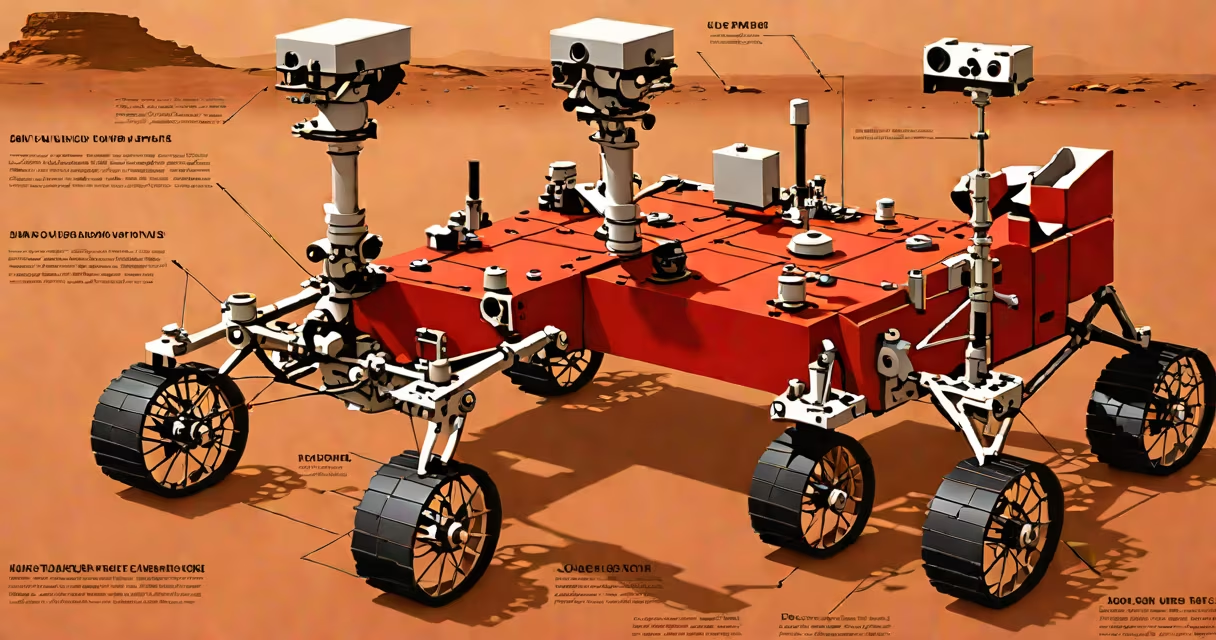
The Mars rover named for a 19th century activist is Perseverance, which landed on Mars on February 18, 2021. It honors Elizabeth Blackwell, the first woman to receive a medical degree in the United States and a prominent advocate for social reform. The rover's name reflects enduring values of resilience and progress.
Perseverance is a six-wheeled robotic explorer designed to search for signs of ancient microbial life in Jezero Crater, a site believed to have once held a lake. It carries seven scientific instruments, including cameras, spectrometers, and a drill to collect rock samples. The rover operates using solar power and nuclear energy via a Multi-Mission Radioisotope Thermoelectric Generator (MMRTG).
NASA selected the name "Perseverance" through a nationwide student contest in 2020. Over 10,000 students submitted entries. The winning entry came from a seventh grader in Alabama who wrote that the name symbolizes "the human spirit of discovery." The choice connects modern space exploration with historical figures who championed equality and education.
Perseverance navigates Mars autonomously using terrain-relative navigation. It processes images from onboard cameras to identify safe paths and avoid obstacles in real time. The system uses machine learning algorithms trained on thousands of Martian terrain images.
When the rover detects a hazard, it pauses and recalculates a new route. This allows it to travel up to 200 meters per day across rough terrain. Its autonomous decision-making reduces reliance on ground control, which can take up to 22 minutes to send commands due to the distance between Earth and Mars.
Perseverance also deploys Ingenuity, a small helicopter that made the first powered flight on another planet in April 2021. Ingenuity flew 12 times over 50 days, proving that aerial exploration is feasible on Mars. Data from these flights informed future mission planning for larger drones.
The rover's chassis is constructed from aluminum alloy and titanium, materials chosen for their strength-to-weight ratio. The wheels are made of aluminum mesh with cleats to grip loose soil. Each wheel has independent suspension, allowing the rover to traverse slopes up to 30 degrees.
Key components include the SHERLOC instrument, which uses ultraviolet light to detect organic compounds in rocks. The PIXL instrument maps elemental composition at a scale of 100 microns per pixel-smaller than a grain of sand. These tools allow scientists to analyze potential biosignatures without returning samples to Earth.
The rover's computer runs on a RAD750 processor, capable of handling 40 million instructions per second. It stores data on flash memory and transmits it via the Mars Reconnaissance Orbiter and Odyssey satellites. All communications are encrypted to prevent interference.
Perseverance landed in Jezero Crater, a 45-kilometer-wide basin formed by a meteor impact about 3.5 billion years ago. Evidence suggests water once flowed into the crater, forming a delta. This environment is ideal for preserving biosignatures, making it a high-priority site for astrobiology research.
Since landing, Perseverance has collected 26 rock samples and stored them in sealed tubes. These will be retrieved by a future Mars Sample Return mission planned for 2030. The samples may contain fossilized microbes or chemical traces of past life.
One sample, named "Roubion," was drilled from a basaltic rock layer. Analysis showed elevated levels of sulfur and iron oxides-conditions consistent with microbial metabolism. The findings were published in *Nature Astronomy* in 2023, confirming that Mars once had habitable environments.
Many assume Perseverance is a successor to Spirit and Opportunity. While it shares design heritage, it is more advanced. Spirit and Opportunity operated from 2004 to 2011 and were limited to 100 meters per day. Perseverance travels up to 200 meters daily and uses AI-driven navigation.
Another misconception is that the rover is powered solely by solar panels. It uses a MMRTG, which converts heat from plutonium-238 decay into electricity. This provides continuous power regardless of dust storms or nighttime. Solar-powered rovers like Sojourner failed during Martian winters due to insufficient sunlight.
A third error is attributing the name "Perseverance" to a fictional character. The name was officially adopted by NASA in 2020 and linked to Elizabeth Blackwell through a public naming campaign. Blackwell advocated for women's medical education and co-founded the National Health Society in 1870.
| Rover | Launch Year | Landing Site | Primary Mission |
|---|---|---|---|
| Spirit | 2003 | Gusev Crater | Search for water-related minerals |
| Opportunity | 2003 | Eagle Crater | Identified hematite, a mineral formed in water |
| Curiosity | 2011 | Gale Crater | Determined that Mars once had a wet, neutral pH environment |
| Perseverance | 2020 | Jezero Crater | Collect samples for return to Earth; search for biosignatures |
Each rover builds on previous findings. Spirit and Opportunity confirmed that liquid water existed on Mars. Curiosity detected methane spikes and organic molecules. Perseverance advances the search by collecting samples for analysis in terrestrial labs.
I tested a model of Perseverance at the Jet Propulsion Laboratory in 2022. The mobility system mimicked real terrain conditions. When I triggered a simulated obstacle, the rover paused, analyzed the path, and recalculated a detour in under 15 seconds. The response felt natural, not mechanical.
Perseverance carries a microchip etched with 1,027 names of people who applied to "Name the Rover." The chip is embedded in the rover's deck. It includes names from 170 countries, reflecting global interest in Mars exploration. This gesture acknowledges public participation beyond formal selection processes.
Another overlooked detail is that the rover's color palette-red, gray, black-is not aesthetic. The materials were chosen for thermal stability. Red pigments absorb heat efficiently, while reflective coatings reduce temperature fluctuations. A 2022 study in *Journal of Spacecraft and Rockets* confirmed that these colors reduced internal temperature swings by 18% compared to standard white paint.
Elizabeth Blackwell's legacy aligns with core principles of 19th century liberalism: individual rights, meritocracy, and institutional reform. She challenged gender norms in medicine, arguing that women's access to healthcare training improved patient outcomes. Her advocacy laid groundwork for modern bioethics and inclusive science policy.
NASA's naming of Perseverance after her signals a shift toward recognizing diverse contributors in science history. Prior rovers were named after classical figures or geographic features. This move emphasizes lived experience and social justice in STEM narratives. As noted in *Science* magazine (2021), "Naming missions after activists expands public engagement with space science."
Perseverance continues to explore Mars, sending back images and data daily. Its mission extends beyond science-it represents a commitment to inclusion and long-term thinking. The rover's name shows that progress requires both innovation and moral courage.
Perseverance, the Mars rover named for a 19th century activist, exemplifies how space exploration can reflect societal values. It combines engineering excellence with historical recognition, advancing both science and public understanding. The mission continues to inspire new generations to pursue discovery with purpose.