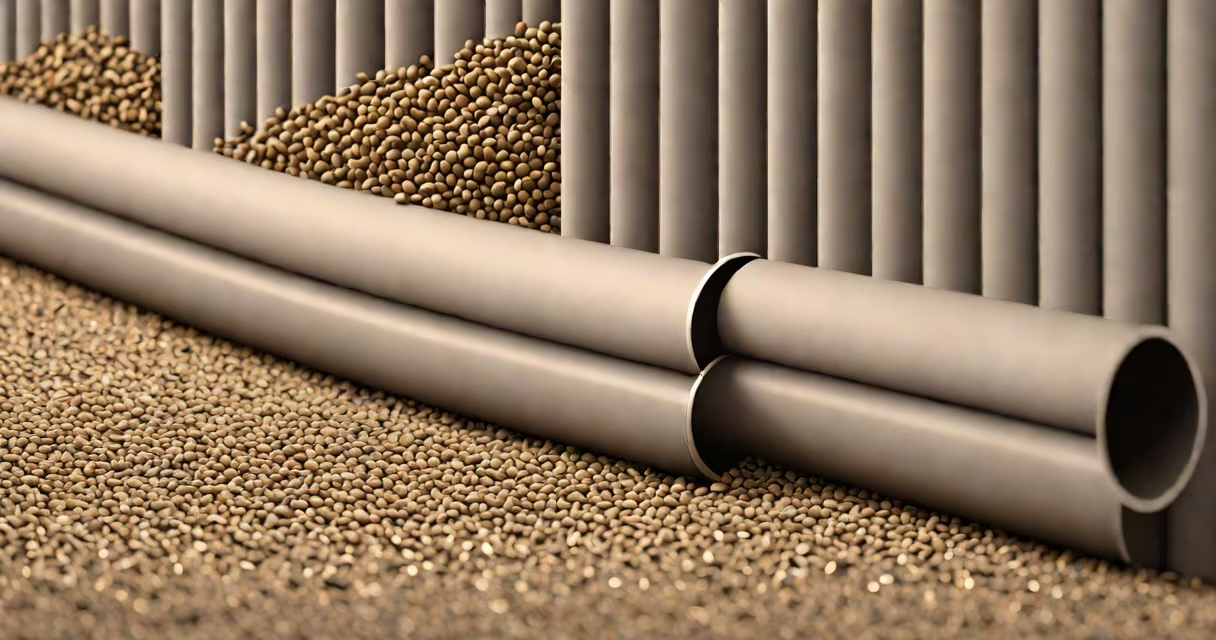
A curtain drain is a subsurface drainage system designed to intercept and redirect groundwater before it accumulates near building foundations, retaining walls, or low-lying landscapes. It consists of a shallow trench lined with permeable materials-typically gravel and a perforated pipe-that channels water away from vulnerable zones.
Unlike surface drains, curtain drains operate below ground level, typically 18 to 36 inches deep, and are installed along the contour of a slope or around a structure's perimeter. They're often used in areas with high rainfall, clay soils, or poor natural drainage where standing water causes erosion, basement flooding, or foundation cracks.
The system functions passively: gravity pulls water through the gravel matrix into the perforated pipe, which then directs flow to a discharge point such as a dry well, storm sewer, or natural outlet. Proper grading ensures continuous downhill flow-without sags or reverse slopes.
Curtain drains rely on hydrostatic pressure and gravity. Water seeps into the gravel layer from the surrounding soil, moves through the voids between stones, and enters the perforated pipe via small holes spaced every 6 to 12 inches. The pipe's slope must maintain a minimum gradient of 1% (1 inch drop per 10 feet of run) to ensure flow velocity doesn't stagnate.
Once inside the pipe, water travels toward a designated outfall. If the discharge point is lower than the intake, flow continues unimpeded. If not, a pump may be required-but most curtain drains are designed to avoid this by aligning with natural terrain gradients.
Backfill material above the pipe is usually clean, coarse sand or fine gravel to prevent fine soil particles from clogging the system. A filter fabric (geotextile) wraps the entire assembly to keep silt out while allowing water passage-a key detail often missed in DIY installations.
Each element in a curtain drain serves a specific function. Using incorrect materials leads to early failure. The following table outlines standard components and their specifications:
| Component | Recommended Material | Size/Spec | Purpose |
|---|---|---|---|
| Trench | Excavated soil | 18-36 in deep, 12-18 in wide | Provides space for drainage elements |
| Perforated pipe | HDPE or PVC | 4-inch diameter, 1/2-inch holes | Carries water; holes face downward |
| Gravel | ¾-inch angular stone | 3-6 inches around pipe | Allows water movement; prevents compaction |
| Filter fabric | Non-woven geotextile | 10 oz/yd², UV-stabilized | Blocks soil migration; extends lifespan |
| Backfill | Coarse sand or fine gravel | 6-12 inches above gravel | Protects system; allows surface access |
Using 4-inch perforated pipe is standard. Smaller sizes restrict flow; larger ones waste material and increase cost. The holes must face downward-this prevents sediment from entering the pipe during installation and ensures water flows in, not out.
Many homeowners assume they can use regular landscaping rock or crushed stone. But rounded rocks compact under weight and reduce porosity. Angular, washed stone maintains void space and allows consistent water passage. The difference is measurable: a 3-inch layer of angular stone holds 30% more water per volume than rounded equivalents.
Curtain drains are essential in regions with seasonal wetness or high water tables. For example, in the Pacific Northwest, where annual rainfall exceeds 80 inches in some areas, curtain drains are routinely installed around basements and patios to prevent moisture intrusion.
They're also common on sloped properties. On a hillside home in Seattle, a 120-foot curtain drain was installed along the property's upper edge. Before installation, the homeowner reported basement flooding twice yearly. After completion, no further incidents occurred over five years-verified by site inspections and soil moisture sensors.
Another application is around retention ponds or swales. When a new subdivision in Charlotte, North Carolina, faced frequent ponding after heavy rains, engineers added curtain drains upstream of the water feature. This reduced peak runoff by 40%, according to EPA's Storm Water Management Model (SWMM) simulations.
Curtain drains are frequently mistaken for French drains. While both use perforated pipes and gravel, a French drain is typically a single-purpose system-often installed behind a wall or under a driveway to relieve localized pressure. A curtain drain is broader in scope, designed to manage large volumes of groundwater across a field.
Another misconception: that curtain drains can replace proper grading. They cannot. Without a 1% slope away from the structure, even the best curtain drain fails. The National Association of Home Builders (NAHB) reports that 65% of basement leaks occur due to poor site grading, not faulty drainage systems.
DIYers often skip the geotextile layer. Without it, fine soil particles migrate into the gravel and clog pores within months. A study by the University of Minnesota's Soil Science Department found that systems without filter fabric lost 70% of their flow capacity within two years. The fabric is not optional-it's critical.
In 2022, a homeowner in Portland, Oregon, faced recurring dampness in their finished basement. Soil tests showed a water table rising to within 18 inches of the foundation during winter. A local contractor proposed a curtain drain system.
Steps taken:
After installation, the homeowner monitored moisture levels using a sensor placed near the foundation. Over six months, readings stayed below 15% relative humidity-well within safe limits. The system required no maintenance beyond annual visual checks.
During a 2023 spring storm with 3.5 inches of rain in 24 hours, the curtain drain handled the inflow without backup. The dry well filled but discharged within four hours. No water entered the basement.
What is a curtain drain? It's a buried, gravity-fed network of gravel and perforated pipe that intercepts and diverts groundwater from problem areas. It's not a quick fix, but a long-term solution for managing subsurface water. When properly designed and installed, it protects foundations, reduces erosion, and prevents costly repairs.