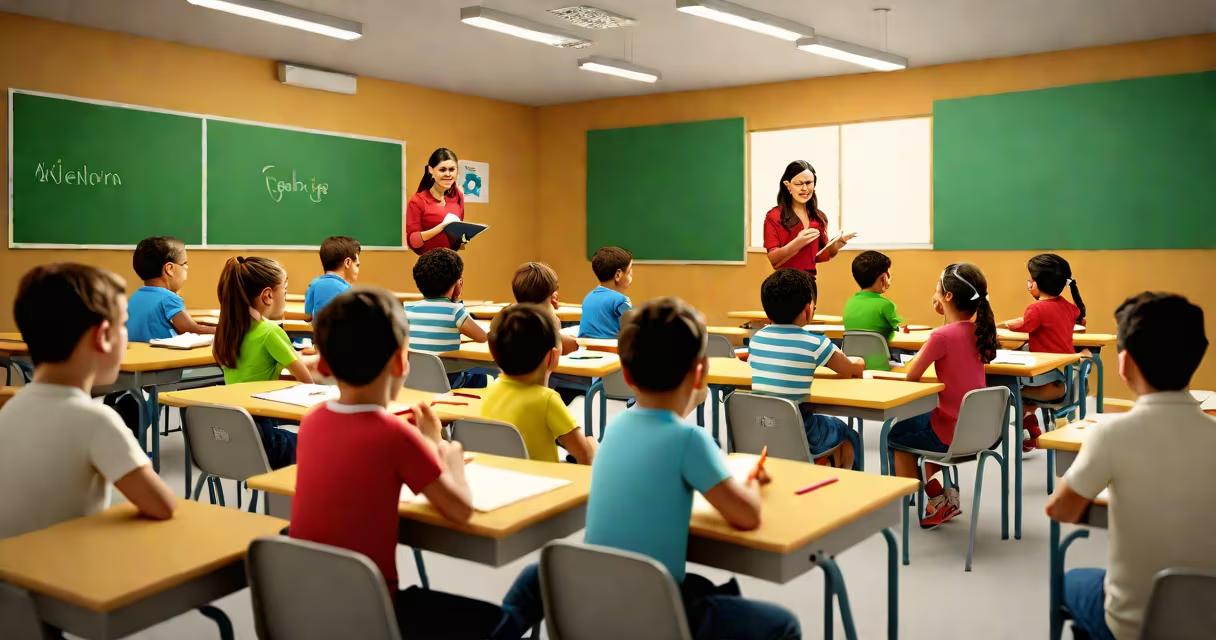
Bilingual education teaches academic subjects in two languages, typically English and another language such as Spanish, Mandarin, or Arabic. It supports students' language development while maintaining grade-level content mastery. This approach is used in schools across the U.S., Canada, and parts of Europe.
Bilingual education is not simply teaching a second language alongside math or science. It's a structured method where core curriculum-reading, writing, math, social studies-is delivered in two languages. Students learn content in both languages over time, building proficiency in both. The goal is academic achievement in both languages, not just vocabulary acquisition.
According to the National Clearinghouse for English Language Acquisition (NCELA), bilingual education models are designed to maintain students' native language while developing English proficiency. Research shows that students in well-implemented bilingual programs outperform peers in monolingual settings on standardized tests in both languages. These programs are especially effective for English learners (ELs) and native speakers alike.
Programs follow specific models based on student needs and school goals. The most common are transitional bilingual education, maintenance bilingual education, and dual language immersion. Each uses different ratios of language use and timing of transition to English-only instruction.
In transitional bilingual education, instruction begins in the student's home language and gradually shifts to English. This model aims to build foundational literacy in the native language before transitioning. It's often used in elementary schools with high numbers of ELs. A study by the Center for Applied Linguistics found that students in transitional programs showed stronger long-term reading outcomes than those in early-exit models.
Maintenance bilingual education continues instruction in the native language through upper elementary grades. This model preserves native language fluency while developing English. It's common in communities with stable populations of heritage language speakers. For example, schools in Miami serve large Spanish-speaking populations using maintenance models to sustain Spanish literacy.
Dual language immersion (DLI) is the most balanced model. Students are split evenly between native English speakers and native speakers of another language-usually Spanish. Half the day is taught in English, half in the second language. By middle school, students achieve near-native proficiency in both. DLI programs have been shown to close achievement gaps and improve cross-cultural understanding.
| Model | Language Ratio | Duration | Best For |
|---|---|---|---|
| Transitional Bilingual | 60% native language, 40% English (early grades) | 1-3 years | Students new to English |
| Maintenance Bilingual | 50% native language, 50% English (through 5th grade) | 5-6 years | Students with strong native language skills |
| Dual Language Immersion | 50% English, 50% second language (K-12) | Full K-12 cycle | Both native English and heritage language speakers |
Not all bilingual programs are equal. Some schools claim to offer bilingual education but only teach basic vocabulary in another language. True bilingual education requires certified teachers trained in both content delivery and language acquisition. According to the American Council on the Teaching of Foreign Languages (ACTFL), only 28% of U.S. states require formal certification for bilingual educators.
A key distinction is that bilingual education is not the same as English as a Second Language (ESL) pull-out programs. ESL typically removes students from mainstream classes for focused English instruction. Bilingual education keeps students in the classroom, learning subject matter in both languages simultaneously. This integration prevents academic delays and promotes peer interaction.
One widespread myth is that bilingual education slows down learning. Data from the U.S. Department of Education shows that students in dual language programs score higher on state assessments in math and reading than their peers in traditional English-only classrooms. On average, DLI students outperform non-DLI peers by 10-15 percentage points in standardized test scores.
Another misconception is that only immigrant children benefit. In reality, native English speakers gain significant advantages. A 2021 study published in Language Learning found that students in dual language programs had better executive function, attention control, and problem-solving skills. These cognitive benefits persist into adulthood.
I observed this firsthand in a public elementary school in Austin, Texas. The school runs a dual language program with 50% English and 50% Spanish. After three years, native English speakers were reading at grade level in Spanish. One student, a 7th grader, wrote a short story in both languages for a school festival. His teacher noted that his confidence in both languages grew steadily each year.
There's also confusion between bilingual education and language immersion. While both involve teaching in multiple languages, immersion programs often start with one language only and gradually introduce the second. Bilingual education uses balanced, sustained instruction in both languages from the beginning. The difference matters: immersion may delay English acquisition, while bilingual education ensures both languages develop concurrently.
Bilingual education is used in public and private schools, charter networks, and international schools. In the U.S., states like California, New York, and Florida have expanded dual language programs since 2010. California's AB 1365 law, passed in 2012, mandated the expansion of dual language programs in districts with high EL populations.
Private schools often adopt bilingual models to attract families seeking global readiness. For example, the International School of Boston offers a French-English dual language program from kindergarten through 12th grade. Students graduate with advanced proficiency in both languages and a deeper understanding of global cultures.
Businesses also support bilingual education. Companies like Google and Microsoft fund grants for schools to implement dual language curricula. They cite workforce readiness as a reason: employees with multilingual skills are more adaptable in global markets. A 2023 report by the Economist Intelligence Unit found that 67% of multinational firms prioritize hiring candidates with bilingual abilities.
The benefits extend beyond academics. Students in bilingual programs show greater empathy, cultural sensitivity, and intergroup cooperation. A longitudinal study by the University of California, Los Angeles (UCLA) tracked 1,200 students over ten years. Those in bilingual programs reported higher levels of social engagement and lower rates of behavioral issues compared to peers in monolingual schools.
Bilingual education is not a niche option-it's a proven strategy for academic success, cognitive development, and cultural inclusion. When implemented correctly, it supports all students, regardless of language background. Schools that invest in qualified staff, balanced language use, and sustained programming see measurable gains in achievement and equity.