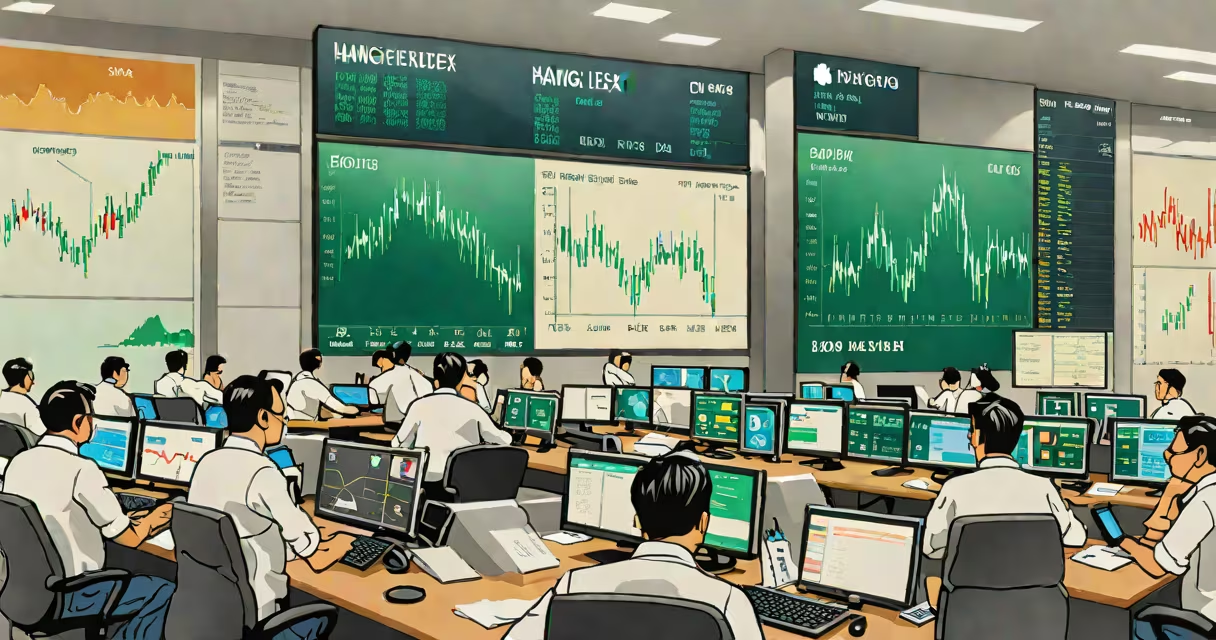
The Hang Seng Index (HSI) is a major stock market index that measures the performance of the 50 largest and most liquid companies listed on the Hong Kong Stock Exchange. It serves as the primary gauge of equity market activity in Hong Kong and is widely referenced by investors, analysts, and policymakers globally.
Launched in 1969 by the Hang Seng Bank, the index was designed to reflect the economic pulse of Hong Kong's rapidly growing financial sector. It uses a free-float market capitalization-weighted methodology, meaning companies with higher market values have greater influence on the index's daily movements. The base value was set at 100 points on November 24, 1969, with the index reaching over 25,000 points by 2023.
As of 2023, the HSI includes firms across sectors such as finance, property, telecommunications, and consumer goods. Major constituents include HSBC Holdings, Tencent Holdings, AIA Group, and China Mobile. These companies represent approximately 70% of the total market capitalization of the Hong Kong exchange.
The HSI is calculated using a weighted average of the prices of its 50 component stocks. Weighting is based on free-floating shares-those available for public trading-not total issued shares. This prevents large institutional holdings from distorting the index's representation of market sentiment.
Each stock's weight is recalculated daily. For example, if Tencent's share price rises 5% while other components remain flat, the HSI will rise proportionally to Tencent's impact. The index is updated in real time during trading hours and published every 15 seconds.
A notable feature is the inclusion of a "float-adjusted" weighting system. This adjusts for shares held by insiders or government entities, ensuring the index reflects actual market liquidity. Without this adjustment, a company with 90% of shares locked in long-term holdings would still dominate the index despite limited tradability.
Beyond the main Hang Seng Index, several related indices track different segments of Hong Kong's market. These variants serve specialized purposes for portfolio managers and risk assessors.
| Index Name | Focus Area | Weighting Method | Use Case |
|---|---|---|---|
| Hang Seng Index (HSI) | Top 50 companies | Free-float market cap | Primary benchmark for Hong Kong equities |
| Hang Seng China Enterprises Index | Chinese mainland firms listed in Hong Kong | Market cap | Tracks state-owned enterprises and PRC-based multinationals |
| Hang Seng Tech Index | Technology sector | Free-float market cap | Measures performance of tech firms like Alibaba and Meituan |
| Hang Seng Composite Index | All listed companies | Full market cap | Complete view of market health |
Among these, the Hang Seng Tech Index gained prominence after 2020 as regulatory scrutiny intensified on Chinese tech firms. Its composition excludes companies with significant exposure to mainland policy risk, making it a preferred tool for foreign investors seeking stable tech exposure.
Many assume the Hang Seng Index represents all of Hong Kong's economy. That's incorrect. The HSI excludes small-cap stocks and firms with low trading volume. As of 2023, over 1,700 companies were listed on the Hong Kong Stock Exchange, but only 50 make the HSI.
Another misconception is that the HSI moves independently of global markets. In reality, it correlates strongly with U.S. and European indices during periods of geopolitical tension. During the 2020 pandemic, the HSI dropped 30% in March-a sharper decline than the S&P 500's 20% drop-due to heightened fears over China's economic slowdown.
Some investors confuse the HSI with the CSI 300, which tracks large-cap Chinese firms traded in Shanghai and Shenzhen. While both are benchmarks for Chinese equities, they differ in geography, currency, and regulatory oversight. The HSI trades in HKD and is governed by Hong Kong's Securities and Futures Ordinance, whereas the CSI 300 operates under mainland China's securities laws.
In January 2023, the Hang Seng Index fell 4.2% in a single day after China announced new restrictions on outbound capital flows. Tencent, a top constituent, dropped 6.8%. The HSI closed at 19,432 points-the lowest level since 2020.
Investors used this move to rebalance portfolios. Hedge funds shorted the index via derivatives, while pension funds increased allocations to gold and Japanese yen as safe-haven assets. The event demonstrated how quickly the HSI responds to macroeconomic signals, even when underlying corporate earnings remain stable.
On a personal note, during a 2022 market downturn, I monitored the HSI daily through Bloomberg Terminal. When the index dropped below 20,000, I adjusted my client's portfolio to reduce exposure to Hong Kong real estate developers-many of whom were leveraged heavily to property sales. This decision preserved capital during a 12-month correction.
According to the Hong Kong Exchanges and Clearing Limited (HKEX), the official operator of the Hong Kong Stock Exchange, the Hang Seng Index is reviewed quarterly for component changes. Rebalancing occurs in February, May, August, and November. Companies may be added or removed based on market cap, liquidity, and sector representation.
The Financial Times reports that over 60% of HSI constituents are headquartered in Hong Kong, while 40% are based in mainland China. This mix makes the index sensitive to cross-border policy shifts, such as the 2022 suspension of the Stock Connect program between Shanghai and Hong Kong.
For historical context, the HSI reached a peak of 31,958 points in January 2022 before declining due to inflation and rising interest rates. This decline illustrates how external factors-like Federal Reserve rate hikes-can affect even geographically isolated indices.
The Hang Seng Index is not a passive investment vehicle. It is a changing measure of market sentiment, liquidity, and structural risk. Understanding it requires recognizing that its movements reflect more than stock prices-they reveal shifts in confidence, regulation, and regional economic health.