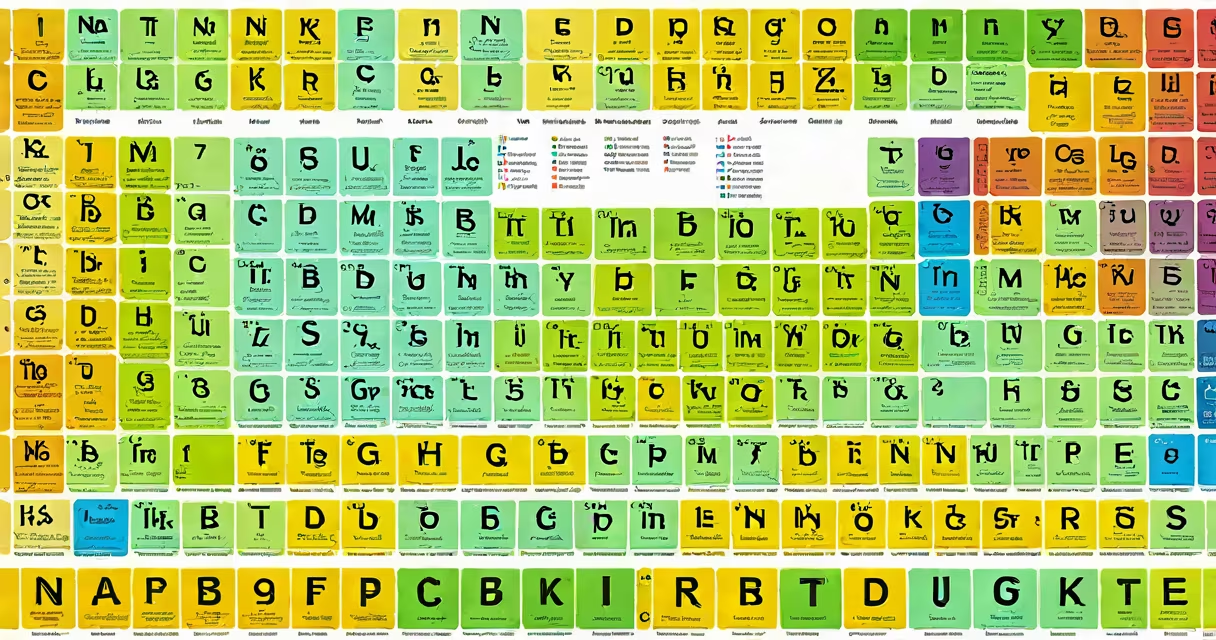
The n periodic table is a structured arrangement of chemical elements based on their atomic number, electron configuration, and recurring chemical properties. It groups elements into rows (periods) and columns (groups) to show trends in reactivity, electronegativity, and atomic size.
Developed by Dmitri Mendeleev in 1869, the modern version of the periodic table organizes 118 confirmed elements in order of increasing atomic number-the number of protons in an atom's nucleus. Elements in the same group share similar chemical behaviors due to matching valence electron counts. For example, Group 1 elements (alkali metals) all react vigorously with water to form strong bases.
Each period corresponds to a new principal energy level being filled. Period 1 contains only hydrogen and helium; Period 2 includes lithium through neon. The table's layout reflects quantum mechanical principles governing electron shells and subshells. This organization allows scientists to predict properties of undiscovered or synthetic elements.
Elements are arranged left to right and top to bottom in ascending order of atomic number. As you move across a period, atomic radius generally decreases due to increasing nuclear charge pulling electrons closer. Moving down a group, atomic radius increases because additional electron shells are added.
Vertical columns (groups) contain elements with similar outer electron configurations. Group 18, the noble gases, have completely filled valence shells and exhibit minimal reactivity. Group 17, the halogens, have seven valence electrons and readily gain one electron to achieve stability. These patterns enable accurate prediction of bonding behavior and compound formation.
Horizontal rows (periods) reflect the filling of successive electron shells. Period 4 begins with potassium (atomic number 19) and ends with krypton (36). Within this period, transition metals occupy the central block (Groups 3-12), characterized by partially filled d orbitals. Their variable oxidation states allow diverse coordination chemistry, important in catalysis and biological systems like hemoglobin.
The standard periodic table divides elements into four main blocks based on electron subshell occupancy:
| Block | Electron Subshell | Examples | Properties |
|---|---|---|---|
| s-block | ns¹⁻² | Lithium, Calcium | High reactivity; form +1 or +2 ions |
| p-block | np¹⁻⁶ | Oxygen, Chlorine, Argon | Includes metals, metalloids, nonmetals; wide range of properties |
| d-block | (n−1)d¹⁻¹⁰ | Iron, Copper, Zinc | Transition metals; variable oxidation states; colored compounds |
| f-block | (n−2)f¹⁻¹⁴ | Uranium, Lutetium | Lanthanides and actinides; complex magnetic and optical behavior |
Some versions display the f-block below the main table to save space. This format maintains clarity while preserving the logical sequence of atomic numbers. Alternative layouts-such as spiral or 3D models-exist but lack widespread adoption due to reduced readability and difficulty in printing.
A key insight often missed: the periodic table is not static. New elements are synthesized in particle accelerators and added to the table. Nihonium (element 113), moscovium (115), tennessine (117), and oganesson (118) were officially recognized by IUPAC in 2016. These superheavy elements decay rapidly and exist only fleetingly under controlled conditions.
Many assume the periodic table is purely alphabetical or based on atomic mass. That was Mendeleev's original approach-but he left gaps for undiscovered elements and adjusted order based on chemical similarity. Today, atomic number determines placement, not mass. For example, tellurium (atomic number 52) appears before iodine (53), even though tellurium has higher average atomic mass.
Another error: thinking all elements are naturally occurring. Of the 118 confirmed elements, only 94 occur in nature. The rest-elements 95 to 118-are man-made, typically produced via nuclear fusion in cyclotrons or particle accelerators. These synthetic elements are unstable and decay within seconds or minutes.
Some confuse the periodic table with a list of common substances. It is not. Water (H₂O) is not on the table-it's a compound. The table lists only pure elements. Carbon, oxygen, iron, gold-these are elements. When they bond, they form molecules and compounds not shown directly on the table.
Engineers use the periodic table to select materials with specific conductivity, strength, or corrosion resistance. Aluminum (13), for instance, is lightweight and forms a protective oxide layer, making it ideal for aircraft construction. Titanium (22) combines high strength-to-density ratio with biocompatibility, enabling use in medical implants.
In medicine, technetium-99m (Tc-99m), derived from molybdenum-99, is used in over 80% of diagnostic nuclear scans. Molybdenum (42) sits in Group 6, sharing chemical traits with chromium and tungsten. Its ability to form stable complexes with ligands makes it valuable in radiopharmaceuticals.
Consider silicon (14), a metalloid in Group 14. Its semiconductor properties enabled the development of transistors and integrated circuits. Without understanding its position relative to carbon and germanium, modern computing would not exist. The periodic table predicted this utility decades before its application.
During my time working in a university lab, I once had to identify an unknown sample using X-ray fluorescence. The spectrum showed peaks at 28.3 keV and 17.5 keV-matching iron and manganese. Consulting the periodic table, I confirmed their positions (Fe: 26, Mn: 25) and verified expected emission lines. The table wasn't just reference-it was diagnostic.
The n periodic table remains a foundational structure in science. It enables systematic study of matter, drives innovation in materials and medicine, and continues to evolve as new elements are synthesized and studied.