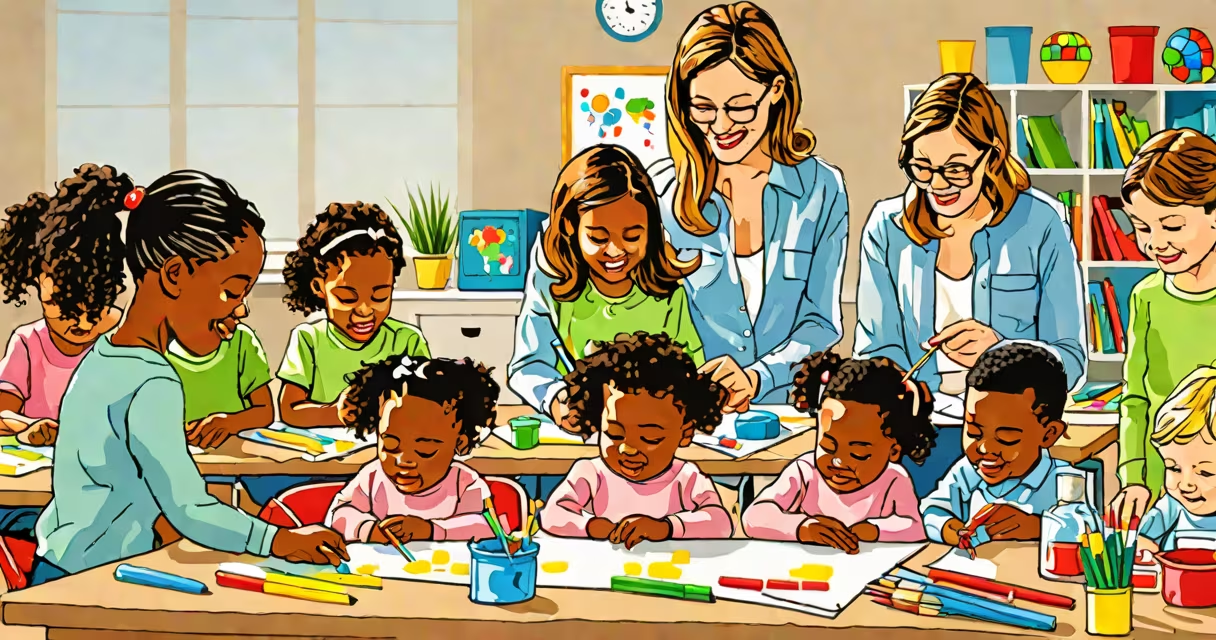
To become a preschool teacher, you must hold at least a high school diploma, complete state-approved early childhood education training, and earn a valid teaching credential. Requirements vary by state but typically include formal coursework in child development, hands-on classroom experience, and passing a background check.
Preschool teachers work with children aged three to five, guiding their social, emotional, and cognitive growth through play-based learning. They design daily routines, manage behavior, and communicate regularly with parents. The role demands patience, consistency, and a deep understanding of developmental milestones.
The U.S. Bureau of Labor Statistics reports that preschool teachers must meet state-specific licensing standards, which often require either an associate degree or a bachelor's degree in early childhood education. Some states allow individuals with only a high school diploma to teach under supervision, but these positions are increasingly rare.
Most states require preschool teachers to hold a Child Development Associate (CDA) credential or a state-issued license. The CDA, offered by the Council for Professional Recognition, requires 120 hours of training, 480 hours of experience working with young children, and a written exam. This credential is widely recognized and accepted across public and private programs.
Bachelor's degrees in early childhood education are becoming standard. According to the National Association for the Education of Young Children (NAEYC), 67% of preschool programs now require teachers to have at least a bachelor's degree. These programs include courses in child psychology, curriculum design, and inclusive education practices.
State licensing varies. For example, California requires a Child Development Permit, while New York mandates a Childhood (Birth-Grade 6) teaching certificate. Teachers must pass state-specific exams such as the Praxis II Early Childhood Education test, which assesses knowledge in literacy development, math concepts, and family engagement strategies.
| Requirement | Minimum Standard | Common State Variations |
|---|---|---|
| Education Level | Associate degree or higher | California: CDA or equivalent; New York: bachelor's degree required |
| Training Hours | 120 hours in child development | Florida: 40 hours of professional development annually |
| Experience | 480 hours working with children | Colorado: 200 hours minimum; must include supervised teaching |
| Certification Exam | Pass Praxis II or state equivalent | Ohio: additional assessment in special education inclusion |
Classroom time is not optional. All states require supervised fieldwork or student teaching during teacher preparation programs. This hands-on component ensures educators can apply theory to real-world scenarios like managing tantrums, supporting language acquisition, or adapting lessons for children with disabilities.
I once observed a student teacher in a Boston public preschool program who struggled to engage a nonverbal four-year-old until she incorporated sensory bins and visual schedules. Her mentor guided her to adjust the environment based on developmental research. That moment showed me how training translates into tangible outcomes-not just compliance, but meaningful connection.
Research from the National Institute for Early Education Research shows that classrooms led by credentialed teachers see 30% higher gains in vocabulary and pre-literacy skills compared to those with unlicensed staff. The difference lies in structured lesson planning, consistent routines, and evidence-based techniques like scaffolding and modeling.
Many assume that being a preschool teacher means "just playing with kids." In reality, it involves designing developmentally appropriate curricula, tracking individual progress, and collaborating with families and specialists. A typical day includes circle time, snack preparation, outdoor play, and documentation of learning goals.
Another misconception is that any college course labeled "early childhood" qualifies. Not all programs meet NAEYC accreditation standards. For example, a 120-hour online course with no practicum may not satisfy state licensing boards. Always verify that your program is approved by your state's department of education.
Some states allow substitute teachers to cover preschool roles without full certification. However, the U.S. Department of Education notes that schools using unlicensed substitutes face increased scrutiny during federal funding reviews. Long-term reliance on temporary staff correlates with lower student outcomes in early literacy and social-emotional development.
After completing your degree and certification, apply for jobs through local school districts, licensed childcare centers, or nonprofit early learning networks. Many programs offer paid internships or residency programs that lead directly to employment.
Salaries vary by location and employer. On average, preschool teachers earn $32,000 annually, according to the U.S. Bureau of Labor Statistics. Urban areas like San Francisco report averages near $45,000, while rural regions may pay $26,000. Higher pay often comes with advanced credentials or leadership roles.