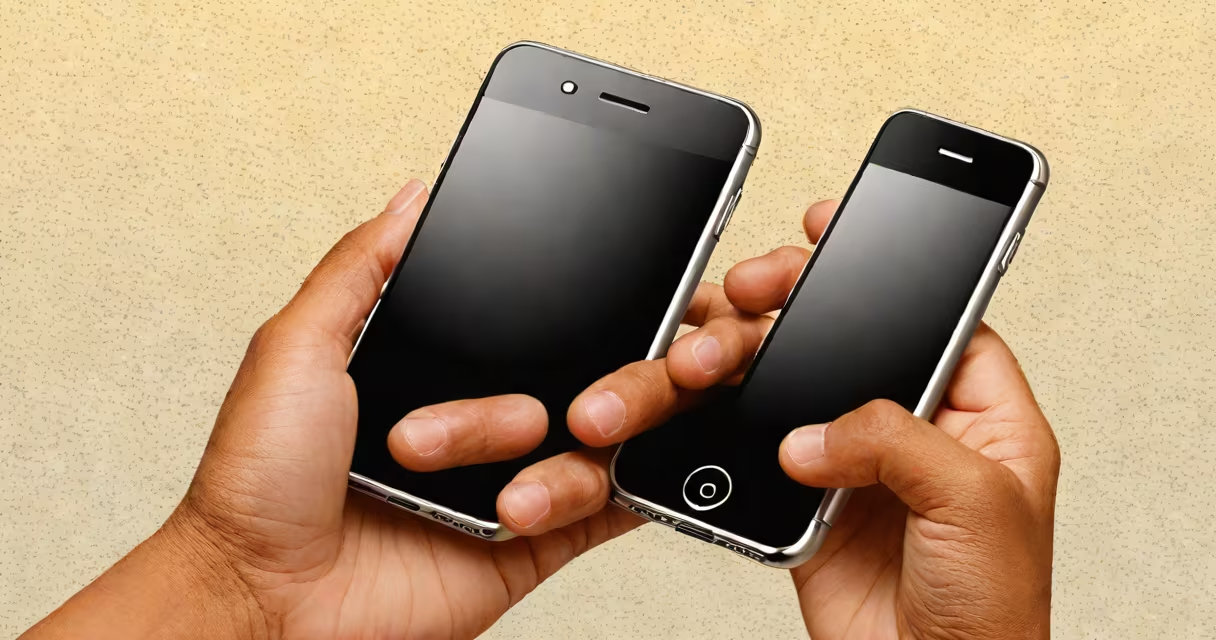
The first generation iPhone, released in June 2007, was Apple's debut smartphone. It combined a mobile phone, a music player, and an internet browser into a single device with a capacitive touchscreen and no physical keyboard.
Apple unveiled the device at Macworld Conference & Expo in January 2007, demonstrating a phone that responded to finger taps and swipes. The hardware included a 3.5-inch touchscreen, a 2-megapixel camera, and a 4GB storage capacity. It ran iPhone OS 1.0, a mobile version of macOS, and required a Wi-Fi connection for web browsing and email.
Unlike modern iPhones, the first generation model had no home button with haptic feedback or Face ID. It used a single physical button at the bottom for navigation. The device was available exclusively through AT&T in the U.S., which controlled network access and limited app installation to the App Store's predecessor-Web-based applications.
The first generation iPhone operated using a capacitive touchscreen that detected electrical charge from human skin. Users interacted via tap, pinch, and swipe gestures. The interface was entirely touch-driven, with no physical buttons beyond the power and volume controls.
Under the hood, the device used a 600 MHz ARM processor, 128 MB of RAM, and a 3.5-inch display with a resolution of 320×480 pixels. Battery life lasted about 8 hours of talk time and 24 hours of standby. Charging occurred via a proprietary USB cable connected to a computer or wall adapter.
Internet connectivity relied on Wi-Fi and EDGE cellular data. Web pages loaded slowly due to limited bandwidth and the lack of hardware-accelerated graphics. Email used IMAP and POP protocols, but push notifications were not supported until later iOS updates.
The device featured a 2-megapixel rear-facing camera capable of capturing still images and recording video at 320×240 resolution at 15 frames per second. Audio playback used the built-in speaker and headphone jack. The device did not support Bluetooth for file transfer or headset pairing during initial release.
Storage was fixed at 4GB or 8GB models, with no expandable memory. Apps were accessed through Safari or embedded web apps hosted on remote servers. The App Store did not exist yet-users could not download native software. Instead, developers created web apps optimized for iPhone OS.
Despite its innovation, the first iPhone lacked features now standard: no front-facing camera, no Siri, no Touch ID, and no wireless charging. It also had no notification center or background app refresh. These limitations were expected given the state of mobile technology in 2007.
| Feature | First Generation iPhone | Modern iPhone (2023) |
|---|---|---|
| Operating System | iOS 1.0 (based on macOS) | iOS 17 (arm64 architecture) |
| Screen Size | 3.5 inches | 6.1 inches (iPhone 15) |
| Camera Resolution | 2 megapixels (rear only) | 12 MP (main), 50 MP (ultra-wide) |
| Storage Options | 4GB or 8GB (non-expandable) | 128GB to 1TB (non-expandable) |
| Connectivity | Wi-Fi, EDGE, USB 2.0 | Wi-Fi 6E, 5G, USB-C, Bluetooth 5.3 |
The first generation iPhone was marketed as a revolutionary device that replaced multiple gadgets. Consumers used it to make calls, listen to music, browse the web, and send emails. Early adopters valued its sleek design and intuitive interface, even though it lacked many features now taken for granted.
Businesses adopted it for field sales teams needing mobile access to customer databases and calendars. Schools and universities used it for student presentations and multimedia projects. Developers experimented with web apps, laying the groundwork for the native app economy.
One notable example: in 2007, a developer named Dave Winer created a web-based RSS reader called "iReader" that ran in Safari on the iPhone. It demonstrated how web technologies could deliver rich functionality without native apps-a concept that evolved into progressive web apps years later.
Many assume the first iPhone had a touchscreen like modern devices. While it did use a capacitive screen, it lacked pressure sensitivity and multi-finger gestures. The system did not recognize long presses or double-taps for context menus-features added in iOS 2.0.
Another myth is that the device had a built-in SIM card slot. It did not. The iPhone 2G used a proprietary SIM tray compatible only with AT&T's network. This locked users into a carrier contract and limited international use.
A lesser-known fact: Apple initially planned to release a version with a physical keyboard. Designers at Apple explored a sliding form factor, but Steve Jobs rejected it in favor of a minimalist, all-touch interface. That decision shaped the entire direction of smartphone design.
I used a first generation iPhone in 2008 while working as a freelance journalist. The device struggled with data-heavy sites and often crashed Safari after five minutes of browsing. I remember waiting 30 seconds for a single photo to load from a news site. But the ease of tapping to zoom and scroll through articles felt magical compared to older phones with tiny screens and styluses.
When I tried to sync my calendar across devices, I discovered the iPhone didn't support iCloud. I had to manually export data via iTunes and import it into Outlook. Still, the ability to access my email inbox from a pocket-sized device felt like science fiction.
The first generation iPhone remains a landmark in consumer electronics history. Its influence extended beyond Apple, shaping the expectations of mobile interaction worldwide. It proved that a single device could replace several others-and set the stage for the smartphone era.