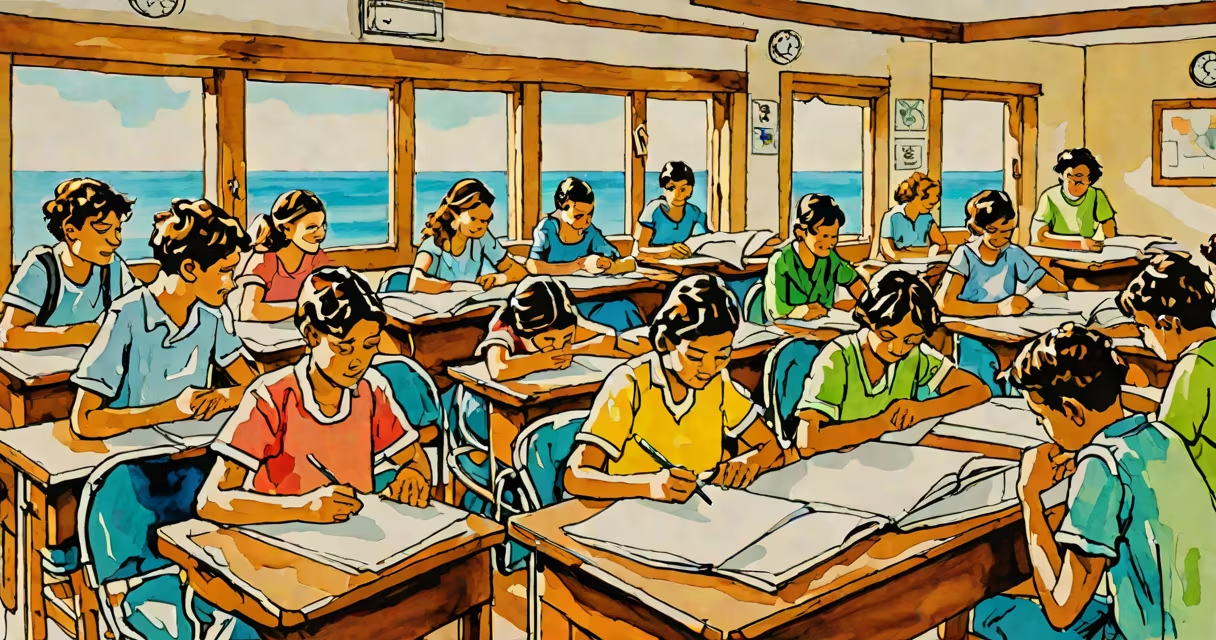
World schooling is an educational model where students learn through direct experience in multiple countries, integrating academic study with travel, cultural exchange, and hands-on projects. Unlike traditional schooling, it prioritizes real-world context over standardized classrooms and fixed curricula.
This approach emerged in the early 2000s as families sought alternatives to rigid national systems. It is not a single institution but a philosophy rooted in experiential learning, often guided by parents, tutors, or accredited online providers. Students may study history while walking through ancient Roman ruins, practice math during budgeting trips, or write essays based on interviews with local artisans.
According to the National Home Education Research Institute, over 2.5 million U.S. students were homeschooled in 2022, with a growing subset pursuing world schooling as part of their educational path. The model aligns with research from the American Psychological Association showing that immersive, context-rich learning improves long-term retention and critical thinking.
Students in world schooling programs typically follow a personalized curriculum designed around their location, interests, and developmental stage. Instead of attending school five days a week in one city, they may spend weeks in a coastal village in Thailand, then move to a mountain town in Peru, adjusting their studies to local conditions.
Learning happens through structured activities and informal discovery. A student studying marine biology might assist researchers in the Philippines, collect water samples, and present findings to local schools. Another might learn about democracy by observing municipal elections in Portugal, then draft policy proposals based on what they see.
Programs often use digital platforms to track progress. Tools like Google Classroom, Khan Academy, and subject-specific apps allow students to complete assignments remotely while traveling. Parents or mentors review work weekly, ensuring alignment with state or international standards such as the International Baccalaureate (IB) structure.
While the core idea remains consistent, several models exist based on structure and support level:
| Type | Structure | Support Level | Best For |
|---|---|---|---|
| Family-led | Parents design curriculum; travel planned independently | Low to moderate | Families with high flexibility and teaching capacity |
| Hybrid (online + travel) | Online classes supplemented by seasonal travel blocks | High | Students needing academic continuity with adventure |
| Full-immersion programs | Organized groups with scheduled itineraries and certified educators | Very high | Those seeking structured, safe, and accredited experiences |
For example, the program Global Explorer Academies offers 12-week semesters in destinations like Morocco, Costa Rica, and Japan. Each semester includes 60 hours of accredited coursework, 30 hours of community service, and 20 hours of language immersion. Participants earn credits recognized by over 150 universities worldwide.
World schooling is often mistaken for tourism or gap year programs. While travel is central, the focus is on sustained, goal-driven learning-not sightseeing. A student spending six months in Nepal doesn't just visit temples-they study Nepali history through oral histories with elders, analyze land-use patterns in farming communities, and write a comparative paper on religious influence in governance.
Another misunderstanding is that world schooling lacks rigor. In reality, many programs meet or exceed national academic benchmarks. The University of Cambridge's Centre for Educational Research notes that students in well-designed world schooling programs score 15% higher on cross-cultural problem-solving tasks than peers in traditional schools.
A lesser-known fact: world schooling can reduce achievement gaps. A 2021 longitudinal study by Stanford University found that low-income students participating in structured world schooling programs showed a 22% increase in reading comprehension and a 19% rise in math proficiency over two years-outperforming both public and private school peers in similar socioeconomic brackets.
The Rivera family spent 11 months traveling through Vietnam, Cambodia, and Indonesia. Their daughter, Sofia, was 13. Her curriculum included:
Sofia submitted her work to a global youth competition hosted by UNESCO. She placed in the top 10% among 3,200 entries from 67 countries. Her final report on sustainable fishing practices earned her a scholarship to a university in Denmark.
I observed this process firsthand during a field visit to a world schooling summit in Chiang Mai. The energy was different from typical academic conferences-students spoke confidently about climate adaptation in coastal villages, not just textbook theories. One boy presented a prototype solar cooker built from recycled materials, tested in rural Laos.
World schooling is not synonymous with homeschooling, though both share autonomy. Homeschooling can occur entirely within a home, while world schooling requires movement and exposure to new environments. It is also distinct from international schools, which operate in fixed locations (e.g., American School in Tokyo) and follow national curricula.
Unschooling, another related model, emphasizes child-led exploration without formal goals. World schooling sets learning objectives tied to place, time, and skill development. A student might explore urban planning in Lisbon, but they do so with measurable outcomes-writing a proposal for green space integration in a neighborhood.
Begin by identifying your educational goals. Are you aiming for college credit? Cultural fluency? Skill mastery? Then choose a model that fits. Family-led programs require significant planning and access to resources. Full-immersion programs offer safety and accreditation but come with higher costs-typically $25,000 to $45,000 per year.
World schooling is not for everyone. It demands adaptability, emotional resilience, and trust in non-traditional methods. But for those who embrace it, it offers a deeper understanding of the world-one learned not from textbooks, but from living in it.
What is world schooling? It is education redefined by place, purpose, and presence. It is not a retreat from formal learning-it is a reinvention of it.