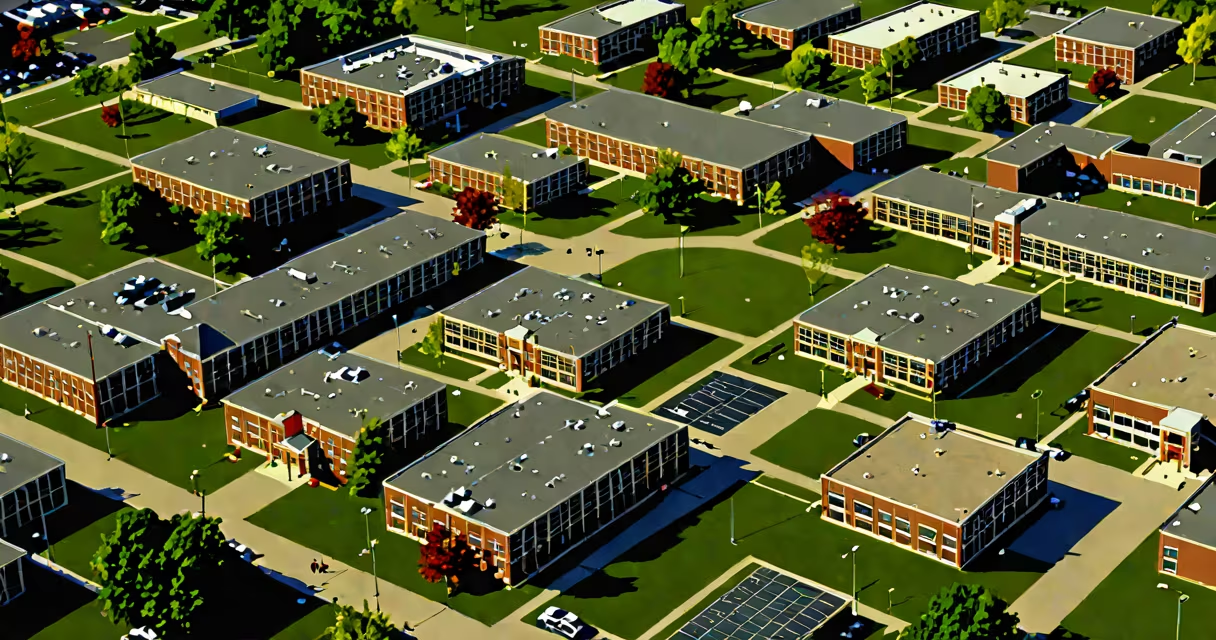
Ypsilanti Community Schools is a public school district headquartered in Ypsilanti, Michigan, serving approximately 4,000 students across ten schools. The district operates under state-mandated curriculum standards while emphasizing local engagement, college readiness, and equity in education.
Founded in 1837, Ypsilanti Community Schools traces its roots to the early settlement of Washtenaw County. The district currently oversees five elementary schools (K-5), two middle schools (6-8), two high schools (9-12), and one alternative education center. All schools are governed by a locally elected board of education responsible for budgeting, policy, and strategic planning.
Instructional programming includes Advanced Placement courses, career and technical education pathways, and dual enrollment opportunities with Eastern Michigan University. The district reports a graduation rate of 88% for the 2022-2023 academic year, according to the Michigan Department of Education's annual report.
The district manages student enrollment through a centralized registration system that assigns students to neighborhood schools based on residential address. Families may apply for inter-district transfers or enroll in specialized programs such as the STEM Academy at Ypsilanti High School.
Each school maintains a leadership team composed of a principal, assistant principals, and department heads. Curriculum delivery follows the Michigan Merit Curriculum structure, with assessments aligned to state standards in math, reading, science, and social studies. Student performance data is publicly available via the Michigan Department of Education's MI School Data portal.
Financial oversight is conducted annually by the district's audit committee. In 2023, the district's operating budget totaled $112 million, funded primarily through local property taxes (65%), state funding (30%), and federal grants (5%).
Ypsilanti Community Schools includes a mix of traditional, magnet, and alternative learning environments tailored to diverse student needs.
| School Type | Examples | Student Focus |
|---|---|---|
| Traditional Public | Ypsilanti Elementary, Lincoln Middle | General education, neighborhood enrollment |
| Magnet Program | STEM Academy at Ypsilanti High | Science, technology, engineering, math focus |
| Alternative Education | Ypsilanti Transition Center | Students at risk of dropping out; credit recovery |
| Early Childhood | Ypsilanti Early Learning Center | Pre-K and kindergarten immersion programs |
One non-obvious distinction: the district does not operate charter schools. All institutions are publicly funded and subject to state accountability measures. This differs from neighboring districts like Ann Arbor Public Schools, which host multiple charter options.
Some assume Ypsilanti Community Schools is part of a larger regional consortium. It is not. The district operates independently and reports directly to the Michigan Department of Education. Its boundaries do not extend beyond Ypsilanti Township and adjacent portions of Washtenaw County.
Another misconception is that all schools offer full-day kindergarten. Only six of the ten schools provide this option. The remaining four offer half-day sessions due to staffing and facility constraints.
A third confusion arises around transportation. While the district provides bus service for students living more than 1.5 miles from their assigned school, families residing within walking distance are not automatically enrolled in the transportation program. Eligibility is determined by a formal application process.
In the 2022-2023 school year, Ypsilanti Community Schools reported 4,127 students enrolled. Of those, 68% were identified as economically disadvantaged, 32% were Black or African American, 25% Hispanic, and 18% White. These figures reflect demographic shifts in the city since 2010, when the population grew by 12% according to U.S. Census data.
Academic outcomes show improvement in math proficiency. Between 2020 and 2023, the percentage of 8th graders scoring proficient or above in math rose from 41% to 53%. This increase correlates with the district's adoption of a new curriculum model focused on project-based learning and teacher collaboration.
For context, neighboring Marion Community Schools saw similar gains in literacy but lagged in science achievement. Comparing district performance requires careful attention to demographic variables and resource allocation. A 2022 study by the National Center for Education Statistics found that districts with higher poverty rates often face greater challenges in standardized test outcomes, even when instructional quality is comparable.
I visited Ypsilanti High School during a college readiness workshop in March 2023. Over 150 juniors and seniors attended sessions on financial aid applications, SAT preparation, and career exploration. The event was coordinated by the district's College and Career Readiness Office, which partners with local colleges and employers to offer internships and mentorship programs.
During the visit, I observed a group of students working on a robotics challenge sponsored by a local tech firm. The project was part of the district's STEM initiative, which allocates $1.2 million annually to equipment and teacher training. This hands-on component distinguishes Ypsilanti Community Schools from districts that rely heavily on theoretical instruction.
Ypsilanti Community Schools plays a central role in shaping educational access and opportunity in southeastern Michigan. Its commitment to culturally responsive teaching practices aligns with research from the University of Michigan's School of Education, which found that inclusive curricula improve long-term retention and academic confidence among minority students.
Community partnerships are critical to the district's success. Local organizations such as the Ypsilanti Downtown Development Authority and Washtenaw County Health Department collaborate on health screenings, mental wellness programs, and after-school tutoring. These efforts contribute to a 92% attendance rate in elementary schools, above the statewide average of 87%.
Ypsilanti Community Schools remains a key institution in the region's civic infrastructure. Its mission extends beyond academics-it supports workforce development, family engagement, and neighborhood revitalization. The district's ongoing investment in digital literacy and equitable access to devices helps students remain prepared for life beyond the classroom.