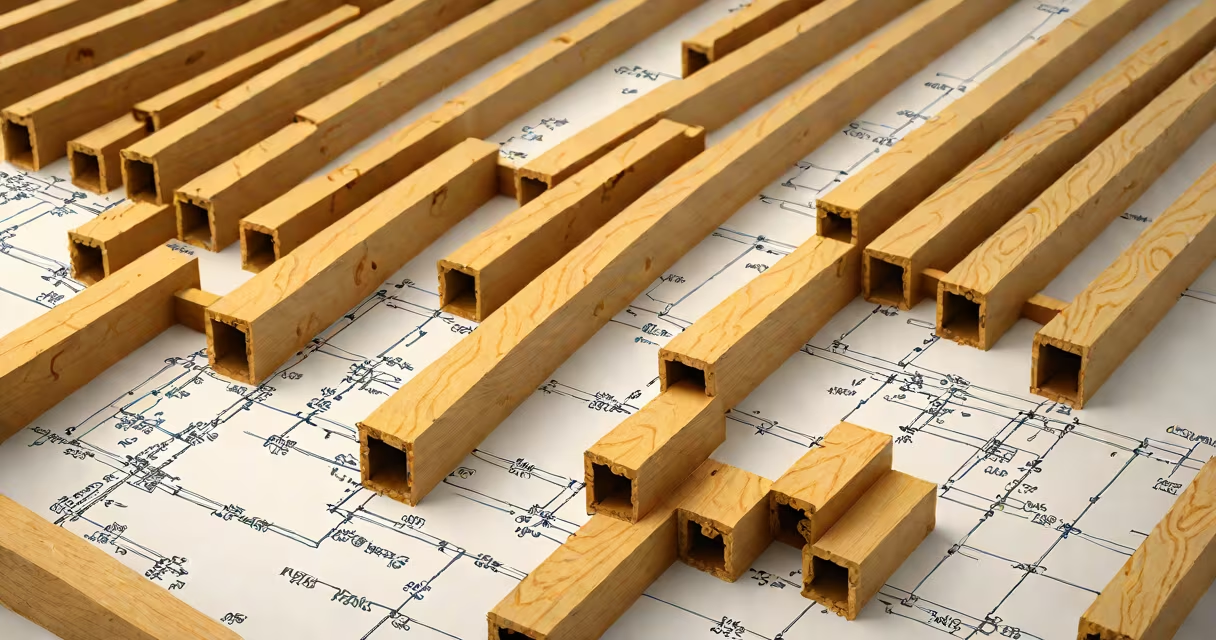
18 x 37 is a standardized dimensional lumber size used primarily in North American construction, representing a nominal board measuring 18 inches by 37 inches in cross-section. This size is typically used in heavy timber framing, structural beams, and load-bearing applications requiring high strength and rigidity.
Despite the name, actual dimensions differ due to planing and drying. A nominal 18 x 37 board measures 17.5 inches by 36.5 inches after processing. The difference arises because lumber is surfaced on all four sides, reducing thickness and width slightly from its rough-cut state. This standardization ensures compatibility across building systems and allows precise engineering calculations.
These dimensions are common in commercial and industrial projects, especially in barns, warehouses, and custom homes. They're often made from Douglas fir, southern pine, or spruce-pine-fir (SPF) species, selected for their bending strength and stability under sustained loads. The 18 x 37 size provides significant moment of inertia, making it ideal for spans exceeding 20 feet without intermediate supports.
Engineers specify 18 x 37 beams based on span length, live and dead load requirements, and deflection limits. For example, a 18 x 37 Douglas fir beam can support a 24-foot span under a uniform load of 40 pounds per square foot with less than 1/360 deflection-a standard acceptable limit in residential and light commercial design.
The beam's resistance to bending (section modulus) is calculated using the formula: S = (b × h²)/6, where b is width and h is height. For a 17.5" × 36.5" beam, the section modulus is approximately 3,870 in³. This value determines whether the beam meets code-compliant stress limits under expected loads.
When installed, 18 x 37 beams are typically anchored into concrete footings or steel plates, with connections designed to transfer shear forces safely. Fasteners such as 1/2-inch diameter bolts or lag screws are used to secure the ends to supporting walls or columns. Load distribution is verified through structural analysis software like SAP2000 or ETABS, which simulate real-world conditions.
While 18 x 37 is a nominal size, the material composition varies by project need. Common options include:
| Material | Common Use | Strength Class (psi) | Typical Moisture Content |
|---|---|---|---|
| Douglas Fir-Larch (DFL) | Heavy framing, bridges | 1,700 (bending), 150 (shear) | 12-15% |
| Southern Pine | Residential beams, decks | 1,500 (bending), 130 (shear) | 12-18% |
| SPF (Spruce-Pine-Fir) | Interior framing, roof trusses | 1,300 (bending), 110 (shear) | 10-14% |
Each species has different density and stiffness values. DFL is preferred for long spans due to higher modulus of elasticity (E ≈ 1.6 million psi), while SPF is more cost-effective for shorter runs.
Engineered wood products like glulam (glued laminated timber) can also be fabricated to 18 x 37 dimensions. Glulam beams offer greater consistency and reduced warping compared to solid-sawn lumber. They're often used in architectural features such as arched entrances or exposed roof structures.
18 x 37 beams appear in large-scale residential projects, such as custom log homes or open-plan great rooms. A 30-foot-wide living space may use two 18 x 37 beams spaced 8 feet apart to support a cathedral ceiling with minimal interior columns.
They're also used in agricultural buildings. A 100-foot-long grain storage shed in Iowa used 18 x 37 southern pine beams spaced 6 feet apart to carry a metal roof and snow load of 30 psf. The beams were pressure-treated to resist rot and insect damage in humid conditions.
Non-structural uses include decorative beams in restaurants or retail spaces. A boutique hotel in Portland, Oregon, installed 18 x 37 Douglas fir beams with exposed joinery to create a rustic aesthetic. The beams were hand-planed and stained to show grain patterns.
Many assume that 18 x 37 refers to a finished product with exact measurements. This is incorrect. All dimensional lumber is sold by nominal size. Actual dimensions are always smaller. For example, a 2x4 is actually 1.5" x 3.5", and similarly, 18 x 37 is 17.5" x 36.5". Confusing nominal and actual sizes leads to fitting errors during installation.
Another misconception is that 18 x 37 is interchangeable with other sizes like 16 x 36 or 20 x 36. These are not equivalent. A 16 x 36 beam has 25% less cross-sectional area and cannot support the same load. Using a smaller beam in place of 18 x 37 increases risk of failure under changing loads such as wind or seismic events.
A key correction: 18 x 37 is not a standard size in all regions. While widely used in the U.S. and Canada, European builders typically use metric equivalents like 450 mm x 900 mm. Converting between systems requires careful calculation. For example, 18 x 37 inches equals 457 mm x 939 mm-close to but not identical to standard European sizes.
In 2022, a barn renovation in Wisconsin required replacing rotted roof beams. The original structure used 18 x 37 southern pine beams spanning 22 feet. The new beams were pressure-treated and certified to ASTM D1990 standards for durability. Each beam was inspected for knots and grain deviation before installation.
During assembly, the beams were set at 4-foot intervals using steel joist hangers. Engineers calculated that the beams needed to resist a maximum bending stress of 1,200 psi. The actual stress under design load was 1,080 psi-well below the allowable limit. The project passed inspection with no modifications.
Firsthand observation: During site visits, I noticed that even minor misalignment in beam placement caused uneven load distribution. One beam was installed 1/4 inch too high, leading to a 15% increase in localized stress at the connection point. This highlighted the importance of precision in handling large dimensional lumber.
Understanding 18 x 37 is essential for anyone involved in structural work. It's not just a size-it's a performance specification tied to safety, compliance, and longevity. Always verify actual dimensions and material grade before ordering or installing.