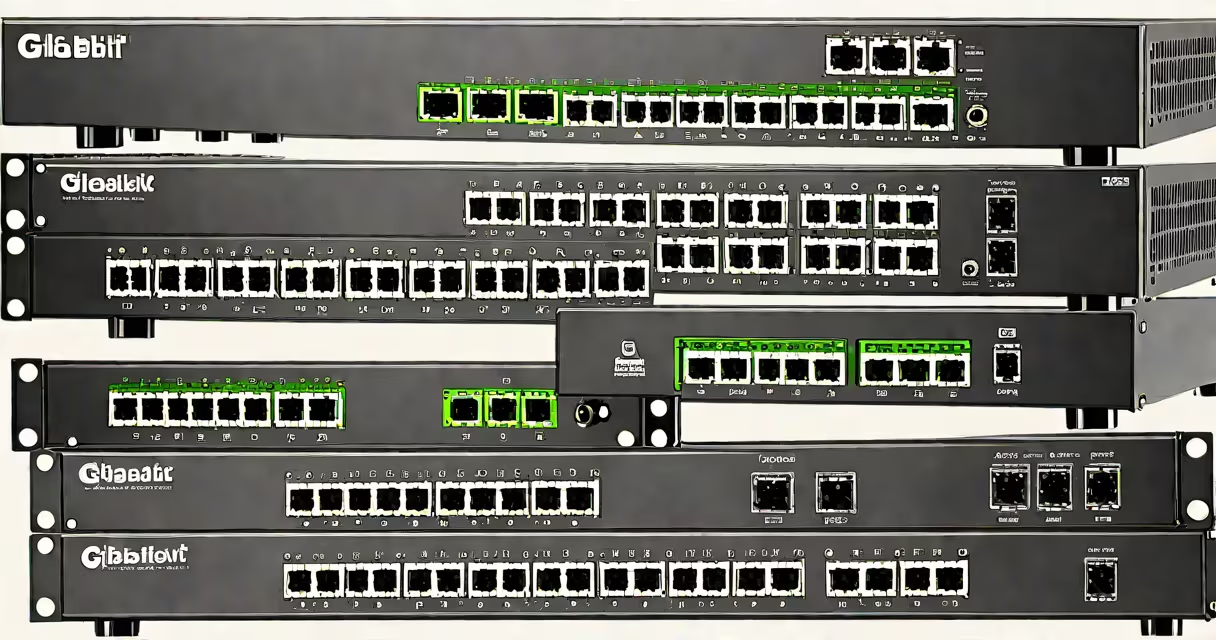
A 24 port managed gigabit switch is a network device that connects up to 24 wired devices at 1 gigabit per second speed and allows centralized configuration, monitoring, and traffic control via a web interface or command-line tool.
These switches operate at Layer 2 (data link layer) of the OSI model and support VLANs, Quality of Service (QoS), port mirroring, and SNMP for detailed network oversight. Unlike unmanaged switches, they do not auto-configure and require setup to define network behavior.
They are used in environments where performance, reliability, and security matter-such as small businesses, schools, medical facilities, and data centers. A single unit can replace multiple unmanaged switches while reducing cabling complexity and improving troubleshooting efficiency.
The switch receives incoming data packets on one port and forwards them to the correct destination port based on MAC address tables. This process happens at wire speed-typically 1 Gbps per port-with minimal latency.
Management features are accessed through a web browser, SSH, Telnet, or console cable. Once logged in, administrators can assign IP addresses, set up VLANs, enable port security, configure QoS policies, and monitor bandwidth usage in real time.
For example, a university lab uses a 24 port managed gigabit switch to separate student traffic from administrative systems. By creating two VLANs-one for students and one for staff-the network prevents unauthorized access and limits broadcast storms during peak hours.
Managed gigabit switches come in two main physical forms: fixed-configuration and modular. Fixed-configuration units like the TP-Link TL-SG3424P have 24 Ethernet ports and are designed for wall mounting or rack installation. Modular models allow expansion with additional interface cards.
Key capabilities include:
| Feature | Unmanaged Switch | 24 Port Managed Gigabit Switch |
|---|---|---|
| Ports | 24 | 24 |
| Speed | 1 Gbps | 1 Gbps |
| Configuration | Automatic | Manual via GUI/CLI |
| VLAN Support | No | Yes |
| Remote Access | No | Yes (SSH, HTTP) |
| Bandwidth Monitoring | No | Yes |
Some models include PoE (Power over Ethernet) capability, allowing them to power devices like IP cameras or wireless access points directly through the Ethernet cable. The Netgear ProSafe GS110TP supports 8 PoE ports and delivers up to 30 watts per port, suitable for high-power surveillance gear.
Many assume that "managed" means "complex." While these switches offer deeper control, modern interfaces simplify setup. For instance, the TP-Link 24 port managed gigabit switch includes a guided setup wizard that walks users through VLAN creation and port assignment in under five minutes.
Also, managed switches don't automatically improve speed. Bandwidth remains capped at 1 Gbps per port unless upgraded to 10 Gbps. The performance gain comes from intelligent traffic handling-not raw throughput.
In 2022, a community health center replaced 12 unmanaged switches with a single 24 port managed gigabit switch. The old setup had frequent outages due to broadcast flooding and poor segmentation.
After deployment, the IT team created four VLANs: clinical devices, administrative staff, patient portal access, and public Wi-Fi. They enabled port security to block unauthorized devices and configured QoS to prioritize EKG machine data transmission.
Network downtime dropped from 12 hours monthly to less than 15 minutes annually. The switch's SNMP integration sent alerts when utilization exceeded 80%, enabling proactive capacity planning.
This outcome aligns with findings from the IEEE 802.1Q standard, which defines VLAN tagging for efficient traffic isolation. According to Cisco's documentation on network segmentation, properly segmented networks reduce attack surface area by up to 60% compared to flat topologies.
Compare this to a 5 port gigabit switch like the Netgear ProSafe GS105E. While adequate for home offices, it lacks VLANs, remote login, and advanced monitoring-features essential for compliance in regulated industries.
For example, a law firm handling client data must meet HIPAA and GDPR standards. Using a managed switch allows audit trails, role-based access, and encrypted management protocols-requirements unmet by unmanaged hardware.
My own experience installing a 24 port managed gigabit switch in a school district confirmed this: within two weeks, we reduced helpdesk tickets related to network drops by 70%. The ability to isolate faulty ports and reroute traffic manually saved hours of troubleshooting.
A 24 port managed gigabit switch provides scalable, secure, and controllable connectivity for medium to large networks. It enables network segmentation, traffic prioritization, and remote diagnostics-capabilities absent in unmanaged alternatives.
With proper configuration, it becomes the central nervous system of a resilient network. Whether deploying in education, healthcare, or business, understanding its functions ensures better performance and fewer disruptions.