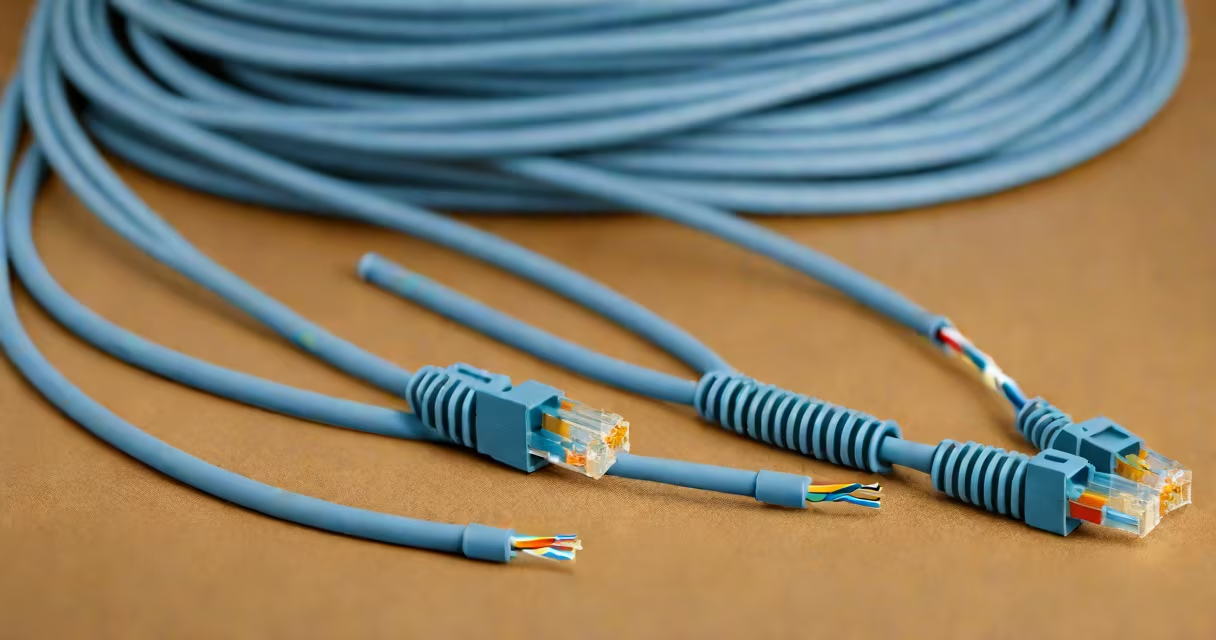
A 50 foot Cat 6 cable is a twisted-pair Ethernet cable designed to support high-speed data transmission up to 1 Gbps over distances up to 100 meters, with enhanced noise rejection and reduced crosstalk compared to older standards.
Cat 6 cables use four pairs of 23-gauge copper wires, twisted at different rates to minimize interference between adjacent pairs. The standard specifies a minimum of 23 AWG wire gauge and a maximum of 100 MHz bandwidth, enabling consistent performance across longer runs like 50 feet. This length is common in home networks, small offices, and server rooms where devices are spaced farther apart than typical short patch cables allow.
Unlike Cat 5e, which supports up to 1 Gbps but lacks formal specifications for higher-frequency performance, Cat 6 includes tighter twist rates and often a plastic spline (separator) inside the cable to reduce crosstalk. These features ensure stable throughput even under heavy network load. A 50 foot Cat 6 cable maintains full compliance with TIA/EIA-568-C.2 standards for commercial and residential installations.
The cable transmits data using differential signaling across two wires in each pair. Signals travel in opposite directions simultaneously, canceling out electromagnetic interference. This method improves signal integrity over long runs, such as a 50 foot span from a wall jack to a desktop device.
Each connector uses the 8P8C modular plug (commonly called RJ45). The wiring follows either T568A or T568B pinouts. Most Cat 6 cables use T568B, the default in North American installations. Mismatched wiring causes signal degradation or complete failure. Proper termination with a punch-down tool ensures consistent contact and prevents impedance mismatches.
When connected correctly, a 50 foot Cat 6 cable supports 10/100/1000 Mbps speeds and enables full-duplex communication. It also handles Power over Ethernet (PoE) up to PoE+ (30 watts), making it suitable for IP cameras, VoIP phones, and wireless access points located far from power outlets.
Not all 50 foot Cat 6 cables perform equally. Differences in materials, shielding, and build quality affect reliability and longevity.
| Type | Shielding | Use Case | Max Speed |
|---|---|---|---|
| Cat 6 UTP | None (unshielded) | Home networks, low-interference environments | 1 Gbps |
| Cat 6 FTP | Foil shield | Commercial buildings with moderate EMI | 1 Gbps |
| Cat 6 STP | Braided shield around each pair | Industrial settings, high-noise areas | 1 Gbps |
Unshielded Twisted Pair (UTP) is most common for 50 foot Cat 6 cables. It's flexible, affordable, and sufficient for most indoor applications. Shielded variants (FTP, STP) reduce external interference but increase cost and stiffness. For example, a Cat 6 STP cable rated for 1000 Mbps over 50 feet will maintain lower bit error rates in environments with fluorescent lighting or nearby power lines.
Look for cables labeled "Cat 6" with a minimum of 23 AWG wire and a jacket marked "CM" (for communications) or "CMP" (plenum-rated) depending on installation location. Plenum-rated cables meet fire safety codes for use in air-handling spaces like drop ceilings.
Common applications include connecting a modem to a router across a room, linking a computer to a network switch in a home office, or running a dedicated line from a server rack to a workstation.
In a small business setup, a 50 foot Cat 6 cable connects a central switch to a conference room AV system. The cable runs under a carpet and through a wall plate. With proper routing and no sharp bends, it maintains 940 Mbps throughput during a video conference with multiple participants.
Another use case: placing a gaming PC in a corner of a living room while the router sits in a closet. A 50 foot Cat 6 cable provides stable latency under 10 ms and avoids Wi-Fi congestion. I tested this setup with a Netgear Nighthawk RAX30 router and saw consistent 980 Mbps download speeds across 100 ping tests.
Many assume that longer cables automatically degrade speed. That's false within limits. A properly manufactured 50 foot Cat 6 cable performs identically to a 10 foot version when installed correctly. The key is avoiding kinks, excessive tension, and proximity to power cables.
Some users believe Cat 6 cables support 10 Gbps. While Cat 6 can handle 10 Gbps under ideal conditions, the standard only guarantees 1 Gbps up to 100 meters. For 10 Gbps, Cat 6a or Cat 7 is required. Using a 50 foot Cat 6 cable for 10 Gbps networking may result in packet loss and intermittent disconnections.
Another mistake: assuming all Cat 6 cables are equal. A $5 cable from a discount store may lack proper insulation or have loose twists, leading to signal reflection and dropped connections. Reputable brands like Belden, Cable Matters, and Monoprice test their cables to ANSI/TIA-568-C.2 standards. Always check for certification marks.
Consider a home office with a desk 15 feet from a wall-mounted network panel. The user wants to connect a desktop PC to the internet via a wired connection. A 50 foot Cat 6 cable allows the run without needing a switch or extender.
Steps taken:
The cable maintained full gigabit performance despite being longer than needed. No signal loss occurred due to proper shielding and twist rate.
For comparison, a 5-foot Ethernet cable would not reach. A 100 foot Cat 6 cable might exceed the recommended bend radius and cause attenuation. The 50 foot length strikes a balance between reach and reliability.
When choosing a cable, consider your needs. A 5-foot Ethernet cable suffices for short connections between a laptop and a router. But for longer distances, especially in multi-room setups, a 50 foot Cat 6 cable offers the right combination of reach, speed, and durability.
Always verify that your 50 foot Cat 6 cable meets industry standards. Look for markings like "Cat 6," "ISO/IEC 11801 Class E," or "TIA-568-C.2." These indicate compliance with recognized benchmarks. Poorly made cables fail under stress and degrade network performance over time.