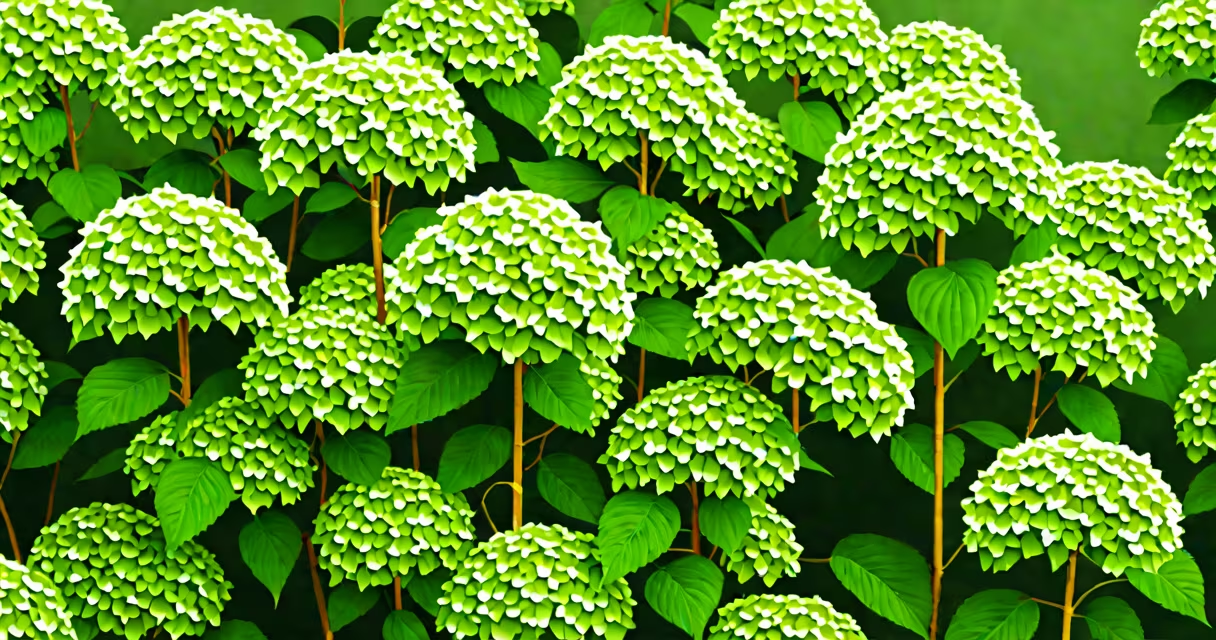
Hydrangea trees refer to upright, shrub-like forms of hydrangea that grow with a single trunk and a rounded canopy, resembling small trees. These are typically cultivars of bigleaf (Hydrangea macrophylla) or oakleaf (Hydrangea quercifolia) hydrangeas trained to develop a woody stem structure.
Unlike true trees, hydrangea trees are woody shrubs that grow 6 to 10 feet tall with a single central trunk. They bloom in late spring to early summer, producing large clusters of flowers in shades of pink, blue, white, or purple depending on soil pH and variety. The term "hydrangea tree" is often used interchangeably with "tree-form hydrangea," though it's not a botanical classification.
These plants thrive in partial shade, well-draining soil, and consistent moisture. They are popular in landscapes for their showy blooms and architectural form. The most widely grown types are bigleaf and oakleaf hydrangeas trained into tree shapes through pruning and staking.
Hydrangea trees are created by selecting a vigorous shoot from a standard hydrangea plant and training it to grow vertically. Gardeners cut back lateral branches and guide the main stem upward using stakes. Over time, the stem thickens and develops bark, mimicking a tree trunk.
Flowers form on old wood (last year's growth) in bigleaf hydrangeas and on new wood in oakleaf types. This difference affects pruning timing. Pruning too late in the season removes flower buds and reduces blooming. Proper timing prevents damage and maintains flowering performance.
Soil pH influences flower color in bigleaf hydrangeas. Acidic soil (pH below 5.5) produces blue flowers; neutral to alkaline soil (pH above 6.0) results in pink blooms. White flowers remain unchanged regardless of pH. Gardeners adjust soil pH with aluminum sulfate (to lower pH) or lime (to raise it).
The two primary types of hydrangea trees are bigleaf and oakleaf. Each has distinct foliage, flower structure, and growing requirements.
| Type | Foliage | Flower Shape | Bloom Time | Hardiness Zone | Common Varieties |
|---|---|---|---|---|---|
| Bigleaf (H. macrophylla) | Large, glossy leaves; oval to heart-shaped | Round mophead or lacecap clusters | June to August | 5-9 | 'Nikko Blue', 'Endless Summer', 'Blue Wave' |
| Oakleaf (H. quercifolia) | Deeply lobed, oak-like leaves; turns red in fall | Flat, cone-shaped clusters | July to September | 5-9 | 'Pee Wee', 'Alice', 'Snowflake' |
Bigleaf hydrangeas are known for their dense, spherical flower heads. The 'Endless Summer' series blooms on both old and new wood, allowing for repeat flowering even if winter kills the previous year's growth. This makes it ideal for colder climates.
Oakleaf hydrangeas have distinctive, deeply lobed leaves that resemble oak leaves. They turn rich burgundy in autumn, adding seasonal interest. Their flowers start pale green and mature to creamy white, lasting six weeks or longer.
A lesser-known type is the panicle hydrangea (Hydrangea paniculata), which grows as a true shrub but can be trained into a tree form. Its large, cone-shaped flowers appear in late summer and fade to tan. While not typically called a "hydrangea tree," it's sometimes used in field design for its size and longevity.
Hydrangea trees are planted in residential gardens, public parks, and commercial landscapes for their ornamental value. They serve as focal points in borders, near patios, or under trees where they receive dappled sunlight.
They are especially effective in shaded areas where few flowering plants thrive. A single hydrangea tree can provide four seasons of interest: spring leaf emergence, summer blooms, fall color (especially oakleaf), and winter structure.
In urban settings, hydrangea trees contribute to biodiversity. They attract pollinators such as bees and butterflies during bloom. According to the National Gardening Association, native species like oakleaf hydrangea support local insect populations better than non-native ornamentals.
Many assume all hydrangea trees are blue or pink. This is incorrect. Flower color depends on variety and soil conditions. For example, 'Snowflake' oakleaf hydrangea produces pure white flowers regardless of soil pH.
Another misconception is that hydrangea trees require full sun. Most types prefer morning sun and afternoon shade. Full sun in hot climates causes leaf scorch and reduced blooming. The USDA notes that excessive direct sunlight leads to water stress and flower drop in bigleaf hydrangeas.
Some gardeners mistake young hydrangea trees for diseased plants due to leaf curl or spotting. These symptoms are often caused by improper watering or fungal infection, not natural development. Healthy hydrangea trees do not naturally shed leaves in summer unless stressed.
Consider a homeowner in zone 7 planting a 'Nikko Blue' bigleaf hydrangea tree. The plant stands 8 feet tall with a single trunk about 2 inches in diameter. Leaves are large, dark green, and slightly wavy at the edges. In mid-June, it produces large, round clusters of deep blue flowers.
By July, the blooms begin to fade. The gardener notices the plant is not flowering again. This is normal. Bigleaf hydrangeas bloom only once per season on old wood. Pruning in late summer would remove next year's buds. The correct approach is to prune only dead or damaged branches in early spring.
Soil testing reveals a pH of 5.2. This explains the blue flowers. If the homeowner wanted pink blooms, they'd need to raise the pH to 6.0 or higher using lime. A 1-pound application per 100 square feet of soil is recommended, applied in fall and watered in.
After three years, the trunk has developed a light gray bark texture. The plant remains healthy and continues to produce abundant blooms annually. This demonstrates how proper selection and care maintain the tree-like form and flowering performance.
For gardeners seeking a low-maintenance, visually striking plant, hydrangea trees offer long-term beauty with minimal upkeep. The combination of showy flowers, seasonal foliage changes, and structural presence makes them a staple in temperate gardens.
Understanding the differences between bigleaf and oakleaf types ensures successful planting and care. Always check hardiness zones and bloom habits before purchasing. Many nurseries label tree-form hydrangeas, but verifying the species avoids mismatched expectations.