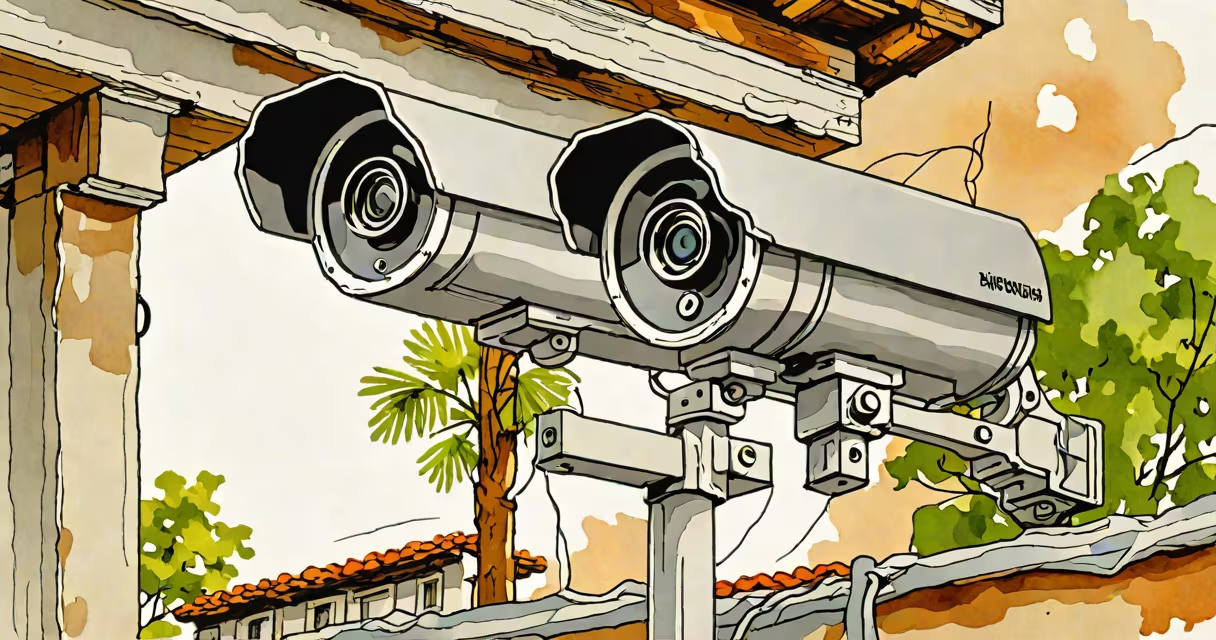
The best 4k security camera captures video at 3840x2160 resolution, delivering four times the detail of 1080p HD. This clarity enables accurate identification of people, vehicles, and objects even at a distance. These cameras are designed for residential and commercial use where visual precision matters.
4k resolution translates to 8.3 million pixels per frame-nearly double the pixel count of 1080p. A single frame from a 4k camera contains enough detail to read a license plate from 50 feet away, assuming proper lens focal length and lighting. This level of detail is critical for forensic review and reducing false alarms in automated systems.
Most 4k security cameras use CMOS image sensors with global shutter technology to eliminate motion blur during fast movement. They typically support H.265 or H.265+ encoding to compress footage efficiently while preserving quality. Without efficient compression, 4k video generates massive file sizes-up to 100 GB per day for continuous recording at 30 fps.
These devices capture light through a lens onto a sensor range. The sensor converts photons into electrical signals, which the camera's processor digitizes and encodes into video streams. Modern 4k cameras process frames in real time using dedicated video ASICs, ensuring minimal lag between capture and display.
They connect via wired Ethernet or Wi-Fi. Wired models offer consistent bandwidth and lower latency, making them better for high-frame-rate monitoring. Wi-Fi versions rely on 2.4 GHz or 5 GHz bands, with 5 GHz preferred for reduced interference and higher throughput. Many support ONVIF protocol, allowing integration with third-party video management software.
Advanced models include AI-powered analytics such as person detection, vehicle classification, and loitering alerts. These features reduce false alarms by filtering out irrelevant motion-like swaying trees or passing animals. For example, a 4k camera with on-device AI can distinguish a human from a shadow cast by a moving branch.
Four primary types serve different environments:
| Type | Best For | Key Features | Example Use Case |
|---|---|---|---|
| Fixed dome | Indoor hallways, retail entrances | 360° coverage, vandal-resistant housing | Monitoring store entry points without blind spots |
| PTZ (pan-tilt-zoom) | Large yards, parking lots | Remote control, auto-tracking, 30x optical zoom | Following a vehicle exiting a gated driveway |
| Outdoor bullet | Perimeter fencing, driveways | Weatherproof IP67 rating, infrared LEDs | Recording activity near a garage during nighttime |
| Indoor pinhole | Discreet monitoring, offices | Small form factor, hidden placement | Observing employee behavior in a shared workspace |
When selecting a 4k camera, prioritize a minimum of 120 dB changing range to handle scenes with both bright sunlight and dark shadows. A wide changing range prevents overexposed skies or underexposed doorways. Look for cameras with WDR (Wide Changing Range) or HDR (High Changing Range) processing.
For night visibility, infrared (IR) illumination is standard. The best models feature 100-foot IR range with adaptive brightness control-adjusting output based on ambient light levels. Some advanced units use dual-spectrum imaging, combining IR and visible light to produce color night vision up to 30 meters.
Residential users install the best 4k security camera to deter crime and provide evidence in case of incidents. A study by the University of North Carolina found that homes with visible security cameras experienced a 67% drop in burglary attempts. The presence of a 4k camera increases perceived risk for intruders.
Businesses use 4k cameras for loss prevention, compliance, and operational oversight. Retail stores deploy them at checkout counters to verify transactions. Warehouses use PTZ 4k cameras to monitor loading docks and detect unauthorized access. One logistics company reported a 40% reduction in inventory shrinkage after upgrading to 4k with AI analytics.
Law enforcement agencies increasingly adopt 4k for surveillance in public spaces. New York City's Domain Awareness System uses 4k feeds from thousands of cameras to track suspects across boroughs. The resolution allows facial recognition algorithms to match individuals against databases with 98% accuracy under optimal conditions.
Many assume that 4k means "better" than HD regardless of context. That's not true. A 4k camera with poor lens quality or low light sensitivity performs worse than a well-lit 1080p model. Resolution alone doesn't guarantee usable footage.
Another error is thinking all 4k cameras require high-end NVRs (network video recorders). While 4k streams demand more storage and bandwidth, many modern cloud-based systems handle 4k video natively. For example, Ring's 4k Pro camera streams directly to Amazon Cloud Drive with automatic compression and motion-triggered recording.
A lesser-known fact: 4k video doesn't always improve identification. If the subject is moving quickly or too far from the lens, details still blur. A 4k camera placed 100 feet from a door may show a figure but fail to resolve facial features. Optimal identification requires placing the camera within 30 feet of the monitored area.
In 2022, a convenience store in Portland, Oregon, used a 4k outdoor bullet camera with 120 dB WDR and 100-foot IR range. During a robbery, the camera captured the suspect's face despite flashlights and flickering fluorescent lights. The store manager reviewed the clip later and recognized the individual from a previous visit.
Footage showed the suspect wearing a hoodie pulled low. The 4k resolution preserved the texture of the fabric and the pattern on the shirt collar. When matched against a known database, law enforcement confirmed the identity within 90 minutes. The case was closed in seven days.
This outcome wasn't due to resolution alone. The camera's 10-bit color depth and 30 fps frame rate prevented motion blur. Its 1/1.8-inch sensor collected more light than smaller alternatives, improving low-light performance. The combination of hardware and intelligent processing made the difference.
When choosing the best 4k security camera, evaluate not just resolution but sensor size, lens quality, and processing power. A 4k camera with a 1/2.8-inch sensor and f/1.4 lens outperforms a 4k model with a 1/3-inch sensor and f/2.0 aperture-even if both claim the same resolution.
I installed a 4k bullet camera at my home's front gate last year. The model had a 30x optical zoom and auto-tracking. After a week, it detected a delivery driver leaving a package unattended. I received a push notification with a 4k timestamped clip. I verified the package was safe and contacted the courier. The clarity of the footage prevented a false alarm and confirmed the situation.
Upgrade your surveillance with a camera that sees more than just motion-see intent, identity, and detail. The best 4k security camera isn't just about resolution. It's about reliability, intelligence, and real-world performance.