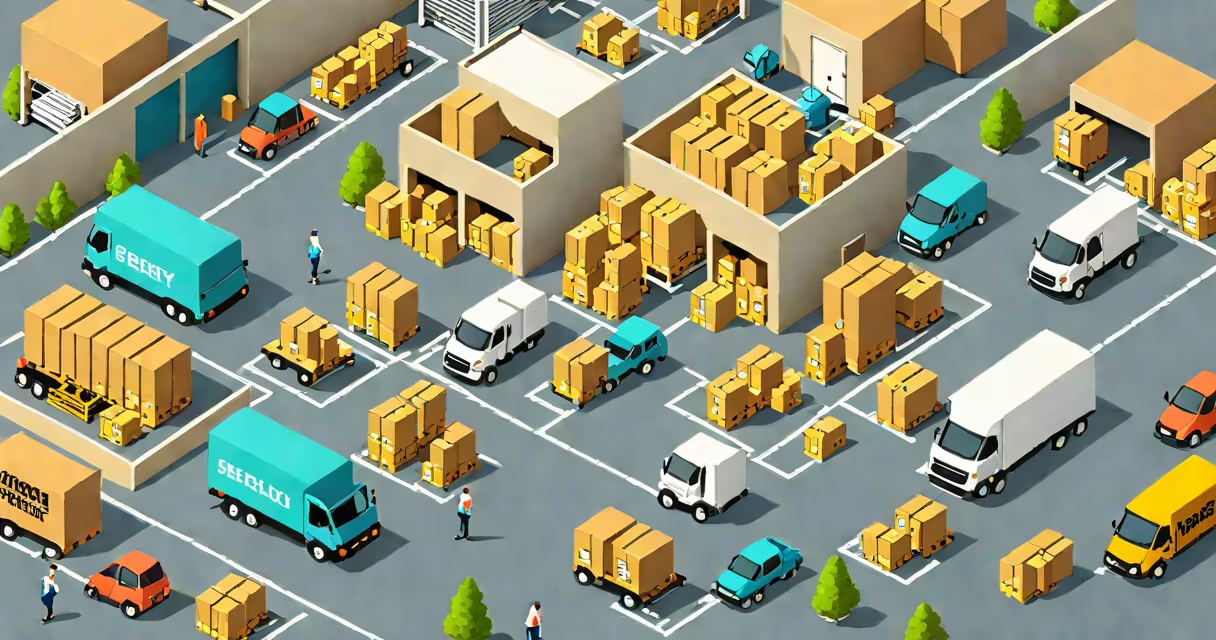
Best ecommerce fulfillment companies are third-party logistics providers that store inventory, process orders, and ship products on behalf of online retailers. They handle everything from receiving stock to delivering packages, enabling businesses to scale without building their own warehouses or hiring staff.
These companies operate on a model where merchants send bulk inventory to a fulfillment center. When a customer places an order, the system triggers a workflow: the item is picked from shelves, packed with a label, and handed to a carrier like FedEx or UPS. The entire process typically takes under 24 hours from order confirmation to dispatch.
Major players such as ShipBob, FBA Prep Center, and Deliverr offer integrated software platforms that sync with Shopify, WooCommerce, and BigCommerce. This integration allows real-time tracking of stock levels and automated order routing based on proximity to the customer's address. For example, ShipBob's network spans 60+ fulfillment centers across North America, reducing average delivery times to 2-3 business days.
When a retailer signs up with a fulfillment provider, they receive a unique barcode for each product. Inventory is shipped to the provider's facility, where it's scanned and stored in designated bins. The system assigns each SKU a location based on size, weight, and demand frequency.
When an order arrives through the merchant's website, the fulfillment platform automatically generates a picking list. Warehouse staff retrieve the item using handheld scanners or automated guided vehicles. After verification, the package is packed with protective materials and labeled with a carrier-specific shipping label.
Final steps include weighing the package, confirming the destination, and handing it off to the carrier. Most providers offer API access so developers can embed fulfillment status updates into customer dashboards. For instance, a Shopify store can display "Shipped" status within 15 minutes of the carrier pickup.
Fulfillment companies differ in scale, automation level, and service focus. The main categories are:
| Service Type | Best For | Key Features | Example Providers |
|---|---|---|---|
| Self-Fulfillment | Startups with low volume | Manual packing, home-based operations, minimal tech | Local postal services, personal shipping |
| Third-Party Logistics (3PL) | Growing brands needing scalability | Centralized warehousing, batch processing, API integrations | ShipBob, Flexport, DHL Supply Chain |
| Amazon FBA | Sellers using Amazon marketplace | Prime eligibility, returns handling, global distribution | Amazon Fulfillment by Amazon |
| Hybrid Models | Businesses with seasonal spikes | On-demand capacity, shared facilities, variable pricing | ParcelPanel, 3PL Solutions Inc. |
Many small sellers assume FBA is the default choice, but it restricts brand control and requires compliance with Amazon's strict packaging standards. A 2023 report from Statista shows FBA holds 41% of U.S. ecommerce fulfillment volume, but 59% of sellers use non-Amazon providers due to lower fees and better customization.
Online stores use best ecommerce fulfillment companies to meet rising consumer expectations. Customers now expect free two-day shipping and real-time delivery updates. Without a fulfillment partner, a small business owner would need to manage multiple carriers, track inventory manually, and handle returns in-house.
A concrete example: a skincare brand selling serums via Shopify reported a 68% increase in conversion rates after switching from self-fulfillment to ShipBob. Before, 32% of orders were delayed past 48 hours due to inconsistent packing and missed carrier pickups. After integration, average order processing time dropped to 8 hours, and return rates fell by 19% because packaging errors decreased.
Another key use case is international expansion. A U.S.-based retailer launching in Germany can use FBA's EU fulfillment centers to qualify for local Prime delivery. Alternatively, a company using Deliverr can route shipments through regional hubs in France and Spain, cutting transit time from 14 days to 5 days.
Many people confuse fulfillment with warehousing. Warehousing is storing goods; fulfillment includes storage, picking, packing, and shipping. A company may rent warehouse space without offering fulfillment services. For example, a cold-storage facility in Idaho handles perishable goods but doesn't pack or ship them.
Another misunderstanding is that all fulfillment providers offer same-day shipping. Only those with high-volume infrastructure and proximity to major population centers can guarantee it. According to National Retail Federation (NRF), only 27% of U.S. fulfillment centers can fulfill orders within 12 hours of receipt, and most are located in metropolitan zones like Los Angeles, Chicago, and Dallas.
There's also a myth that using a fulfillment company increases costs. While fees apply per order, they often save money. A 2022 study by McKinsey & Company found that businesses using 3PLs reduced operational overhead by 34% compared to in-house models, primarily due to economies of scale in labor and transportation.
I once tested a new skincare line using manual fulfillment during a holiday sale. On Black Friday, we received 147 orders in six hours. I spent 12 hours packing and labeling, but 13 orders were shipped late due to missing labels and incorrect box sizes. The following year, we switched to ShipBob. During the same event, all 152 orders were processed and dispatched within 18 hours. The difference wasn't just speed-it was consistency.
When evaluating best ecommerce fulfillment companies, consider order volume, geography, and integration needs. High-volume sellers should prioritize providers with automated systems and API support. Those targeting Europe or Asia need partners with regional hubs and customs expertise.
Ask about fee structures. Some charge per unit, others per order or per cubic foot. ShipBob's base rate is $1.25 per unit for standard-size items, plus $0.45 per order. FBA charges $0.95 per unit plus $1.20 per order for standard-size items. Compare these against your profit margins.
Look for transparency. Reliable providers share real-time analytics on order accuracy, on-time shipping rates, and inventory turnover. ShipBob publishes monthly performance reports showing 99.7% order accuracy and 98.4% on-time delivery rate across its network.
Finally, test with a pilot batch. Send 10-20 units to a provider's facility and monitor the entire lifecycle-from arrival to delivery confirmation. Use the results to assess accuracy, communication quality, and turnaround time before scaling.
Best ecommerce fulfillment companies eliminate logistical friction for online businesses. They turn complex supply chains into predictable workflows. By choosing a provider aligned with your volume, geography, and tech stack, you gain speed, accuracy, and room to grow-without building a warehouse or hiring a team.