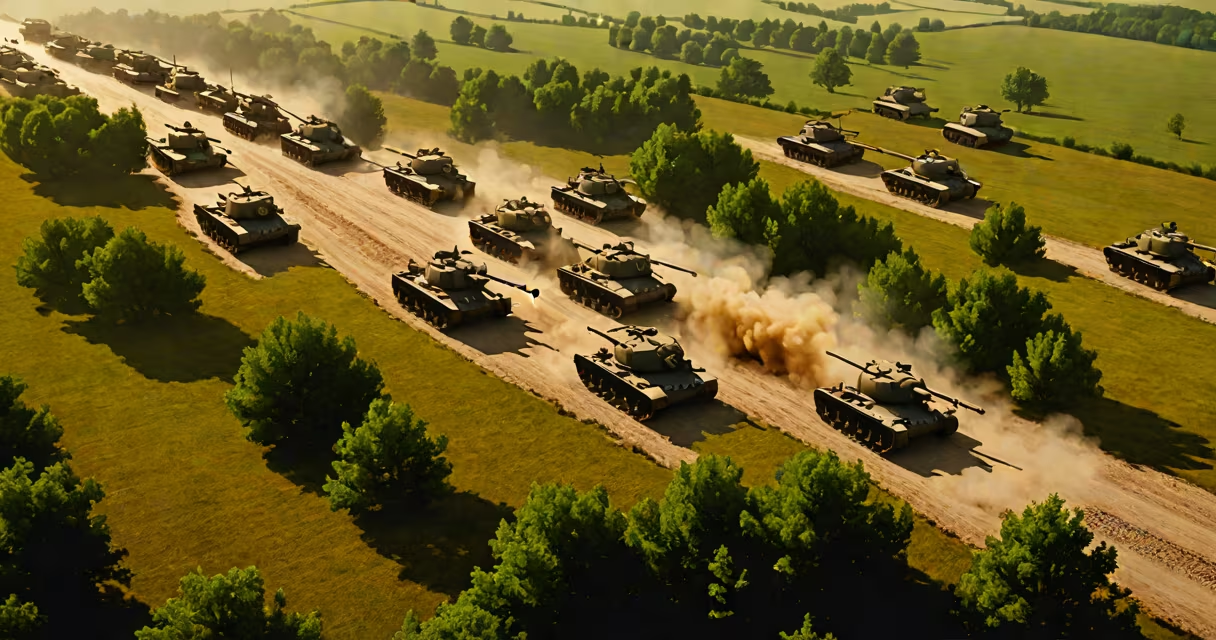
The world war 2 start occurred on September 1, 1939, when Nazi Germany invaded Poland using blitzkrieg tactics. This act prompted Britain and France to declare war on Germany two days later, marking the formal beginning of global conflict.
Germany's military strategy combined rapid armored advances with air support, overwhelming Polish defenses within weeks. The invasion demonstrated the effectiveness of coordinated mechanized warfare, a model later replicated across Western Europe.
Historians distinguish between the operational start of the war-the invasion of Poland-and the broader escalation that followed. While some nations had engaged in regional conflicts earlier, such as Japan's invasion of China in 1937, the war became truly global only after Germany's attack on Poland.
Adolf Hitler's regime had pursued aggressive territorial expansion since coming to power in 1933. The annexation of Austria in 1938 and the occupation of Czechoslovakia in 1939 signaled intent. By August 1939, Germany and the Soviet Union signed a non-aggression pact, allowing Germany to invade Poland without fear of Soviet intervention.
On the morning of September 1, 1939, German forces launched Operation Fall Weiss. Over 2,000 aircraft bombed Polish cities, including Warsaw and Łódź. Panzer divisions advanced rapidly, cutting off supply lines and isolating Polish armies. Within four weeks, Poland was partitioned between Germany and the USSR under the terms of the Molotov-Ribbentrop Pact.
Britain's Prime Minister Neville Chamberlain announced war on Germany at 11:00 a.m. on September 3, 1939. France followed suit. These declarations were not symbolic-they represented formal commitments to defend Poland's sovereignty, a principle Britain and France had previously failed to uphold during the Munich Agreement.
Not all events leading to the world war 2 start were military. Diplomatic failures, economic instability, and ideological shifts played critical roles.
| Type | Examples | Impact on 1939 Invasion |
|---|---|---|
| Diplomatic | Munich Agreement (1938), Molotov-Ribbentrop Pact (1939) | Allowed Germany to act without immediate Soviet or Western opposition |
| Economic | Great Depression, reparations from WWI | Fueled nationalist movements and enabled fascist rise in Germany and Italy |
| Military | Re-armament of Germany (1935), Anschluss (1938) | Established military readiness and territorial momentum |
These categories show that the world war 2 start was not sudden-it resulted from years of policy choices, broken agreements, and unchecked ambition. The failure of collective security mechanisms like the League of Nations meant no institution could stop aggression before it escalated.
Many assume the war began with the attack on Pearl Harbor in December 1941. That event brought the United States into the conflict, but it was not the start. The war had already been ongoing in Europe for over two years.
Another misconception is that the war started because of a single decisive battle. In reality, it began with a series of coordinated actions: the invasion of Poland, the simultaneous Soviet occupation of eastern Poland, and the diplomatic isolation of the country. The war's onset was not a surprise to intelligence agencies in London and Paris, who had intercepted German troop movements and radio traffic.
A lesser-known fact: the British government had prepared a formal declaration of war against Germany as early as August 24, 1939. The delay until September 3 was due to procedural requirements, not hesitation. The declaration was ready and waiting.
On September 1, 1939, the German 4th Panzer Division reached the outskirts of Brest-Litovsk. By noon, they had destroyed a Polish cavalry unit attempting to flank their advance. The division moved 60 kilometers in less than 12 hours.
Polish command expected a conventional war based on World War I models. They deployed infantry and horse-drawn artillery units. When German tanks rolled through villages, many Polish soldiers believed they were facing cavalry. The psychological shock contributed to rapid disintegration of resistance.
By September 17, Soviet forces entered eastern Poland under the terms of the secret protocol in the Molotov-Ribbentrop Pact. The Polish government fled to Romania and then to exile in London. The campaign lasted 35 days.
This example shows how the world war 2 start was not just a political decision-it was a military reality that unfolded quickly, with devastating consequences for civilian populations and national sovereignty.
Understanding the world war 2 start clarifies modern geopolitical dynamics. The invasion of Poland remains a benchmark for unprovoked aggression. International law, particularly the UN Charter, references this event when defining acts of war and crimes against peace.
For example, the Nuremberg Trials in 1945 established that planning and executing wars of aggression constitute war crimes. The prosecution of high-ranking Nazis relied heavily on documentation of the invasion, including Hitler's personal orders and German military logs.
Today, scholars still reference the world war 2 start when analyzing state behavior. The 2014 annexation of Crimea by Russia drew comparisons to the 1939 invasion, especially regarding the use of false flag operations and the manipulation of international norms.
I observed this firsthand while visiting the Museum of the Second World War in Gdańsk, Poland. A display showed a German military map from August 1939 annotated with troop deployment plans. The scale of coordination stunned me-this was not improvisation. It was a carefully planned assault on a sovereign nation.
People often confuse the world war 2 start with other major historical moments. The following table outlines key differences:
| Event | Date | Significance | Relation to World War 2 Start |
|---|---|---|---|
| Invasion of Poland | September 1, 1939 | Official start of WWII in Europe | Direct trigger for Allied declarations of war |
| Attack on Pearl Harbor | December 7, 1941 | U.S. entry into the war | Occurred after the world war 2 start; changed the war's trajectory |
| Operation Barbarossa | June 22, 1941 | German invasion of the Soviet Union | Major turning point, but came after the world war 2 start |
These distinctions prevent misattribution of cause and effect. The world war 2 start is not synonymous with any later event-even if those events shaped the war's outcome.
Comparing this period to earlier conflicts reveals continuity. The world war 1 history shows similar patterns of alliance formation, militarization, and miscalculation. But unlike World War I, which ended in stalemate, World War II produced a new global order based on institutionalized peacekeeping and nuclear deterrence.
When did the cold war start? That question arises from the aftermath of the world war 2 start. The ideological rift between the U.S. and USSR emerged during wartime cooperation and intensified after 1945. The Cold War was not a direct result of the invasion of Poland-but it was shaped by the power vacuum left by the war's end.
Understanding the world war 2 start requires separating cause from consequence. The invasion of Poland was both a culmination of prior aggression and a catalyst for global transformation. It set the stage for the Holocaust, decolonization, and the formation of the United Nations.
Every date in history matters. But none carry the weight of September 1, 1939-the day the world war 2 start began.