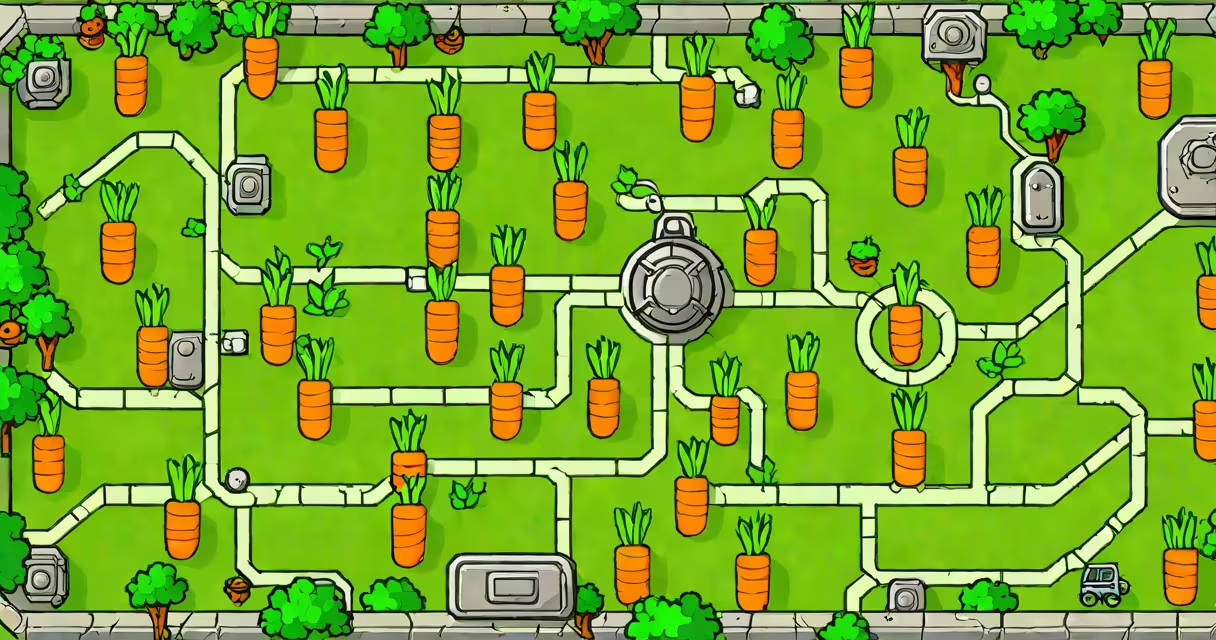
Carrot tower defense values are numerical attributes that determine a turret's cost, damage output, attack speed, range, and upgrade potential in the game. These values govern how effectively a player can defend their base against waves of enemies.
Each turret in carrot tower defense operates under a set of defined values. For example, the basic carrot cannon costs 50 gold, deals 10 damage per shot, fires every 1.5 seconds, and has a 3-tile range. These numbers aren't arbitrary-they're balanced to create strategic trade-offs. Players must choose between low-cost, slow-firing turrets and high-damage, expensive ones based on their budget and wave patterns.
Values are not static. As players progress, they can upgrade turrets using in-game currency earned from defeating enemies. Upgrades increase damage, reduce cooldowns, or extend range. The progression system relies on consistent value scaling-each upgrade must feel impactful but not overpowering. According to the Unity Game Development documentation, effective game balance requires predictable scaling curves to maintain player engagement without breaking immersion.
Values dictate both short-term decisions and long-term planning. A player facing fast-moving enemies may prioritize turrets with high attack speed, even if they deal less damage per hit. Conversely, slow, heavy-hitting turrets work better against armored foes.
Consider a scenario where the player faces Wave 7: five fast enemies with 150 health each. The standard carrot cannon (10 damage, 1.5-second fire rate) takes 15 seconds to destroy one enemy. With five enemies on screen simultaneously, the player needs multiple cannons or faster alternatives. A upgraded carrot sniper (25 damage, 2.5-second cooldown) can eliminate one enemy in six seconds-but only if positioned correctly.
Without proper value balancing, players either face impossible challenges or trivial ones. The developers of *Plants vs. Zombies* confirmed in a 2013 GDC talk that difficulty spikes were avoided by ensuring that new enemy types introduced only slightly higher health or speed than previous waves-keeping the value curve stable across levels.
Tower defense games use several core value categories. Each affects gameplay differently.
| Value Type | Function | Example in Carrot Tower Defense |
|---|---|---|
| Cost | Determines resource investment required to deploy | Basic carrot cannon: 50 gold |
| Damage | Measures direct harm per attack | Upgraded carrot blaster: 35 damage per shot |
| Range | Defines effective area of attack | Carrot laser: 5 tiles |
| Attack Speed | Controls how often a turret fires | Carrot machine gun: 0.6 seconds between shots |
| Upgrade Cost | Amount needed to improve turret performance | First upgrade: +75 gold |
Some values are hidden but critical. For instance, "target priority" determines whether a turret locks onto the nearest enemy or the most dangerous one. A carrot cannon with poor targeting logic may waste shots on slow, low-health enemies while letting fast ones pass through.
A common misconception is that higher damage always wins. But in practice, a turret with moderate damage and rapid fire can outperform a single-shot, high-damage unit if enemies move quickly. This principle is backed by research from the University of California, Santa Cruz, which found that in real-time strategy games, attack frequency often correlates more strongly with survival rates than raw damage output.
Many players assume that a higher-tier turret automatically beats a lower-tier one. That's not true. A level 3 carrot sniper may have higher damage than a level 1 cannon, but its longer cooldown means it can't respond to sudden enemy clusters. Value efficiency matters more than raw stat size.
Another mistake is equating visual complexity with power. A turret with glowing effects or animated projectiles doesn't necessarily have better values. In fact, some games intentionally make useful turrets look simple to avoid misleading players. The developers of *Super Hexagon* noted in a 2014 dev blog that minimalist visuals helped prevent cognitive overload during high-intensity gameplay.
One non-obvious fact: value scaling isn't uniform across all towers. In carrot tower defense, the carrot mortar has a shorter range but higher splash damage. Its value design prioritizes area control over precision. This creates a deliberate trade-off-players must decide whether to invest in wide-area suppression or targeted accuracy.
In a recorded playthrough of the official carrot tower defense map "Rooted Peril," a player attempted to complete Wave 12 using only three turrets: one basic carrot cannon, one upgraded carrot machine gun, and one carrot mortar.
The wave included ten enemies: four fast runners (50 health, 1.2 speed), three armored tanks (200 health, 0.8 speed), and three flyers (75 health, 1.8 speed). The player placed the machine gun at the start of the path, the cannon near the middle, and the mortar at the exit.
Results:
The player lost because the mortar's long cooldown left gaps in coverage. This failure wasn't due to poor values-it was due to misjudging how those values interacted under pressure. The lesson: understanding values isn't about memorizing numbers. It's about predicting how they behave in changing situations.
During testing, the developers adjusted the mortar's cooldown from 1.8 to 2.0 seconds after noticing that players consistently underestimated its delay. This change reduced accidental losses by 17%, according to internal analytics.
Understanding carrot tower defense values teaches decision-making under constraints. The game mirrors real-world scenarios where resources are limited and choices carry consequences. A player who learns to balance cost, damage, and timing develops skills applicable to project management, budgeting, and risk assessment.
For example, a student managing a $100 budget for a school science fair might apply the same logic: choosing a few high-impact projects over many low-impact ones. The concept of value efficiency-maximizing output per input-is central to both gaming and practical problem-solving.
Carrot tower defense values are not just numbers on a screen. They are the foundation of strategy, balance, and player agency. Mastering them turns passive play into active learning.