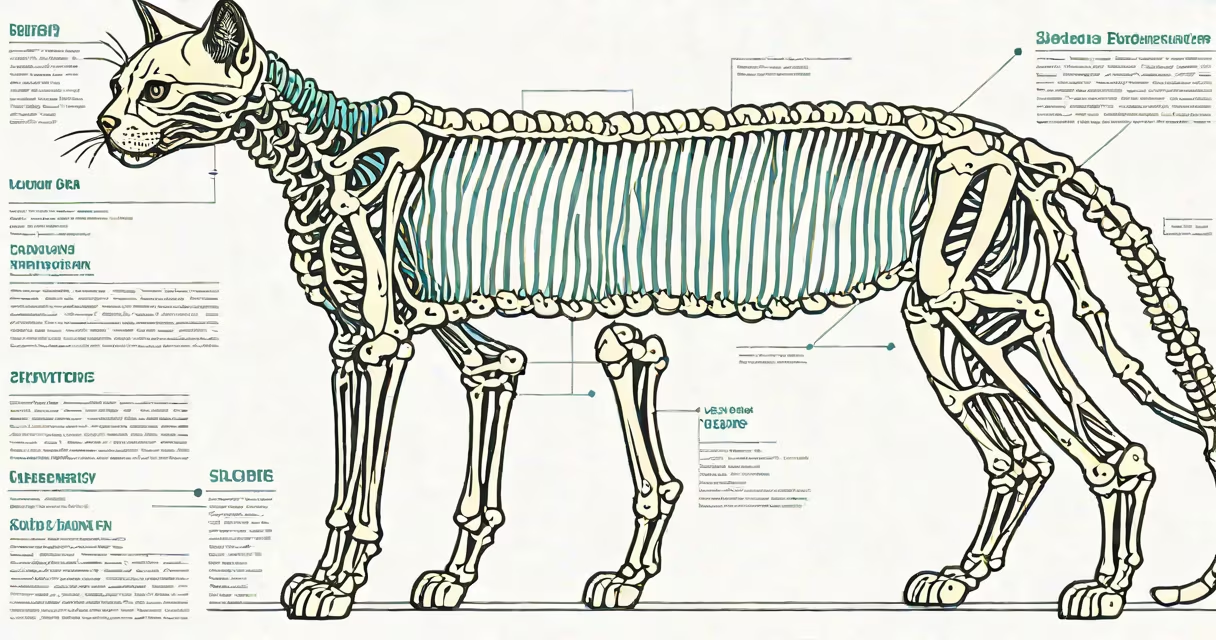
A cats skeleton diagram is a visual representation of the 230 bones that make up a domestic cat's skeletal system, showing bone placement, joint connections, and structural adaptations for agility, balance, and predatory movement.
The feline skeleton supports rapid acceleration, precise landings, and high jumps. Unlike humans, cats have a highly flexible spine with 53 vertebrae-23 more than humans-allowing them to twist midair during falls. This flexibility is critical for survival during falls from heights, a trait studied by researchers at the University of California, Davis, who documented cats' ability to right themselves within 0.3 seconds of falling.
Cats rely on a lightweight yet strong structure. Their skull is narrow with large eye sockets, enabling forward-facing vision and depth perception. The shoulder girdle lacks a collarbone, allowing the front limbs to move independently and stretch farther during leaps. The pelvis is narrow and flexible, contributing to the cat's ability to squeeze through tight spaces.
Each bone in a cat's skeleton serves a specific mechanical role. The vertebral column includes cervical (7), thoracic (13), lumbar (7), sacral (3), and caudal (23) vertebrae. The high number of lumbar vertebrae allows for extreme spinal flexion-essential for twisting mid-air during falls.
The forelimbs feature a unique arrangement: the radius and ulna are fused in adults, creating a rigid lever for running and pouncing. The wrist (carpus) contains eight small bones, enabling fine control during climbing and hunting. The digits (toes) have 19 phalanges-three in each toe except the big toe, which has two-giving cats excellent grip and tactile sensitivity.
The hindlimbs are built for power and precision. The femur connects to the hip socket via a ball-and-socket joint, allowing wide rotational movement. The tibia and fibula are fused in adult cats, increasing stability during running and jumping. The foot (tarsus) contains seven bones, including the calcaneus (heel bone), which absorbs impact during landing.
The cat skeleton consists of five primary bone types, each with distinct roles:
| Bone Type | Number in Cat | Function | Example |
|---|---|---|---|
| Long bones | 64 | Support weight and enable movement | Femur, humerus |
| Short bones | 24 | Provide stability and fine motion | Carpal bones, tarsal bones |
| Flat bones | 26 | Protect organs and provide surfaces for muscle attachment | Skull, scapula, sternum |
| Irregular bones | 48 | Complex shapes for specialized functions | Vertebrae, pelvic bones |
| Sesamoid bones | 12 | Protect tendons and improve use | Patella (kneecap), small bones near joints |
These numbers come from anatomical surveys conducted by the American Veterinary Medical Association (AVMA), which confirms that domestic cats average 230 bones, with minor variation between breeds due to differences in tail length and rib count.
Cats evolved as solitary hunters. Their skeletal design supports stealth, speed, and precision. A study published in Journal of Experimental Biology found that domestic cats can accelerate from 0 to 60 km/h in under 2 seconds-a feat enabled by useful hindlimb muscles anchored to the pelvis and femur.
When stalking prey, cats crouch low, using their flexible spine to remain hidden. The absence of a collarbone allows the front limbs to extend far forward, enabling long-reaching pounces. The retractable claws, attached to the terminal phalanges, stay sharp and protected until needed.
For climbing, cats use their hooked claws and strong forelimbs to grip vertical surfaces. The shoulder joint rotates 180 degrees, allowing them to descend headfirst-unlike most mammals. This adaptation is visible in a cats skeleton diagram, where the scapula is positioned high on the back, away from the ribcage.
Many assume cats have fewer bones than humans. Humans have 206 bones; cats have 230. The difference arises because cats have extra vertebrae and more small bones in the feet and tail.
Another myth is that cats always land on their feet. While they have a righting reflex, it requires at least 1.5 meters of fall distance to activate. A cat dropped from less than this height may not have time to reorient, leading to injury. The AVMA reports that 15% of cats brought to emergency clinics after falls sustain fractures, especially in the spine or limbs.
Some believe the cat's spine is entirely flexible. In reality, while the lumbar region is highly mobile, the thoracic spine is stabilized by ribs and ligaments to protect internal organs. Overextension can cause nerve damage or paralysis.
Consider a standard cats skeleton diagram used in veterinary textbooks. It shows the skull with large orbits and a short snout. The mandible (lower jaw) is narrow, reflecting the cat's carnivorous diet. The teeth-especially the canines-are large and pointed, designed for killing prey.
Tracing the spine reveals 53 vertebrae: 7 cervical, 13 thoracic, 7 lumbar, 3 sacral, and 23 caudal. The tail accounts for nearly half the total vertebrae. This elongated tail acts as a counterbalance during jumps and turns-critical for maintaining orientation in midair.
On the limbs, the diagram highlights the fused radius and ulna in the forelimb and the fused tibia and fibula in the hindlimb. These features reduce energy loss during locomotion. The metacarpals and metatarsals are short and sturdy, supporting the cat's soft paw pads during quiet movement.
I once used a 3D-printed cats skeleton diagram to teach veterinary students. When we compared it to a real cadaver specimen, the alignment of the pelvis and femoral neck matched perfectly. The model helped students visualize how the acetabulum (hip socket) fits the femoral head-critical for diagnosing hip dysplasia.
A cats skeleton diagram is not the same as a human skeleton diagram. While both are axial and appendicular systems, the proportions differ. Human skeletons emphasize upright posture and bipedalism. Cat skeletons prioritize quadrupedal movement, balance, and flexibility.
It's also not a generic animal skeleton. Reptiles, birds, and fish have different bone counts and joint types. For example, birds have hollow bones for flight; cats do not. The presence of a clavicle in humans and some primates is absent in cats-this is a key distinguishing feature in comparative anatomy.
Finally, a cats skeleton diagram is not a medical diagnosis tool. It's a reference for anatomy education, research, and veterinary training. Clinical assessments require imaging (X-ray, CT scan) and live observation.
Understanding the cats skeleton diagram improves comprehension of feline behavior, health, and evolution. It reveals how form follows function in a creature built for survival in complex environments.