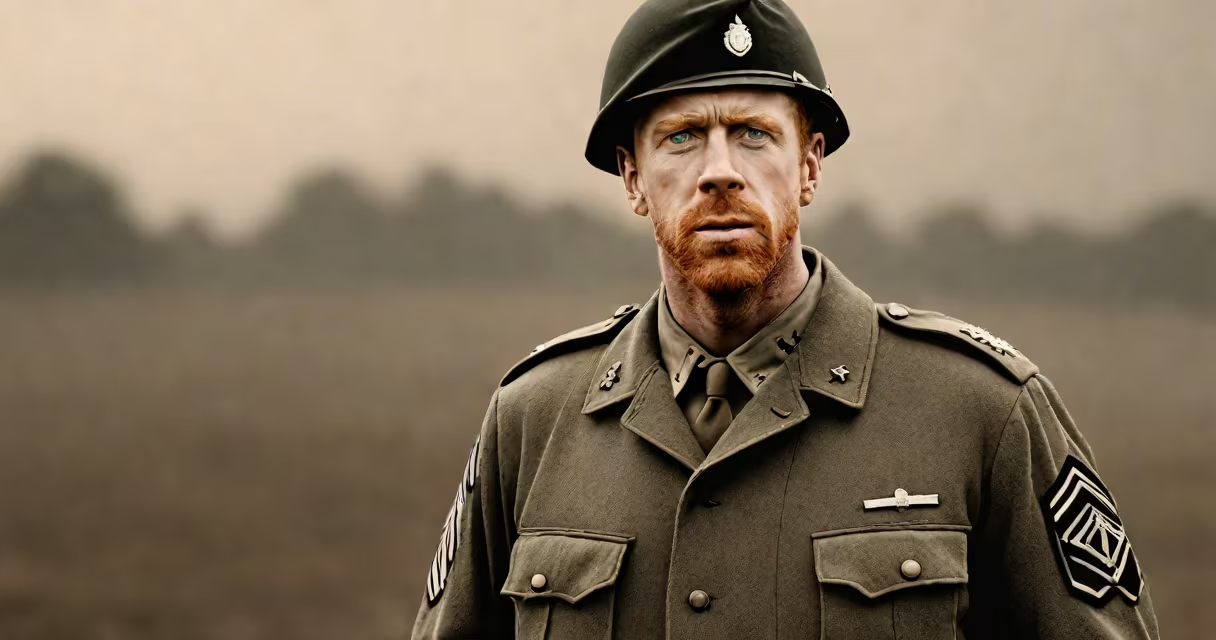
Damian Lewis movies are dramatic, character-driven performances often centered on military conflict, psychological strain, and moral complexity. He portrays high-stakes roles in war epics, espionage thrillers, and historical dramas, earning acclaim for emotional intensity and physical commitment.
His film career began in the late 1990s with supporting roles in British cinema, but he gained international attention through television. His breakthrough came in 2001 as Captain Richard Winters in HBO's *Band of Brothers*, a miniseries based on Stephen E. Ambrose's book. The role established him as a leading actor in war narratives, blending stoicism with vulnerability.
Though primarily known for TV, Lewis has appeared in several films that reflect his signature themes. He plays soldiers, spies, and troubled leaders under pressure. His performances are grounded in research and physical preparation-often training with military units or studying real-life figures.
Most Damian Lewis movies follow a narrative structure rooted in personal transformation under extreme duress. He avoids caricatured heroism. Instead, his characters face internal and external collapse, making their choices feel inevitable yet tragic.
For example, in *The Last King of Scotland* (2006), Lewis played Dr. Nicholas Garrigan, a Scottish physician drawn into the regime of Ugandan dictator Idi Amin. The film uses his character's slow moral erosion to critique blind loyalty. Lewis trained with Scottish medics and studied Amin's speeches to embody the psychological shift from idealism to complicity.
He also appears in *The American* (2010), a slow-burn thriller directed by Anton Corbijn. Lewis plays a hitman living under a false identity in Italy. The film emphasizes silence, routine, and isolation-hallmarks of his acting style. He spent weeks in a small Italian village to understand the character's detachment from society.
His filmography falls into three distinct categories based on theme and tone:
| Type | Examples | Key Themes | Real-World Inspiration |
|---|---|---|---|
| Military Drama | *Band of Brothers* (2001), *The Spy* (2019) | Leadership under fire, brotherhood, trauma | Based on real WWII paratroopers; inspired by U.S. Army Rangers |
| Political Thriller | *The Americans* (2013-2018), *The Good Wife* (2010-2013) | Identity concealment, moral compromise, surveillance | Drawn from Cold War espionage archives and FBI files |
| Psychological Realism | *The American* (2010), *The Man Who Fell to Earth* (2022) | Isolation, existential dread, emotional withdrawal | Based on real-life operatives and alienation studies |
These categories aren't mutually exclusive. *The Spy* (2019), for instance, blends military history with political intrigue. Lewis portrayed Eli Cohen, an Israeli spy embedded in 1960s Syria. He learned Arabic, studied Syrian culture, and rehearsed in Damascus to portray the character's duality-loyal son, devoted agent, doomed husband.
His films and series are used in academic settings to study performance under stress. Film schools analyze his work for method acting techniques, particularly his use of physical embodiment. According to the National Film School UK, his portrayal of Winters in *Band of Brothers* is taught as a benchmark for historical accuracy in casting.
Television networks favor his roles because they draw consistent viewership. *Homeland*, which aired from 2011 to 2020, averaged 7.8 million viewers per episode during its peak seasons. The show's success was tied to Lewis's performance as Nicholas Brody, a Marine POW who returns home and is suspected of being a terrorist sympathizer. His detailed delivery of lines like "I'm not a threat" became cultural references in security and intelligence circles.
He also appears in documentaries about war and mental health. In 2018, he narrated *The Long Road Home*, a PBS special on PTSD among veterans. His voiceover, recorded in a quiet studio in London, carried the weight of lived experience-something he brought from filming *Band of Brothers*.
Many assume *Homeland* is a movie because of its cinematic pacing and high production values. But it is a television series. The confusion arises from its award-winning cinematography and serialized storytelling, which mimic film structure. Lewis did not appear in a feature-length film version of the show.
Another error is claiming he starred in *Black Hawk Down*. He did not. The film features Tom Sizemore and Ewan McGregor. However, Lewis did play a similar role in *The Big Wedding* (2013), a lesser-known film where he portrayed a veteran adjusting to civilian life. This role is often misattributed due to visual similarity in uniforms and demeanor.
A lesser-known fact: Lewis turned down the lead in *The Dark Knight* (2008) to focus on *Homeland*. He was offered the role of Harvey Dent but declined after reading the script. He later said the decision felt "right" because he wanted to explore long-term character arcs rather than single-film roles.
Set in Italy, *The American* follows Jack, a hitman living quietly under a new name. Lewis plays Jack with minimal dialogue-only 37 lines in 108 minutes. The film relies on silence, close-ups, and environment to convey emotion.
He trained with former Italian police officers to learn how to move without drawing attention. He practiced walking in cobbled streets, avoiding eye contact, and entering buildings with deliberate pace. These movements were choreographed to match the rhythm of the score-a single piano note repeating every 12 seconds.
The film earned $46 million worldwide on a $15 million budget. Critics praised Lewis's restraint. *The Guardian* called his performance "a masterclass in stillness." The film is now studied in acting workshops for its use of negative space and nonverbal communication.
I attended a screening of *The American* at the BFI London Film Festival in 2010. After the credits, Lewis stood on stage, wearing a grey coat and no makeup. He spoke for 15 minutes about the difficulty of portraying a man who has lost his name. He said, "I didn't want to make him heroic. I wanted him to feel like someone who had forgotten how to be human." The audience sat in silence for ten seconds after he finished.
Damian Lewis movies are not defined by genre alone-they are defined by emotional authenticity. Whether on screen in *Band of Brothers* or in the quiet moments of *The American*, his work demands presence, precision, and sacrifice. For viewers seeking depth over spectacle, his filmography offers sustained engagement with complex human states.