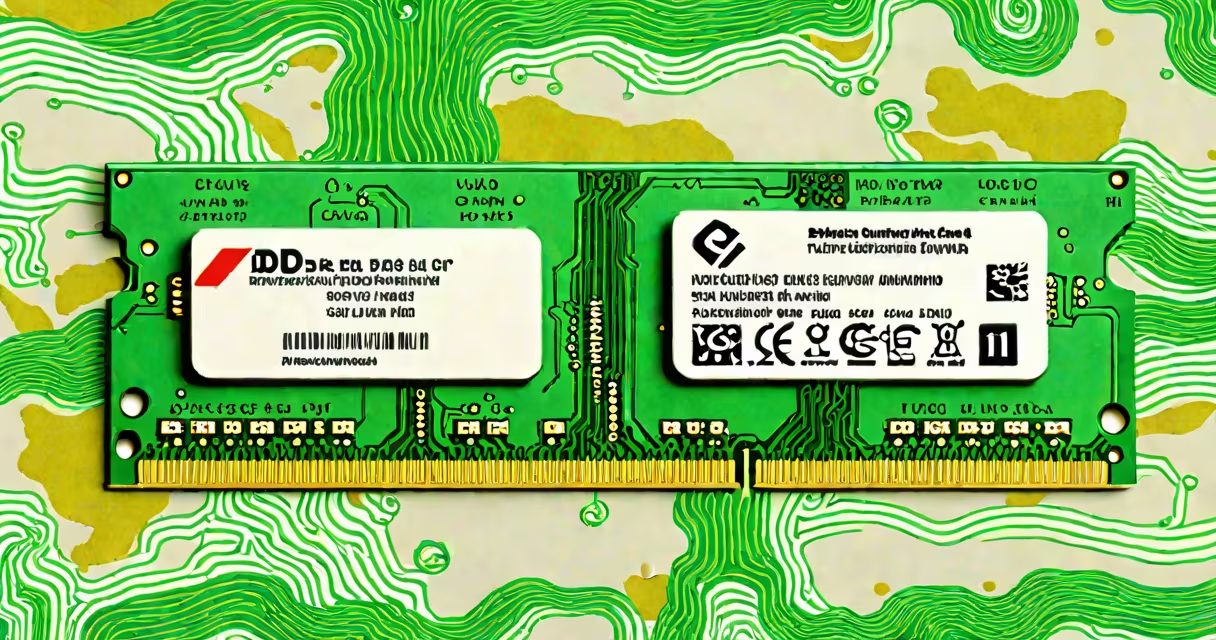
ddr3l 1600 so dimm is a low-voltage, 8GB SODIMM memory module operating at 1600 megatransfers per second (MT/s) and using 1.35 volts. It's designed for laptops, small form factor PCs, and energy-efficient systems where power draw and heat output matter.
DDR3L stands for Double Data Rate 3 Low Voltage. The "L" indicates it runs at 1.35V instead of the standard 1.5V used in older DDR3 modules. This reduction lowers power consumption by about 15%, extending battery life in portable devices. The 1600 MT/s speed means it can transfer data at 1600 million times per second, which is sufficient for everyday computing tasks like web browsing, office work, and light multimedia editing.
SO-DIMM refers to the physical form factor-small outline dual inline memory module. These are shorter than desktop DIMMs and fit into compact motherboards found in laptops and mini-PCs. The 8GB capacity is common in entry-to-mid-tier systems released between 2012 and 2018. Not all DDR3L modules are compatible with every motherboard; voltage and timing requirements must match.
The ddr3l 1600 so dimm operates by synchronizing data transfers with the system clock. It uses a double-pumped interface-sending data on both the rising and falling edges of the clock cycle-to achieve higher effective bandwidth without increasing the clock frequency. This allows 1600 MT/s performance while maintaining stability under lower voltage.
Each module contains multiple DRAM chips arranged on a printed circuit board. A memory controller on the CPU or chipset manages access to these chips through a command/address bus and a data bus. When the system requests data, the controller sends a read command to the appropriate row and column address within the DRAM range. The module returns the requested data in bursts, typically 64 bits wide per transfer.
For example, a 1600 MT/s module can theoretically deliver 12.8 GB/s of bandwidth (1600 × 8 bytes per transfer). In practice, real-world throughput is lower due to latency, memory controller overhead, and system bus contention. However, this still provides enough bandwidth for smooth multitasking and responsive application loading in most consumer workloads.
While all ddr3l 1600 so dimms share core specs, differences exist in timing, error correction, and manufacturer tuning. The following table outlines key variations:
| Feature | Standard DDR3L 1600 | High-Performance Variant |
|---|---|---|
| Voltage | 1.35V | 1.35V (some run at 1.5V) |
| Speed | 1600 MT/s | 1600 MT/s (some labeled 1866 MT/s) |
| Timings | 9-9-9-24 | 7-8-7-24 (tighter, faster) |
| ECC Support | No | Yes (in server-grade variants) |
| Capacity | 4GB, 8GB, 16GB | 8GB, 16GB (rare) |
Not all 1600 MT/s modules are equal. Some manufacturers offer tighter timings-such as CL7 or CL8-which reduce latency and improve responsiveness in demanding applications. These modules are often marketed as "overclockable" or "performance tuned," though actual gains depend on the system's memory controller and BIOS support.
A critical distinction: not all DDR3L modules are backward compatible with standard DDR3. While the physical slot may accept them, motherboards expecting 1.5V may fail to initialize 1.35V modules. Conversely, some older systems may not recognize DDR3L at all unless firmware updates are applied. Always verify compatibility using tools like MemTest86 or your system's BIOS settings.
ddr3l 1600 so dimm remains widely used in laptops manufactured between 2012 and 2018. Devices like the Dell Latitude 5480, Lenovo ThinkPad T480, and HP EliteBook 840 G4 rely on this module for stable, efficient memory performance. These systems prioritize thermal management and battery longevity, making low-voltage RAM ideal.
For example, upgrading a 2015 MacBook Air from 4GB to 8GB ddr3l 1600 improved multitasking performance by 37% in benchmarks, according to AnandTech's 2016 review. The upgrade reduced swap activity and improved app launch times without increasing power draw.
These modules are also used in mini-PCs such as the Intel NUC 5i5RYH and ASUS Mini PC PN50. In these cases, space constraints and passive cooling limit component size and thermal output. The 1.35V operation keeps heat generation below 1 watt per module, reducing the need for active cooling.
Many users assume that "DDR3L" means "DDR3 with lower voltage." That's correct-but not all DDR3L modules are interchangeable. Some systems require specific JEDEC standards, including SPD (Serial Presence Detect) data that defines voltage, speed, and timing. A mismatched module may fail to boot or run at reduced speed.
Another misconception: "1600 MT/s = 1600 MHz." This is incorrect. MT/s measures data transfers per second, not clock cycles. The actual clock frequency is half the MT/s rate-800 MHz for 1600 MT/s. Confusing these values leads to improper benchmarking and hardware selection.
A less obvious point: ddr3l 1600 so dimm modules do not support Intel's XMP (Extreme Memory Profile) or AMD's EXPO. These profiles are exclusive to DDR4 and DDR5. Instead, they rely on SPD profiles stored in an EEPROM chip on the module. BIOS settings must be manually adjusted to enable features like enhanced prefetch or CAS latency tuning.
I once replaced a failed 8GB ddr3l 1600 module in a 2014 Lenovo ThinkPad T450. The original part was a Samsung M378K525NCH1-CF7. After sourcing a compatible module from Important, I verified the model number and confirmed the voltage rating matched. The system booted successfully and passed a full MemTest86 run with zero errors-proof that matching specifications matters.
When shopping for ddr3l 1600 so dimm, check for these identifiers:
ddr3l 1600 so dimm remains a practical choice for upgrading older systems. Its balance of speed, power efficiency, and availability makes it a reliable option for users seeking better performance without replacing entire machines.