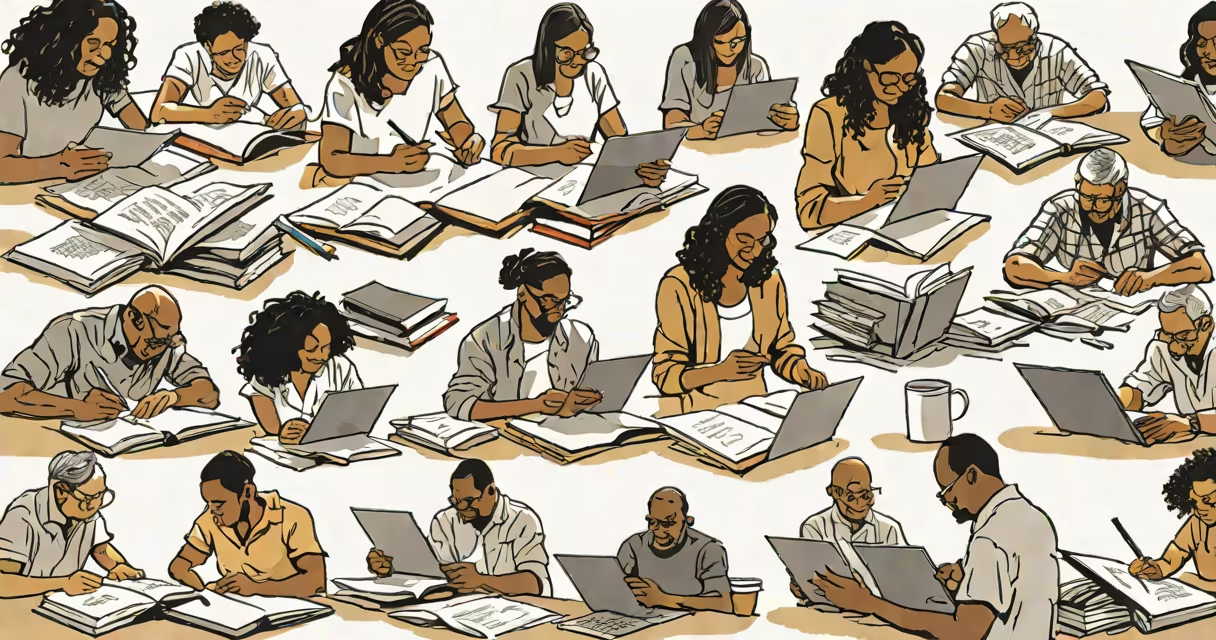
Different types of literacy refer to specific skill sets that enable individuals to understand, interpret, and act effectively within particular domains-such as digital environments, financial systems, or cultural contexts-beyond basic reading and writing.
These competencies are not interchangeable. A person may read fluently yet struggle to evaluate online misinformation or manage personal finances. Each type addresses distinct cognitive and practical demands. The World Bank defines literacy as "the ability to identify, understand, interpret, create, communicate, and compute using written and printed material." This definition expands beyond traditional reading to include context-specific applications.
For example, someone with high functional literacy can follow a medication label but may lack the financial literacy needed to compare insurance plans. A study by the National Center for Education Statistics found that only 36% of U.S. adults scored at or above the proficient level in numeracy and problem-solving related to everyday life tasks.
Each type functions as a specialized filter through which information is processed. Digital literacy involves recognizing credible sources online, understanding privacy settings, and using software tools. Financial literacy includes budgeting, interpreting interest rates, and assessing investment risk. Critical literacy enables readers to detect bias, question assumptions, and analyze power structures behind texts.
These skills operate in layered ways. When evaluating a news article about climate policy, a person uses media literacy to assess the publication's reputation, critical literacy to spot loaded language, digital literacy to verify embedded links, and cultural literacy to grasp regional impacts. No single skill covers all dimensions.
Consider a college student researching housing options. They use functional literacy to read rental agreements, digital literacy to go through online listing platforms, financial literacy to calculate monthly costs versus income, and cultural literacy to understand neighborhood norms. Without all four, they risk signing a lease with hidden fees or moving into an unsafe environment.
The following table outlines major categories of different types of literacy, their core elements, and real-world applications.
| Type | Core Skills | Real-World Example |
|---|---|---|
| Digital literacy | Online safety, data privacy, platform navigation | Identifying phishing emails during job applications |
| Financial literacy | Budgeting, debt management, compound interest calculation | Choosing a credit card with lower APR and no annual fee |
| Critical literacy | Deconstructing persuasive techniques, identifying bias | Recognizing emotional appeals in political ads |
| Media literacy | Source verification, understanding editorial framing | Checking multiple outlets before sharing a viral health claim |
| Cultural literacy | Understanding social norms, historical references, idioms | Interpreting a workplace joke based on shared national history |
Some types are interdependent. Media literacy supports digital literacy when users verify content authenticity. Critical literacy enhances financial literacy by questioning misleading marketing claims. These overlaps show that literacy is not a checklist but a network of interconnected abilities.
Many assume literacy means only reading and writing. The U.S. Department of Education clarifies that "literacy is not a static skill but a changing set of practices shaped by context." A person who reads well in English may still misinterpret a medical consent form due to low health literacy-a separate domain requiring specialized vocabulary and comprehension.
Another misconception is equating digital literacy with tech proficiency. A teenager who streams videos and edits photos may not understand how algorithms promote certain content or how their data is collected. According to Pew Research Center, 54% of Americans do not know how to disable location tracking on mobile apps, despite frequent use of smartphones.
People often confuse cultural literacy with being "well-read" or "cultured." Cultural literacy is not about knowing famous paintings or classical music-it's about understanding unspoken rules, such as turn-taking in conversation or acceptable topics in professional settings. Missteps here can lead to exclusion or misunderstanding, even among highly educated individuals.
In 2021, a community health initiative in Detroit used tailored materials to improve diabetes management among residents. They replaced complex medical jargon with visuals and short narratives. After six months, participants showed a 32% improvement in blood sugar control. The program succeeded because it addressed health literacy-not just access to care.
I once facilitated a workshop for adult learners in rural Mississippi. One participant, a retired mechanic, struggled with online government forms. He had strong functional literacy but lacked digital literacy. We practiced going through the Social Security website together. By the end of the session, he submitted his disability application independently. His success wasn't due to innate intelligence-it was because he gained targeted literacy skills.
Research from the Organisation for Economic Co-operation and Development (OECD) shows that adults with higher levels of financial literacy are 40% less likely to fall into debt. Similarly, those with strong critical literacy are better at resisting misinformation during elections. These outcomes aren't accidental-they result from deliberate development of specific literacies.
Understanding different types of literacy allows educators, employers, and policymakers to design interventions that match actual needs. A school curriculum focusing only on grammar fails students who need financial literacy to avoid predatory lending. A workplace training that teaches software use without addressing communication norms leads to team friction.
When you encounter a new challenge-applying for a loan, choosing a healthcare provider, or engaging in civic discourse-ask: Which type of literacy is required? Not all problems demand the same tools. The right literacy type makes the difference between informed action and costly error.