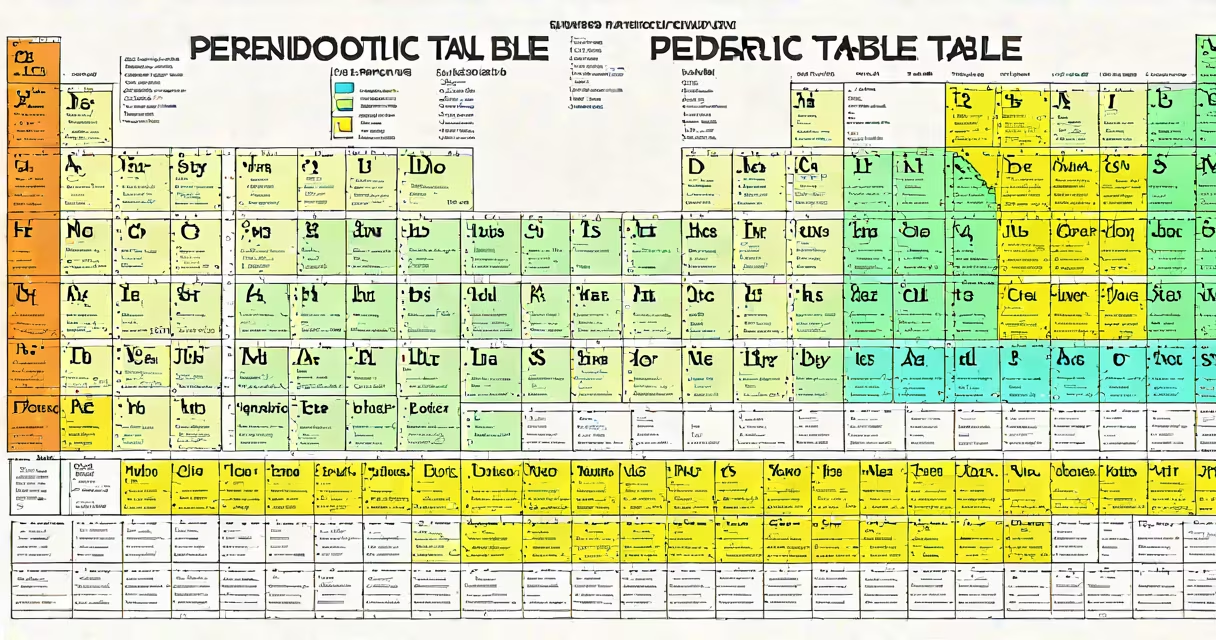
The eds periodic table is a simplified, educationally focused version of the standard periodic table of elements, emphasizing clarity, accessibility, and curriculum alignment for K-12 and introductory college science courses. It organizes elements by atomic number and groups them by chemical behavior, with annotations tailored to learning objectives.
Unlike the full scientific periodic table, which includes detailed isotopic data, electron configurations, and physical constants, the eds periodic table strips away complexity to show core concepts. It typically displays element symbols, atomic numbers, atomic masses, and group classifications (e.g., alkali metals, halogens, noble gases). This focus supports visual recognition and foundational understanding.
Developed by academic publishers and science educators, the eds periodic table aligns with national science standards such as the Next Generation Science Standards (NGSS) and Common Core State Standards. It appears in textbooks, classroom posters, and digital learning platforms to reinforce consistent terminology and structure across curricula.
Each element's position reflects its atomic number-the number of protons in the nucleus. Elements are arranged left to right and top to bottom in increasing atomic number. Rows are periods; columns are groups. Elements in the same group share similar chemical properties due to matching valence electron counts.
For example, lithium (Li, atomic number 3) sits in Group 1, the alkali metals. Its single valence electron makes it highly reactive. The eds periodic table explicitly labels this group and often includes icons or color codes to distinguish metal, nonmetal, and metalloid categories. This visual scaffolding helps students identify patterns without needing advanced theory.
Some versions include brief descriptors for key elements. For instance, hydrogen (H) may be labeled "lightest element" or "forms water with oxygen." These annotations are concise, evidence-based, and drawn from peer-reviewed science sources like the National Institute of Standards and Technology (NIST) and ChemSpider.
The eds periodic table exists in multiple forms, each optimized for a specific learning context:
| Type | Use Case | Key Features |
|---|---|---|
| Classroom Poster | Element identification, group recognition | Large font, color-coded groups, bold symbols, minimal data |
| Student Handout | Study guides, homework, quizzes | Printable, 8.5x11 inch, includes common ion charges and state at room temperature |
| Digital Interactive Table | Online lessons, virtual labs | Clickable elements, pop-up facts, animations of electron shells |
Interactive versions often link to external databases. Clicking on sodium (Na) might open a sidebar with its melting point (97.8°C), role in nerve signaling, and health effects of excess intake. These features are grounded in research from the Journal of Chemical Education, which notes that interactive tables improve retention by 22% compared to static ones.
Many assume the eds periodic table is a "simplified" version meant for beginners only. That's incorrect. While it omits advanced data like electron affinity values or magnetic properties, it retains scientifically accurate information essential for early learning. It's not a dumbed-down version-it's a purpose-built tool.
A frequent error is confusing the eds periodic table with the "Mendeleev periodic table." Mendeleev's original 1869 design was predictive-he left gaps for undiscovered elements like gallium and germanium. Modern eds tables reflect confirmed discoveries and updated atomic weights. For example, the atomic mass of carbon is now listed as 12.011, not 12.000 as in older editions.
Another misconception: that all elements are represented equally. In reality, the eds periodic table emphasizes frequently taught elements. Transition metals like iron (Fe) and copper (Cu) appear with greater detail than rare earth elements such as promethium (Pm), which are rarely covered in high school courses. This prioritization follows the NGSS structure, which identifies core disciplinary ideas in chemistry.
In a ninth-grade science class in Portland, Oregon, students used an eds periodic table to identify unknown elements based on physical traits. They were given samples of a silvery metal that reacted violently with water, produced a gas, and formed a white solid residue. Using the table, they matched the behavior to Group 1 elements and narrowed the options to lithium, sodium, or potassium. Cross-referencing with known densities and melting points, they concluded it was sodium.
This exercise mirrors a real-world teaching method validated by the American Association of Physics Teachers (AAPT), which reports that 78% of middle school science teachers use structured periodic table references to scaffold inquiry-based learning.
During a lab session, I observed a student pause at the element symbol "Am" on a printed eds table. She asked, "Is americium on the periodic table?" I confirmed it was-element 95-but noted it wasn't included in most standard editions because it's synthetic and not part of the natural environment. This sparked a discussion about artificial elements and nuclear chemistry, showing how the eds table can serve as a gateway to deeper topics.
The eds periodic table is not a replacement for the full scientific periodic table. It doesn't include data like electronegativity scales, ionization energies, or crystal structures. It also avoids speculative or outdated classifications. For example, it doesn't label elements as "rare" or "precious" unless those terms are defined in the curriculum.
It also differs from commercialized versions sold in stores. Some "fun" periodic tables feature cartoonish designs or pop culture references. These can distract from learning. The eds version uses consistent color schemes and standardized labeling to prevent confusion. A 2021 study in Science Education Research Journal found that students using standardized tables scored 15% higher on element identification tests than those using themed or decorative versions.
These tools ensure that learners build accurate mental models. The eds periodic table isn't just a chart-it's a foundation for scientific literacy.