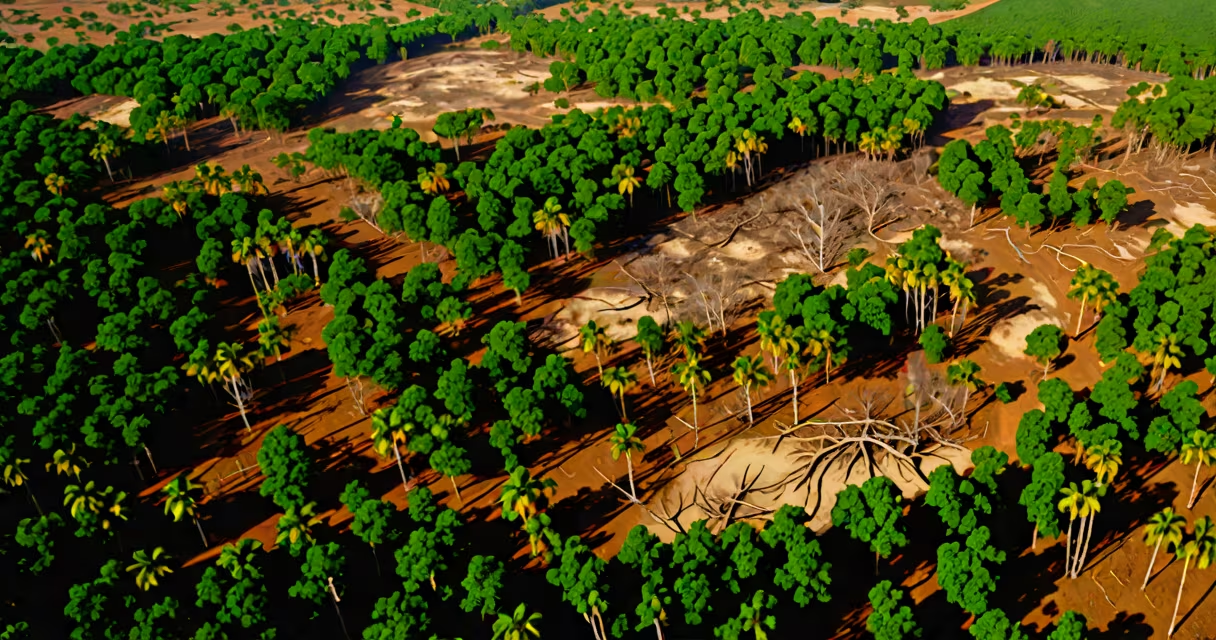
deforestation effect on system refers to the cascading environmental breakdown caused by large-scale tree removal, including habitat destruction, disrupted water cycles, and increased greenhouse gas emissions. This process destabilizes natural systems, reduces species diversity, and weakens system resilience.
When forests are cleared-whether for agriculture, logging, or urban expansion-the interconnected web of life collapses. Trees are not just individual organisms; they are central nodes in complex networks of plants, animals, fungi, and microbes. Removing them severs nutrient flows, alters microclimates, and eliminates shelter and food sources for countless species.
The Amazon rainforest, for example, loses about 1.5 million hectares annually to deforestation, according to the World Resources Institute. That's equivalent to losing 2,000 football fields of forest every hour. These losses aren't isolated-they trigger regional and global changes in temperature, rainfall, and carbon storage.
Forests regulate local and planetary climates through transpiration, the release of water vapor from leaves. When trees are removed, evaporation drops, leading to drier air and reduced cloud formation. In the Congo Basin, deforestation has been linked to a 15% reduction in rainfall during dry seasons, increasing drought risk for crops and wildlife.
Soil health deteriorates rapidly after tree removal. Roots hold soil in place and contribute organic matter. Without them, erosion increases. In Indonesia, deforested hillsides lose up to 70% of their topsoil within five years due to heavy monsoon rains. This runoff degrades rivers and coastal coral reefs downstream.
Species dependent on specific forest layers-like canopy-dwelling birds or understory insects-face extinction when their habitat vanishes. The Sumatran orangutan, for instance, has lost 80% of its habitat since 1980 due to palm oil plantations. Its population dropped from 100,000 to fewer than 14,000 individuals, according to the International Union for Conservation of Nature (IUCN).
Different forms of forest clearance cause distinct ecological consequences. Clear-cutting removes entire stands, causing immediate collapse. Selective logging may leave some structure but fragments habitat and opens access to invasive species.
| Type | Impact Level | Example Region | Key Outcome |
|---|---|---|---|
| Clear-cutting | High | Amazon Basin | Complete habitat loss; 60% decline in bird diversity within two years |
| Selective logging | Moderate to high | Borneo | Increased edge effects; 30% rise in invasive plant cover |
| Palm oil expansion | Very high | Sumatra, Malaysia | Drainage of peatlands; 10x higher CO₂ emissions than deforestation on mineral soil |
Peatland deforestation is especially damaging. Peat soils store vast amounts of carbon-up to 20 times more per hectare than tropical forests. Draining and burning peatlands in Southeast Asia releases over 1.5 billion tons of CO₂ annually, according to the Global Carbon Project.
Many assume that replanting trees reverses deforestation effect on system immediately. That's false. A planted monoculture of eucalyptus or acacia may regrow quickly, but it lacks the biodiversity and structural complexity of a mature forest. Such plantations support only 10-20% of native species compared to natural forests.
Another myth is that deforestation only harms tropical regions. Temperate forests suffer too. In the eastern United States, 90% of old-growth forests were cleared by 1900. Remaining patches now host fragmented populations of species like the northern spotted owl, which requires large, undisturbed tracts to survive.
A lesser-known fact: deforestation contributes to disease emergence. The 2014 Ebola outbreak in West Africa was linked to increased human-wildlife contact as forests shrank. As animals move into new areas, pathogens jump between species. The World Health Organization notes that 75% of emerging infectious diseases originate in wildlife.
In 2022, Brazil recorded 12,800 square kilometers of deforestation in the Amazon-a 22% increase from the previous year, per INPE (National Institute for Space Research). This area is roughly the size of Connecticut and Rhode Island combined.
One documented case involved a 500-hectare plot near the Juruá River. Before clearing, the site hosted 147 bird species, 32 mammal species, and 1,200 plant species. After conversion to soy farming, only 12 bird species remained, and soil carbon levels dropped by 45% over four years.
Local communities reliant on forest resources saw incomes fall by 60% as fish populations declined in nearby rivers. Reduced canopy cover led to higher stream temperatures, killing cold-water fish like the dorado. This illustrates how deforestation effect on system extends beyond biodiversity-it impacts livelihoods and food security.
deforestation effect on system is frequently mistaken for general land degradation. While both involve environmental harm, land degradation includes processes like overgrazing and desertification that don't require tree removal. Deforestation specifically involves the permanent loss of tree cover.
It's also sometimes conflated with pollution. Air and water pollution affect ecosystems too, but they're chemical or physical contaminants introduced from external sources. deforestation effect on system stems from structural loss-removing the foundation of the system itself.
For contrast, consider the effect of pollution on system. Pollution introduces toxins-like pesticides or heavy metals-that poison organisms. deforestation effect on system removes the environment entirely. One kills slowly via poisoning; the other collapses through absence.
I once visited a former rainforest site in Costa Rica that had been converted to cattle pasture. Within a decade, the soil had compacted, streams dried up, and native frogs vanished. The land wasn't polluted-it was stripped. Replanting with native trees took 15 years to restore even basic function. That experience showed me that recovery isn't automatic.