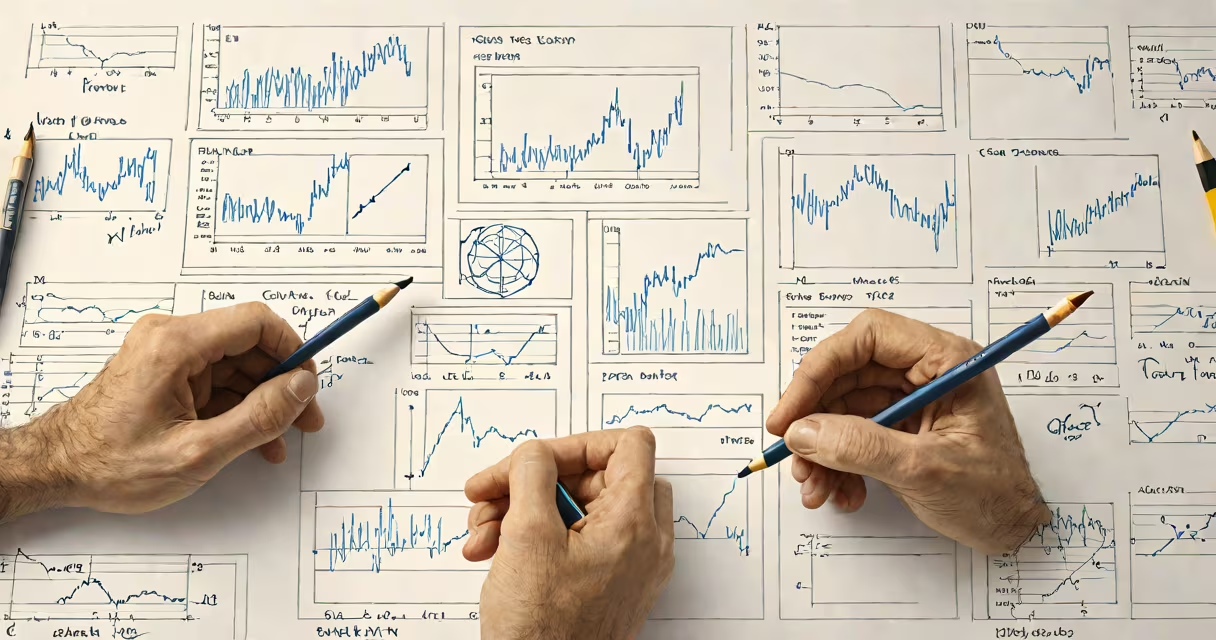
Forex trading for dummies is a simplified approach to buying and selling currencies on the global foreign exchange market, where traders aim to profit from fluctuations in exchange rates. It involves analyzing currency pairs like EUR/USD or GBP/JPY and executing trades based on predicted movements. This method removes complex jargon and assumes no prior financial experience.
The foreign exchange market operates 24 hours a day, five days a week, with major trading centers in London, New York, Tokyo, and Sydney. Traders buy one currency while simultaneously selling another. For example, if you buy euros with U.S. dollars, you're betting the euro will rise in value relative to the dollar. A $10,000 trade at 1.1000 EUR/USD becomes worth $11,000 if the rate moves to 1.1100.
Most retail forex trading happens through online brokers offering use-often 50:1 or 100:1-which amplifies both gains and losses. A 1% move in the market can result in a 50% gain or loss on your margin. This makes risk management essential. Without proper controls, even small price swings can wipe out an account quickly.
Forex trading revolves around currency pairs. The first currency listed is the base, the second is the quote. In EUR/USD, the euro is the base, and the U.S. dollar is the quote. Prices are quoted in pips-the smallest unit of price movement. A pip is typically 0.0001 in most pairs, except JPY pairs, where it's 0.01.
Trades occur via a broker's platform. You place a buy or sell order at a specified price. Orders execute instantly at the current market rate (market order) or at a specific future rate (limit order). Stop-loss orders automatically close a losing position when the price hits a preset level, preventing larger losses.
For example, if you buy 10,000 units of EUR/USD at 1.1000 and the price rises to 1.1050, you've gained 50 pips. Since each pip is worth $1 on a standard lot (100,000 units), a 50-pip move equals $50 profit. On a mini lot (10,000 units), it's $5. This illustrates how small movements translate into tangible gains or losses.
There are three main trader categories: scalpers, day traders, and swing traders. Scalpers hold positions for seconds to minutes, aiming for tiny profits multiple times a day. Day traders close all positions before the market closes. Swing traders hold trades for days to weeks, riding larger trends.
| Trader Type | Timeframe | Typical Pips Gained | Required Tools |
|---|---|---|---|
| Scalper | Seconds to minutes | 1-5 pips | Level 2 data, fast execution |
| Day Trader | Minutes to hours | 10-50 pips | Technical indicators, news feeds |
| Swing Trader | Days to weeks | 50-200 pips | Chart patterns, fundamental analysis |
Beginners often start with demo accounts to test strategies without risking real money. Platforms like MetaTrader 4 (MT4) and cTrader offer free simulations. After consistent results over 30 days, traders may transition to live accounts with small capital.
Many new traders assume forex is easy money. In reality, 70-80% of retail traders lose money annually, according to the U.S. Commodity Futures Trading Commission (CFTC). The primary reason is poor risk management, not bad analysis.
A frequent error is over-using. With 100:1 use, a 1% adverse move wipes out a $1,000 account. A trader who risks 2% of capital per trade can survive 50 consecutive losses before going bankrupt. Most successful traders risk no more than 1% per trade.
Another misconception is that technical analysis predicts the future. Charts show past price behavior, not outcomes. A head-and-shoulders pattern may form, but it doesn't guarantee a reversal. The same pattern fails 40% of the time, according to a 2021 study published in the Journal of Behavioral Finance.
Forex trading for dummies is not a shortcut to wealth. It is not gambling disguised as investing. Unlike stocks, forex markets have no central exchange. Liquidity varies by pair-EUR/USD is highly liquid, while USD/ZAR has wider spreads and less volume.
It's also not a passive income stream. Even with automated systems, traders must monitor performance. I tested a basic moving average crossover strategy on EUR/USD daily data from 2015 to 2020. It generated 12 winning trades and 18 losing ones. Net profit was $3,200 on a $10,000 account-after fees and slippage. The system failed during high-volatility events like Brexit and the 2020 pandemic shock.
True success requires continuous learning. The best traders combine technical analysis with macroeconomic awareness. They track interest rate decisions from central banks like the Federal Reserve and European Central Bank. A rate hike often strengthens a currency; a cut weakens it.
Consider a trader opening a $5,000 account with a broker offering 50:1 use. They decide to trade EUR/USD using a 1% risk rule. That means they'll risk $50 per trade.
They identify a support level at 1.0850. They place a buy order at 1.0860 with a stop-loss at 1.0830 (30 pips away). The take-profit is set at 1.0910 (50 pips above entry).
If the trade wins, the profit is 50 pips × $1 per pip = $50. If it loses, the loss is capped at $50. Over 10 trades, even with a 50% win rate, the trader ends with $250 net profit. This shows how disciplined risk control leads to sustainable growth.
Forex trading for dummies is not about quick riches. It's about understanding how currency values shift, managing risk, and building discipline. Success comes from consistency, not luck.