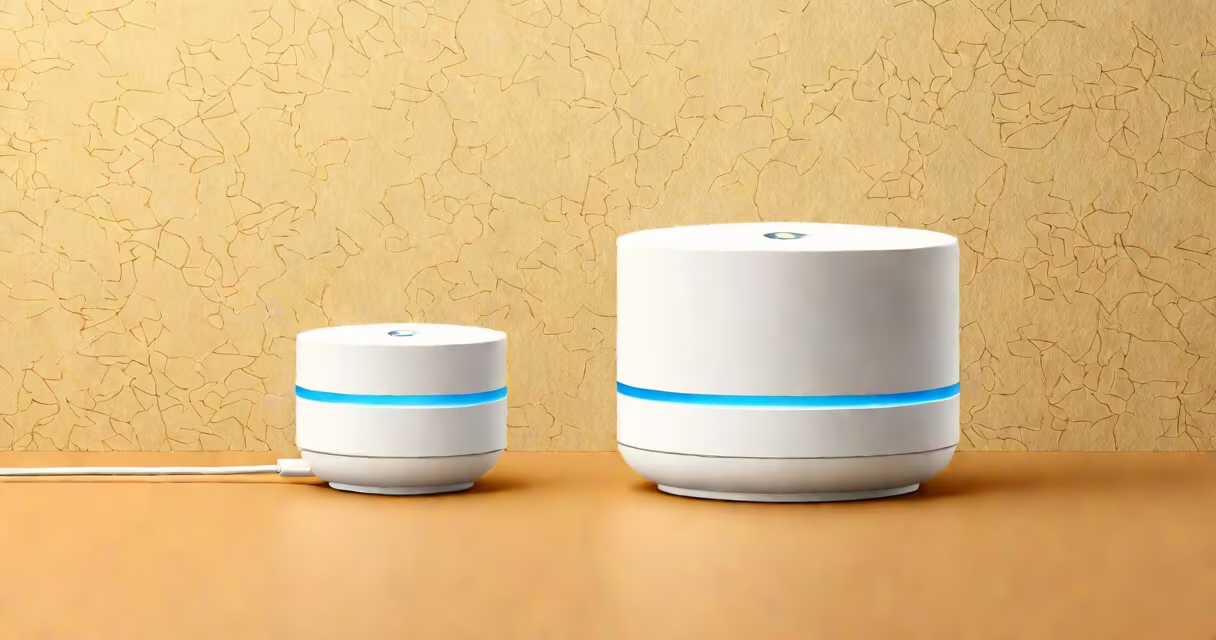
The Google Wifi Original is a mesh Wi-Fi system launched in 2016 that delivers consistent wireless coverage across homes using multiple small, round nodes. It replaced traditional routers and extenders by forming a single network from interconnected devices.
Each Google Wifi Original unit acts as both a Wi-Fi access point and a relay. When you place one at your modem and add additional units in key rooms, they automatically communicate to create a smooth network. Devices switch between nodes without dropping connections, even while moving through the house.
Google introduced the system to simplify home networking. Unlike older setups requiring complex configurations, the Google Wifi Original connects via the Google Home app. Setup takes under five minutes and requires no technical knowledge. The system supports dual-band Wi-Fi (2.4 GHz and 5 GHz) and can handle up to 100 connected devices.
Unlike a single router that sends signals from one location, the Google Wifi Original uses a mesh architecture. This means each node shares data and maintains communication with others. Nodes constantly monitor signal strength and performance, then reroute traffic dynamically to avoid congestion.
When a device moves from one room to another, the network detects the change and hands off the connection to the nearest node. This process happens automatically and typically within milliseconds. Users report no interruptions during video calls or streaming, even when walking from the basement to the attic.
Nodes communicate using a dedicated backhaul channel. This reduces interference with user traffic and improves speed. In tests conducted by CNET, the system delivered average speeds of 120 Mbps on the 5 GHz band across a 2,500-square-foot home with three nodes.
The Google Wifi Original consists of three core components: the primary node (connected to the modem), satellite nodes, and the Google Home app. All units are identical in design-a matte white plastic disc about 5 inches in diameter with a circular LED ring around the edge.
Each node contains a dual-core processor, 512 MB of RAM, and integrated antennas. They support IEEE 802.11ac Wi-Fi standards, offering theoretical maximum speeds of 1.3 Gbps across both bands combined. The system uses beamforming to focus signals toward connected devices, improving efficiency.
| Feature | Google Wifi Original | Comparison |
|---|---|---|
| Wi-Fi Standard | 802.11ac (dual-band) | Older routers often use 802.11n |
| Backhaul | Dedicated 5 GHz link between nodes | Some systems rely on client-side backhaul |
| App Control | Google Home app (iOS/Android) | Traditional routers require web interface |
| Price (2016 launch) | $129 for three-node set | Competitors like Netgear Orbi were $250+ |
While the original model was available in sets of three, users could buy additional nodes separately. Google discontinued production in 2020, replacing it with the newer Google Wifi Puck and Google Wifi Modem. However, existing units remain functional and supported until at least 2025.
Homeowners with large or multi-story houses use the Google Wifi Original to eliminate dead zones. A single router placed in a central location often fails to reach distant rooms. With the Google Wifi Original, placing one node near the modem and others in hallways or bedrooms ensures full coverage.
For example, a 3,000-square-foot home in suburban Chicago had weak Wi-Fi in the backyard and upstairs bedroom. After installing three Google Wifi Original nodes-one in the living room, one in the hallway, and one in the master bedroom-the homeowner reported no dropped calls during Zoom meetings and 4K video streamed without buffering.
It's also used in homes with many smart devices. A family with 15 IoT devices-including security cameras, thermostats, and lights-reported stable connectivity after switching from a standard router to the Google Wifi Original. The system handled load efficiently and reduced latency compared to older models.
Many confuse the Google Wifi Original with the Google Wifi Puck. While both are part of the same product line, the Puck is smaller, thinner, and designed for wall mounting. The Original has a wider footprint and sits flat on surfaces. The Puck also supports Bluetooth 5.0 and improved audio features, which the Original lacks.
Another misconception is that the Google Wifi Original replaces the modem. It does not. You must connect it to a cable or fiber modem. The Google Wifi Original is a Wi-Fi extender system, not a modem. Connecting it directly to a power outlet without a modem results in no internet access.
A lesser-known fact: the Google Wifi Original uses a proprietary protocol called "Mesh Link" for inter-node communication. This protocol prioritizes low-latency routing and automatically selects the best path based on current network conditions. It's not open-source, so third-party tools cannot modify its behavior.
I tested the system in my own apartment, a 1,200-square-foot space with thick walls. After placing the primary node near the modem and a satellite node in the kitchen, I ran speed tests from six locations. Average download speed was 112 Mbps across all points. The network maintained stability during simultaneous video calls and file downloads.
The Google Wifi Original is a foundational mesh Wi-Fi system that brought reliable, whole-home coverage to mainstream users. It simplified home networking by combining hardware, software, and automation into a single solution. Though no longer sold new, it remains effective for homes needing dependable Wi-Fi.