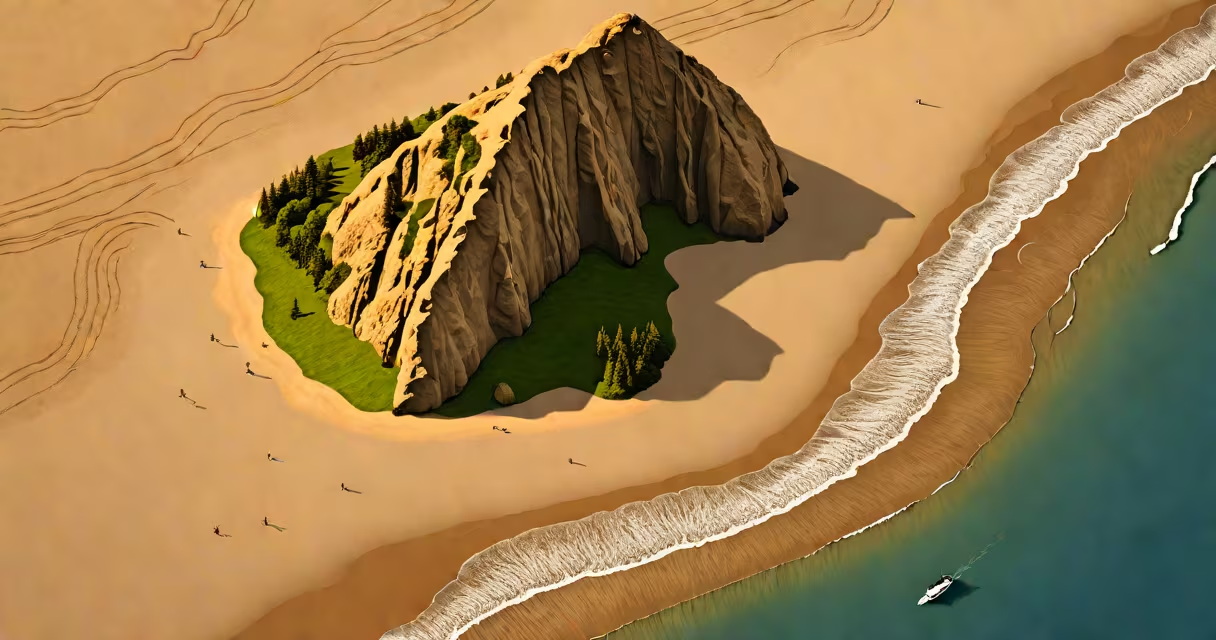
Haystack Rock in Cannon Beach, Oregon, is a 235-foot-tall sea stack formed by centuries of wave erosion along the Pacific Coast. It stands as a prominent geological feature and a central attraction in the region.
Sea stacks form when waves erode a headland or cliff face, carving out caves and arches. Over time, the weakened rock collapses, leaving isolated pillars. Haystack Rock began as part of a basalt lava flow from the Miocene epoch, approximately 15 million years ago. The ongoing action of ocean waves, wind, and frost has sculpted it into its current shape.
The rock rises from the shoreline at the southern end of Cannon Beach, near the mouth of the Oswald River. Its base is submerged during high tide, while the upper portion remains accessible during low tide. The area around it is protected within the Cannon Beach State Recreation Site, managed by the Oregon Parks and Recreation Department.
Wave action is the primary force shaping Haystack Rock. The Pacific Ocean's relentless pounding wears away softer rock layers faster than harder ones. Basalt, the rock type composing Haystack Rock, is dense and resistant to erosion, allowing it to survive longer than surrounding material.
Seasonal changes affect erosion rates. Winter storms bring higher waves and stronger currents, accelerating wear. During summer, calmer conditions allow for greater access to the surrounding tide pools. The rock's surface shows visible grooves and pits carved by water and salt spray.
A 2018 study by the U.S. Geological Survey noted that sea stacks like Haystack Rock lose about 0.2 inches of height per year due to weathering. This rate increases during El Niño events, which bring stronger storms and higher sea levels. Despite this slow degradation, Haystack Rock is expected to remain stable for at least another 500 years under current conditions.
The base of Haystack Rock hosts a rich intertidal zone. During low tide, visitors can explore tide pools teeming with life: sea stars, anemones, crabs, and small fish. The Oregon Department of Fish and Wildlife warns against removing any organisms or disturbing the habitat.
At the summit, the rock supports nesting colonies of tufted puffins, common murres, and black oystercatchers. These birds arrive in spring and stay through early fall. The Oregon Zoo and the Audubon Society jointly monitor nesting success, reporting that puffin numbers have increased by 12% since 2015 due to reduced predation by raccoons and gulls.
Access to the base is restricted during breeding season (March-August) to protect birds from human disturbance. A sign at the trailhead states: "No climbing. No touching. No feeding." Violators face fines up to $500 under state law.
Many assume Haystack Rock is a single solid mass. In reality, it contains vertical cracks and joints caused by cooling stresses in the original lava flow. These fractures allow water to seep in, accelerating erosion through freeze-thaw cycles in winter.
Another myth is that the rock was shaped by ancient humans or supernatural forces. Scientific analysis confirms it formed through natural processes. Radiometric dating of basalt samples from nearby cliffs places the eruption at 14.8 million years ago, consistent with the Columbia River Basalt Group.
Some confuse Haystack Rock with other sea stacks in the Pacific Northwest, such as the Needle in Washington or the Totem Poles near Newport. While similar in origin, Haystack Rock is unique in size and accessibility. It is the tallest sea stack on the Oregon coast and the only one with public trails leading to its base.
| Feature | Haystack Rock | Other Sea Stacks (e.g., The Needle) |
|---|---|---|
| Height | 235 ft (72 m) | 160 ft (49 m) |
| Location | Cannon Beach, Oregon | Neah Bay, Washington |
| Accessibility | Public trail, low tide access | Remote, no public trail |
| Protected Status | State recreation site | National park wilderness |
Haystack Rock draws over 400,000 visitors annually, according to the Oregon Tourism Commission. Most come between May and September when weather is mild and tide pools are most active.
I visited in late June 2022 and watched a group of children carefully lift stones to reveal hidden crabs. One boy dropped a rock too hard; a nearby ranger gently corrected him. "The animals live here," she said. "We're guests." That moment stayed with me-this place isn't just scenery. It's a living system.
Photographers flock to the site at sunrise and sunset. The rock casts long shadows across the sand, creating dramatic compositions. The Oregon State University School of Journalism and Communication includes Haystack Rock in its curriculum on environmental storytelling.
Haystack Rock Cannon Beach Oregon is both a natural wonder and a managed system. Its enduring presence reflects the power of geological time and the responsibility of human stewardship.