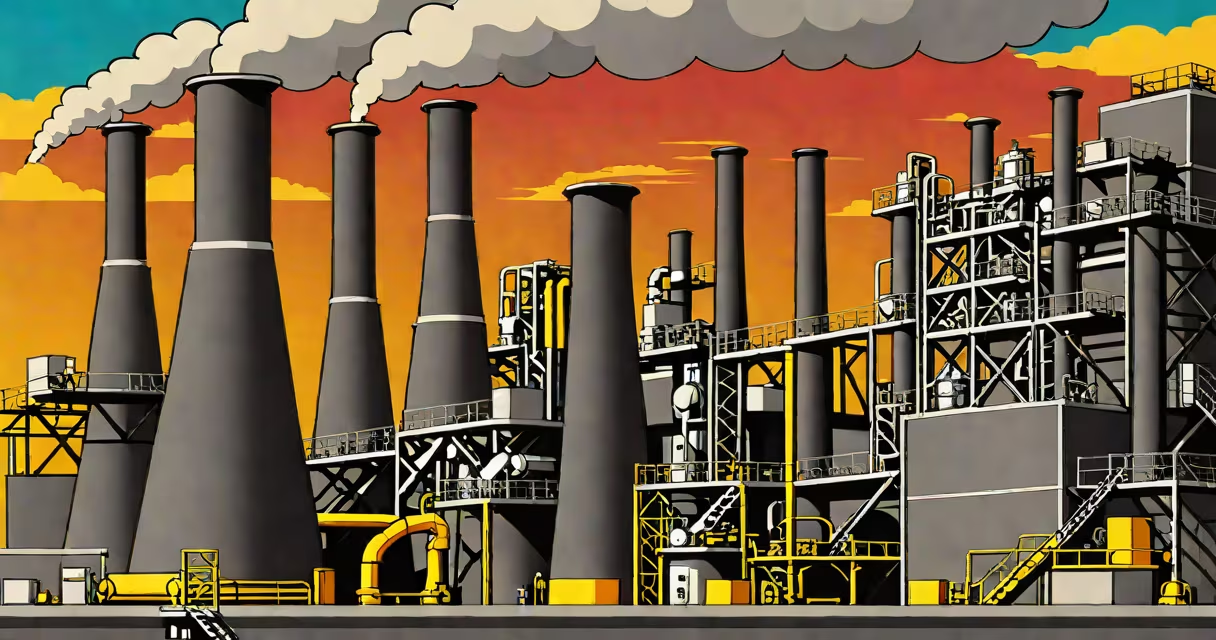
Coal produces energy by burning in a power plant's boiler, releasing heat that turns water into high-pressure steam. The steam spins a turbine connected to a generator, which converts mechanical energy into electricity. This process powers approximately 18% of global electricity demand, according to the International Energy Agency.
Coal is a fossil fuel formed over millions of years from compressed plant material buried under sediment. When burned, the stored chemical energy in coal transforms into thermal energy. Power plants capture this heat to drive a thermodynamic cycle involving steam, turbines, and generators. The entire system operates on principles of energy conversion governed by the laws of thermodynamics.
The most common method is pulverized coal combustion. Coal is crushed into fine powder, blown into a furnace, and ignited. Temperatures reach 1,400°C (2,550°F), producing intense heat. Water in pipes surrounding the furnace absorbs this heat, turning into steam at pressures exceeding 150 atmospheres. The steam flows through a turbine, causing blades to spin at 3,000 revolutions per minute. A magnetic field inside the generator converts this rotation into electrical current.
Not all coal delivers the same energy. Rank-measured by carbon content and heat value-determines efficiency. Bituminous coal, with 77-87% carbon, yields about 24 megajoules per kilogram (MJ/kg). Sub-bituminous coal, at 60-77% carbon, produces 18-24 MJ/kg. Lignite, the lowest rank, contains only 40-60% carbon and delivers 10-18 MJ/kg.
| Type | Carbon Content (%) | Energy Yield (MJ/kg) | Common Use |
|---|---|---|---|
| Anthracite | 86-98 | 28-35 | Industrial heating, limited power use |
| Bituminous | 77-87 | 24-32 | Primary fuel in U.S. and Chinese power plants |
| Sub-bituminous | 60-77 | 18-24 | Used in Western U.S. and Canada |
| Lignite | 40-60 | 10-18 | Local power stations, low efficiency |
Higher-rank coals burn hotter and cleaner, reducing ash and emissions per unit of energy. In the United States, bituminous coal accounts for 70% of coal-fired electricity generation due to its consistent performance and availability in Appalachia and the Midwest.
At a typical coal-fired facility, the process unfolds in five stages:
A single 500 MW coal plant consumes about 1.2 million tons of coal per year. For context, the Navajo Generating Station in Arizona, which closed in 2019, used 3.5 million tons annually-enough to fill 200 railroad cars daily.
Coal releases carbon dioxide (CO₂), sulfur dioxide (SO₂), nitrogen oxides (NOₓ), and particulates. A 1,000 MW coal plant emits roughly 6 million metric tons of CO₂ yearly-equivalent to 1.3 million gasoline-powered cars. The U.S. Environmental Protection Agency (EPA) regulates emissions under the Clean Air Act, requiring scrubbers to reduce SO₂ by up to 95%.
One misconception is that coal plants operate continuously. In reality, they ramp up and down based on demand. During peak hours, output may exceed 90% capacity. At night, load drops to 40%, requiring reduced firing or shutdowns. Modern plants use automated control systems to adjust fuel input in real time, maintaining stable steam pressure.
Another error is equating coal with inefficiency. While older plants achieve 33% efficiency, newer ultra-supercritical units reach 45%. China's Shandong Power Plant, operational since 2015, uses 350-bar steam and 620°C temperatures, reducing CO₂ emissions by 20% compared to standard designs.
Coal outperforms biomass and solar in baseload reliability. Unlike intermittent sources, coal provides constant output. However, it lags behind natural gas and nuclear in emissions per kWh. Natural gas plants emit 50% less CO₂ than coal equivalents. Nuclear reactors generate 1,000 times more energy per ton of fuel.
| Source | Emissions (g CO₂/kWh) | Efficiency (%) | Capacity Factor (%) |
|---|---|---|---|
| Coal (subcritical) | 820 | 33 | 55 |
| Coal (ultra-supercritical) | 700 | 45 | 60 |
| Natural Gas (combined cycle) | 400 | 55 | 58 |
| Onshore Wind | 12 | 35 | 35 |
| Solar PV | 40 | 15 | 20 |
Despite lower efficiency, coal remains critical in developing nations. India's coal fleet supplies 70% of its electricity. In 2023, India added 10 GW of new coal capacity, citing energy security and affordability.
I visited a coal plant in Ohio during a winter outage. The control room showed real-time data: coal feed rate, steam temperature, and generator load. At 3 a.m., the plant operated at 85% load. A technician adjusted the pulverizer speed manually to maintain consistent particle size. The sound was a steady hum-no sudden shifts. This stability is why coal still supports grids even as renewables grow.