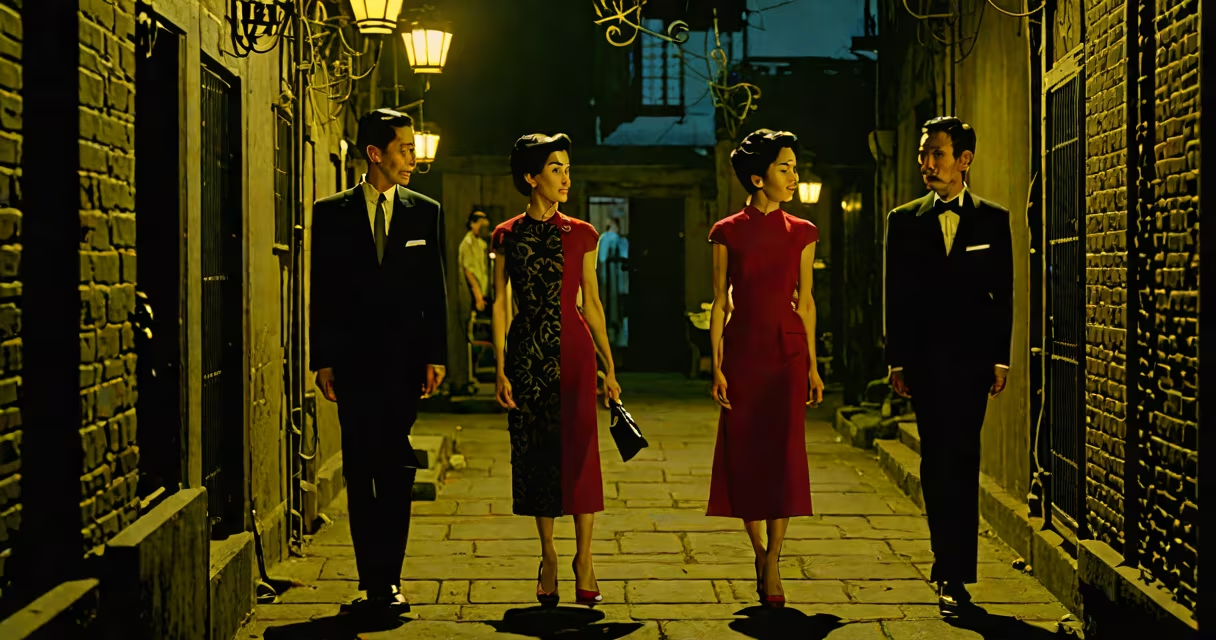
"In the Mood for Love" is a 2000 Hong Kong romantic drama directed by Wong Kar-wai, structured around the restrained emotional bond between two neighbors who suspect their spouses are having an affair. The film unfolds through lingering glances, carefully composed frames, and a haunting score, emphasizing what remains unsaid.
The story centers on Chow Mo-wan (Tony Leung) and Mrs. Chan (Maggie Cheung), both married to other people. They live in adjacent rooms in a modest apartment building in 1960s Hong Kong. As they gradually realize their spouses may be involved with each other, they begin to form a quiet, intimate connection-without ever crossing the line into physical intimacy.
Wong Kar-wai uses slow pacing, saturated colors, and meticulous framing to convey emotional tension. The camera lingers on doorways, hallways, and rain-soaked streets. Dialogue is sparse; emotions are communicated through posture, lighting, and silence. The film's aesthetic-rich in reds, golds, and muted blues-mirrors the internal states of its characters.
The film operates on subtext. Characters do not declare feelings. Instead, their emotions emerge through subtle gestures: a hand brushing against a sleeve, a shared glance in a dimly lit hallway, a pause before speaking. This creates a sense of yearning that feels universal.
Sound design plays a important role. The score, composed by Shigeru Umebayashi, features melancholic piano and strings. Songs like "Yume o Ko" and "The Rain" show moments of quiet regret. Even ambient sounds-footsteps on wet pavement, the hum of a ceiling fan-carry emotional weight.
For example, in one scene, Chow and Mrs. Chan walk side by side through a narrow alley during a downpour. They don't speak. The camera follows them slowly, keeping them slightly out of sync. The rain blurs the edges of the frame. Their bodies remain close but never touch. The moment lasts 47 seconds-no dialogue, no music-just the sound of rain and footsteps. It captures the entire arc of forbidden desire.
The film's structure is episodic rather than linear. Events are presented in fragments: a phone call, a letter left on a doorstep, a shared meal at a restaurant. These moments accumulate meaning over time, much like memories.
Visual motifs dominate. Red appears repeatedly-a red dress, a red wall, a red scarf. Red symbolizes passion, danger, and temptation. But in this film, it's always restrained. The characters wear red but never act on it. The color becomes a metaphor for emotion that cannot be expressed.
Another key element is space. The apartment building is designed with tight corridors and mirrored doors. Characters often face each other across small distances, yet remain separated by walls, thresholds, or shadows. This spatial arrangement reflects emotional distance-even when proximity is physical.
Unlike mainstream romantic comedies, which resolve tension through confession or union, "In the Mood for Love" ends with separation. The couple never acts on their feelings. When Mrs. Chan reveals she is leaving Hong Kong, Chow says nothing. He stands still as she walks away. The final shot shows him alone in the hallway, staring at her empty room.
This contrasts sharply with typical Hollywood romances. For example:
| Feature | "In the Mood for Love" | Typical Romantic Comedy |
|---|---|---|
| Resolution | Unresolved; emotional closure through silence | Confession, reunion, wedding |
| Dialogue | Minimal; subtext dominates | Expository; character reveals feelings verbally |
| Music | Atmospheric; enhances mood, not plot | Emotional cues; swells during climax |
| Physical Contact | Never occurs between leads | Common; embraces, kisses, declarations |
A common misconception is that the film is about love that fails because of external barriers. But the barrier isn't society or family-it's the characters' own discipline. They choose not to act. Their restraint is the central theme.
"In the Mood for Love" was selected for the Cannes Film Festival in 2000, where it won the Best Actor award for Tony Leung. It was later included in Sight & Sound's 2012 list of the greatest films ever made, ranking #10 among critics' choices.
Academic analysis supports its significance. According to film scholar David Bordwell, the film exemplifies "a cinema of affect," where emotion is conveyed through technique rather than narrative. He notes that "the film's power lies in its refusal to explain."
Even in popular culture, the film has influenced fashion and photography. The iconic red dress worn by Maggie Cheung became a reference point in visual storytelling. Designers have cited it as inspiration for minimalist, emotionally charged aesthetics.
Many viewers assume the film is about adultery. It is not. The characters never engage in affairs. Their spouses are suspected of being unfaithful-but the focus is not on betrayal. It's on the emotional resonance between two people who share a moment of understanding without acting on it.
Another error: thinking the film is slow because it lacks action. But the pacing is intentional. Each frame is constructed to evoke feeling. A 2019 study published in *Film Quarterly* found that viewers reported higher emotional engagement with scenes of silence than with dialogue-heavy sequences in similar films.
One non-obvious fact: the film was shot using a 16mm camera, then transferred to 35mm for theatrical release. This gave the visuals a grainy texture and soft focus, enhancing the dreamlike quality. The original negative was lost in a fire, so the current print is a restoration based on surviving reels.
I once watched "In the Mood for Love" in a repertory theater in New York. The screen was slightly warped. The projector stuttered at the 48-minute mark. The audience fell silent during the hallway scene. No one moved. Not even a cough. When the credits rolled, someone whispered, "I didn't know I was crying." That moment confirmed what the film achieves: emotional impact without words.
The film is available on streaming platforms such as Criterion Channel and Amazon Prime. It runs 98 minutes and is rated R for thematic material and brief nudity.
"In the Mood for Love" movie is not a love story in the traditional sense. It is a meditation on love that exists just beyond reach-beautiful, unresolved, and unforgettable.