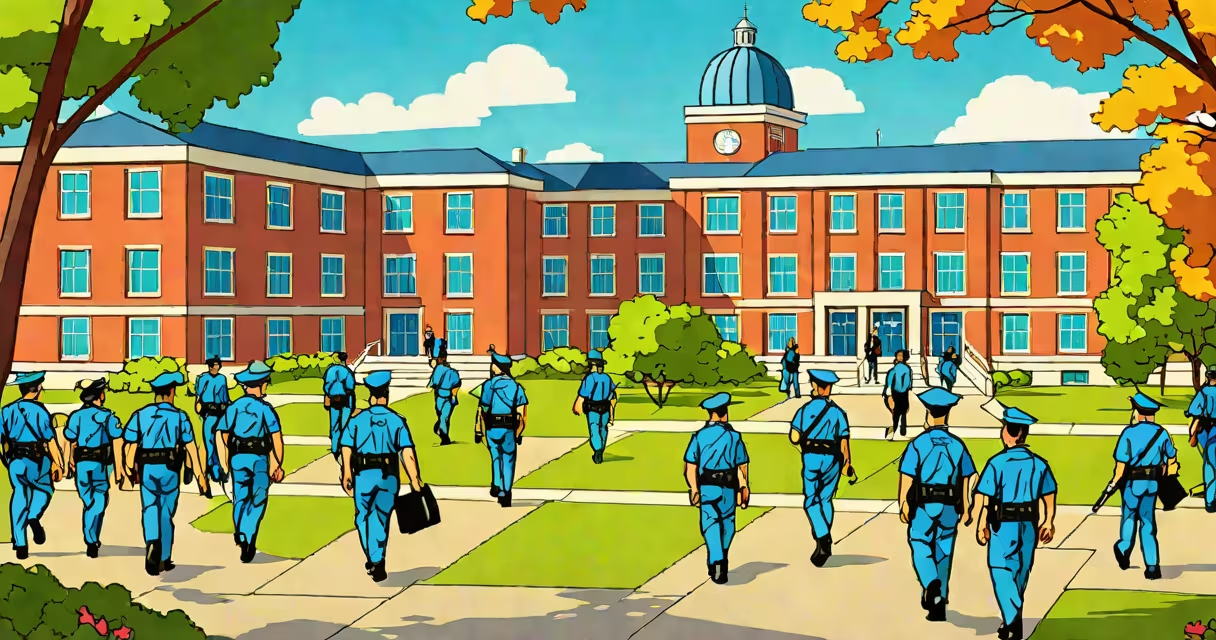
A bachelor of police is a four-year undergraduate academic program that trains individuals for careers in law enforcement, emphasizing criminal justice theory, legal procedures, investigative methods, and ethical conduct in public service. The degree combines classroom instruction with practical simulations and field placements to prepare graduates for roles such as patrol officers, detectives, or police administrators.
Unlike vocational police academies that offer short-term certification, a bachelor of police is a formal degree awarded by accredited institutions. It typically includes courses in constitutional law, criminology, forensic science, crisis management, and community policing. Graduates meet state and federal requirements for entry-level positions in municipal, state, or federal law enforcement agencies.
The program is designed for those seeking long-term careers in public safety. It often requires completion of 120 credit hours, including internships with local police departments. Students who earn this degree demonstrate both academic proficiency and applied readiness for real-world policing responsibilities.
Students enrolled in a bachelor of police program follow a structured curriculum that builds technical knowledge and professional skills. Core classes cover the structure of the U.S. justice system, evidence handling, de-escalation tactics, and data-driven policing. These courses are taught by faculty with experience in law enforcement, corrections, or criminal justice policy.
Practical components are integrated throughout the program. Students participate in mock crime scene investigations, role-play suspect interviews, and attend ride-alongs with sworn officers. Many programs require a capstone project involving a research paper or policy proposal on a current issue in policing, such as use-of-force reform or mental health response protocols.
Admission typically requires a high school diploma or GED, a minimum GPA of 2.5, and a background check. Some schools also require applicants to pass a physical fitness test or written exam assessing reasoning and judgment under pressure. Upon graduation, students receive a Bachelor of Science or Bachelor of Arts in Police Studies, Criminal Justice, or a related field.
While the term "bachelor of police" is not a standardized academic title in most universities, several institutions offer degrees with similar focus areas. These programs may go by different names but share core objectives and competencies.
| Program Name | Focus Area | Typical Coursework | Accreditation Body |
|---|---|---|---|
| Bachelor of Science in Criminal Justice | Law enforcement, corrections, probation | Criminology, forensic psychology, cybercrime | ACJS (Accrediting Commission for Criminal Justice Education) |
| Bachelor of Arts in Police Administration | Public safety leadership, policy development | Organizational behavior, budgeting, crisis leadership | CAEP (Council for the Accreditation of Educator Preparation) |
| Bachelor of Science in Homeland Security & Emergency Management | National security, disaster response, intelligence | Threat assessment, emergency planning, surveillance ethics | ABET (Accreditation Board for Engineering and Technology) |
Some programs offer specializations in areas like cybercrime investigation, juvenile justice, or tactical operations. A few universities partner with local police departments to provide cadet tracks, where students train alongside officers and may be hired upon graduation.
Colleges and universities in the United States, Canada, and parts of Europe offer bachelor of police-related degrees. Institutions such as the University of New Haven, John Jay College of Criminal Justice, and the University of Central Florida have well-established programs in criminal justice with strong ties to law enforcement agencies.
These programs are used to meet growing demand for educated, ethically grounded officers. According to the U.S. Bureau of Labor Statistics, police and sheriff's patrol officers must have at least a high school diploma, but many departments now prefer candidates with college degrees. In 2023, 62% of police departments in cities with populations over 100,000 required at least some college education for new recruits.
For example, the Los Angeles Police Department (LAPD) mandates a bachelor's degree for promotion to sergeant and above. Officers with a bachelor of police or equivalent degree are more likely to qualify for leadership roles, specialized units, or internal affairs positions. The degree also enhances eligibility for federal jobs such as FBI Special Agent or U.S. Park Ranger.
Many people assume that a bachelor of police is a direct path to becoming a police officer. This is incorrect. The degree itself does not grant a police commission or badge. Graduates must still complete a separate police academy training program, which varies by jurisdiction and lasts between 6 and 12 weeks.
Another misconception is that all bachelor of police programs are identical. In reality, curricula differ based on institutional focus. A program at a liberal arts college may emphasize ethics and social justice, while one at a technical university may prioritize forensic science and digital evidence collection. Students should review course catalogs and accreditation status before enrolling.
A lesser-known fact: some states allow credit for prior military or law enforcement service toward a bachelor of police degree. For example, the State University of New York (SUNY) offers a "prior learning assessment" option where officers can submit reports, certifications, or training logs to earn up to 30 credits. This reduces time to graduation and lowers tuition costs.
I once observed a student at a community college in Oregon complete a bachelor of police program entirely online while working full-time as a reserve officer. She used her job experience to fulfill a required internship, submitting video documentation of interactions with the public and a reflective journal. Her final project analyzed racial disparities in traffic stops within her county, using data from the state's Open Justice Portal. The program accepted her submission because it met academic standards and demonstrated applied learning.
The bachelor of police is often mistaken for a police academy certificate. While both lead to law enforcement careers, they differ in duration, depth, and recognition. A police academy typically takes 6-12 weeks and focuses on hands-on training in firearms, defensive tactics, and legal authority. A bachelor of police spans four years and includes advanced study in policy, research, and administration.
It is also sometimes confused with a bachelor of science in criminal justice. Though overlapping, the latter is broader and may include pathways into corrections, probation, or private security. A bachelor of police emphasizes operational policing skills and is tailored for those aiming to serve in uniformed roles.
Some confuse the degree with a master's in public administration (MPA) or a law degree (JD). These are advanced qualifications that prepare individuals for policymaking or legal oversight, not frontline duty. A bachelor of police is a foundational credential for entry-level and mid-career officers.
For those considering a career in law enforcement, a bachelor of police provides a strong academic base. It improves job prospects, supports advancement, and aligns with national standards set by the National Institute of Justice and the International Association of Chiefs of Police. Graduates enter the workforce with both theoretical understanding and practical readiness.