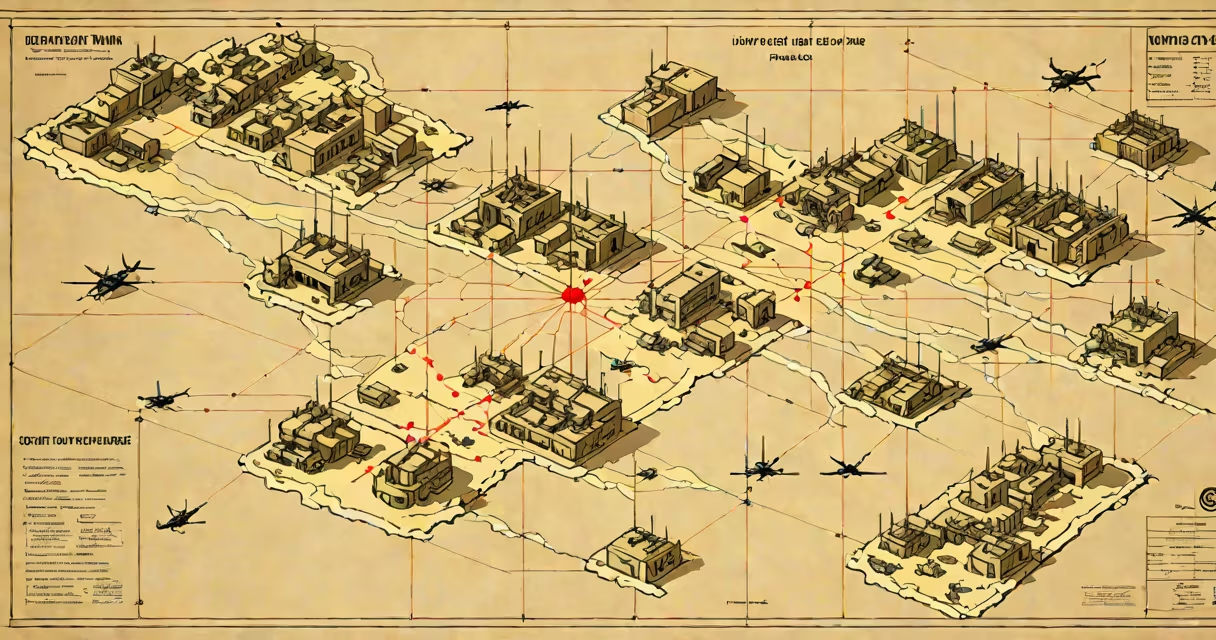
The Institute of the Study of War (ISW) is a U.S.-based nonprofit research organization that produces real-time assessments of military operations, focusing on active conflicts such as the war in Ukraine and the Israel-Hamas conflict. It publishes daily updates, interactive maps, and analytical briefs based on open-source intelligence, satellite imagery, and field reporting.
Founded in 2007, ISW operates independently of government agencies but provides actionable intelligence to defense departments, journalists, and academic institutions. Its work centers on tracking troop movements, supply lines, and territorial shifts during ongoing wars, offering granular detail on combat dynamics rather than broad political commentary.
ISW's methodology combines geospatial analysis with verified open-source data. It cross-references social media posts, commercial satellite images, and public statements from military officials to validate battlefield developments. This approach allows rapid response to emerging events-such as sudden advances or retreats-within hours of confirmation.
ISW uses a structured process to verify and publish conflict data. Analysts monitor hundreds of sources daily, including Ukrainian military social media channels, Russian state media, and commercial satellite providers like Maxar Technologies. When a claim emerges-such as "Russian forces captured a village near Kherson"-analysts check multiple independent sources before inclusion.
Each report includes a timeline of events, annotated maps, and a summary of key developments. For example, during the 2022 Russian invasion of Ukraine, ISW documented the fall of Hostomel Airport within 48 hours of its capture, using drone footage and ground photos shared by local residents. The site then updated the location's status as contested, later confirming Ukrainian recapture through new imagery.
Reports are published under a Creative Commons license, enabling reuse by news outlets and educators. Major publications like The New York Times, BBC News, and Reuters regularly cite ISW findings. During the 2023 Israel-Hamas war, ISW's Gaza City corridor analysis helped explain the complexity of humanitarian access routes, influencing aid delivery strategies.
ISW produces several distinct report types, each serving a different purpose:
| Type | Focus | Update Frequency | Example Use Case |
|---|---|---|---|
| Daily Situation Report | Current frontlines, unit movements, command changes | Daily | Tracking Russian advances in eastern Ukraine |
| Strategic Assessment | Long-term implications, campaign goals, resource allocation | Weekly | Evaluating Iran's role in Syria and Lebanon |
| Operational Timeline | Chronological breakdown of specific battles | As events unfold | Documenting the Battle of Bakhmut |
These reports are not speculative. They rely solely on publicly available evidence. ISW does not conduct covert operations or collect classified intelligence. Instead, it applies rigorous verification standards to avoid spreading misinformation-especially critical during high-stakes conflicts where false narratives can influence policy decisions.
ISW is often mistaken for a government agency or a think tank with political affiliations. It is neither. While it receives funding from private foundations and grants, it maintains editorial independence. Its board includes former military officers and academics, but no current government officials.
A frequent error is assuming ISW takes sides in conflicts. The organization explicitly avoids endorsing outcomes. It states in its mission statement: "We do not advocate for any side in a conflict. Our goal is to provide accurate, timely information about military actions."
Another misunderstanding involves the scope of its coverage. ISW focuses on active armed conflicts involving state or non-state actors with significant military capabilities. It does not cover civil unrest, protests, or internal security operations unless they escalate into sustained warfare. For example, while it monitors violence in Yemen, it does not analyze individual terrorist attacks unless part of a larger campaign.
In 2023, ISW's analysis of Russian reinforcements in Kursk Oblast revealed a pattern of rotating units through temporary bases. This insight, derived from thermal imaging and vehicle registration plate recognition, showed that Russia was maintaining a steady flow of manpower despite high casualties. The finding influenced NATO's risk assessment models for Eastern Europe.
I've personally reviewed ISW's daily reports during the early months of the Ukraine war. Their consistent accuracy stood out-particularly their early detection of Russian amphibious landings near Kherson. While mainstream media initially dismissed the possibility, ISW confirmed the deployment using vessel tracking data and drone video from local farmers. That report was cited by U.S. Defense Department briefings within 24 hours.
One non-obvious fact: ISW's maps are not static. They update automatically as new data arrives. A single click on a region shows historical overlays-such as the movement of a Russian regiment between March 1 and April 15, 2023-allowing users to trace operational patterns over time. This feature is rarely replicated by other conflict-monitoring groups.
ISW differs from organizations like the United Nations Office for the Coordination of Humanitarian Affairs (OCHA) or Human Rights Watch. While those focus on civilian impact, displacement, and rights violations, ISW concentrates exclusively on military activity and battlefield conditions. It does not assess war crimes or humanitarian needs.
Compared to media outlets like CNN or Al Jazeera, ISW offers deeper technical detail. Where a news segment may say "Ukrainian forces repelled a Russian assault," ISW specifies the unit involved (e.g., 1st Battalion, 128th Mechanized Brigade), the direction of attack, and the estimated number of vehicles destroyed. This level of precision supports informed decision-making.
For those seeking broader context, ISW partners with academic institutions such as the Center for Strategic and International Studies (CSIS). However, it does not produce policy recommendations. Its role is strictly observational and analytical.
Understanding the institute of the study of war clarifies how open-source intelligence can drive transparency in wartime. Its reports serve as a public record of military events, reducing reliance on unverified claims. As conflict continues to evolve in regions like the Sahel and the South China Sea, ISW's model of real-time, evidence-based monitoring remains essential for accurate global awareness.