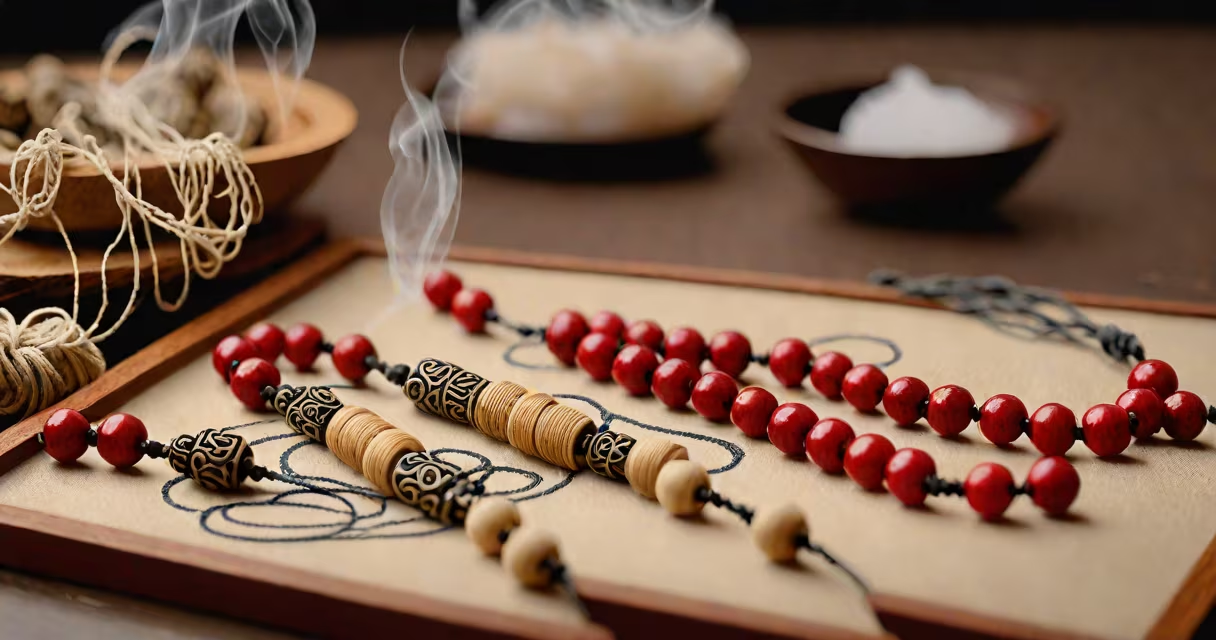
Japanese juzu buddhist prayer beads are ritual stringed beads used in Zen and Pure Land Buddhism to count mantras, prayers, or breaths during meditation. Typically made of wood, seeds, or glass, they consist of 108 beads plus a larger front bead called the *hishi* or *kyōzō*, symbolizing the 108 human desires to overcome.
These beads are not decorative. They serve as tactile anchors in devotional practice. Each bead represents a step in reciting a mantra-most commonly the Nembutsu, "Namu Amida Butsu"-and help maintain focus during prolonged chanting sessions. The physical act of moving through the beads grounds the practitioner in the present moment.
The tradition dates back to the 8th century, introduced from India via China and Korea. By the Heian period (794-1185), juzu became standard equipment in monasteries. Today, they remain central in both temple rituals and home altars across Japan.
Juzu are typically strung on a cord made of cotton, silk, or hemp. The most common configuration is 108 small beads followed by a single larger bead-the *hishi*. This front bead often features a carved symbol such as a lotus, a mandala, or a Buddhist character like "n" (for *nembutsu*).
Materials vary by region, sect, and purpose. Common types include:
| Type | Material | Common Use | Symbolism |
|---|---|---|---|
| Shōkō juzu | Wooden beads (often sandalwood or zelkova) | Monastic practice, formal ceremonies | Purity, longevity |
| Kyōzō juzu | Seed beads (e.g., bodhi, lotus, or rosewood) | Personal devotion, home altars | Natural impermanence, simplicity |
| Shūjū juzu | Glass or crystal beads | Ritual offerings, altar displays | Clarity, light, transcendence |
Some juzu include a metal clasp or a small bell attached to the cord. The bell, when rung before or after chanting, marks the beginning and end of a session, signaling the transition into sacred time.
A lesser-known fact: the number 108 is derived from Indian cosmology. It corresponds to the 108 *mālās* (beaded necklaces) used in Hindu traditions, which were adopted and adapted by early Mahayana Buddhism. The number also reflects the 108 defilements or mental afflictions described in the *Śūraṅgama Sūtra*.
Practitioners hold the juzu in the right hand, using the thumb and index finger to move one bead at a time while reciting a mantra aloud or silently. The motion is deliberate, not rushed. After completing 108 beads, the practitioner turns the string around and continues in reverse, symbolizing the cyclical nature of existence.
In Zen temples, monks chant the *Nembutsu* 108 times daily during morning services. A single session may last 15 minutes. Each bead touched corresponds to one utterance of "Namu Amida Butsu," meaning "Praise to Amida Buddha."
For lay practitioners, juzu are used during personal meditation at home. A typical routine involves sitting in seiza (kneeling posture), placing the juzu on the lap, and chanting for 10-20 minutes. The tactile feedback helps sustain attention, especially during long periods of silence.
When I visited a temple in Kyoto in 2022, I observed a novice monk performing *shōdō* (chanting practice) with a juzu made of black lacquered wood. He moved each bead slowly, eyes closed, lips barely moving. His breathing synchronized with the cadence of the chant. The sound was low and resonant-like a hum beneath the surface of thought.
Juzu are not amulets or lucky charms. Unlike *omamori* (protective talismans), they do not promise health, success, or safety. Their function is purely devotional and meditative.
Another misconception: juzu are not interchangeable across sects. While all Buddhist traditions use prayer beads, the specific form and usage differ. For example, Tibetan *mālās* use 108 beads too-but they are worn around the neck and often have a tassel. Japanese juzu are held in the hand and never worn.
Also, the color of the beads is not arbitrary. Red beads often appear in Pure Land Buddhism, symbolizing compassion and life force. White beads represent purity and emptiness. Black beads denote mourning or the impermanence of life. These choices reflect deeper doctrinal meanings.
Juzu are still produced today in traditional workshops in Kyoto and Nara. The process takes weeks: beads are hand-carved, sanded, and polished. Some artisans use natural dyes from plants like indigo or safflower.
According to the NHK Special on Religious Practices in Japan, over 60% of households with a Buddhist altar in Japan own at least one juzu. Most are passed down through generations, sometimes repaired rather than replaced.
During the Obon festival, families use juzu to chant for ancestors. The beads are placed on the family altar alongside photos and offerings. The act of touching each bead becomes a way of remembering and honoring the dead.
Modern adaptations exist. Some designers create minimalist juzu with transparent resin beads containing dried flowers or leaves. These are sold as art pieces, but they lack the spiritual context required for authentic use in ritual.
Understanding juzu requires seeing them not as objects, but as tools for mindfulness. Their value lies not in material worth but in disciplined repetition. As the *Platform for Buddhist Studies* notes, "The power of the juzu is not in the beads themselves, but in the intention behind each movement."
For those exploring Buddhist practice, learning to use juzu correctly begins with observing a teacher. You cannot master the rhythm of the chant or the timing of the bead movement without guidance. Even a single misstep-such as skipping a bead or turning the string too quickly-breaks the flow.
While juzu are deeply rooted in Japanese culture, their principles apply beyond religion. The concept of using physical objects to regulate attention and memory is echoed in modern mindfulness apps and cognitive behavioral therapy techniques. The juzu's design predates neuroscience by centuries.
Understanding japanese juzu buddhist prayer beads reveals more than ritual mechanics-it shows how material objects can shape inner experience. They are not relics. They are living tools, still used today in temples, homes, and meditation centers worldwide.