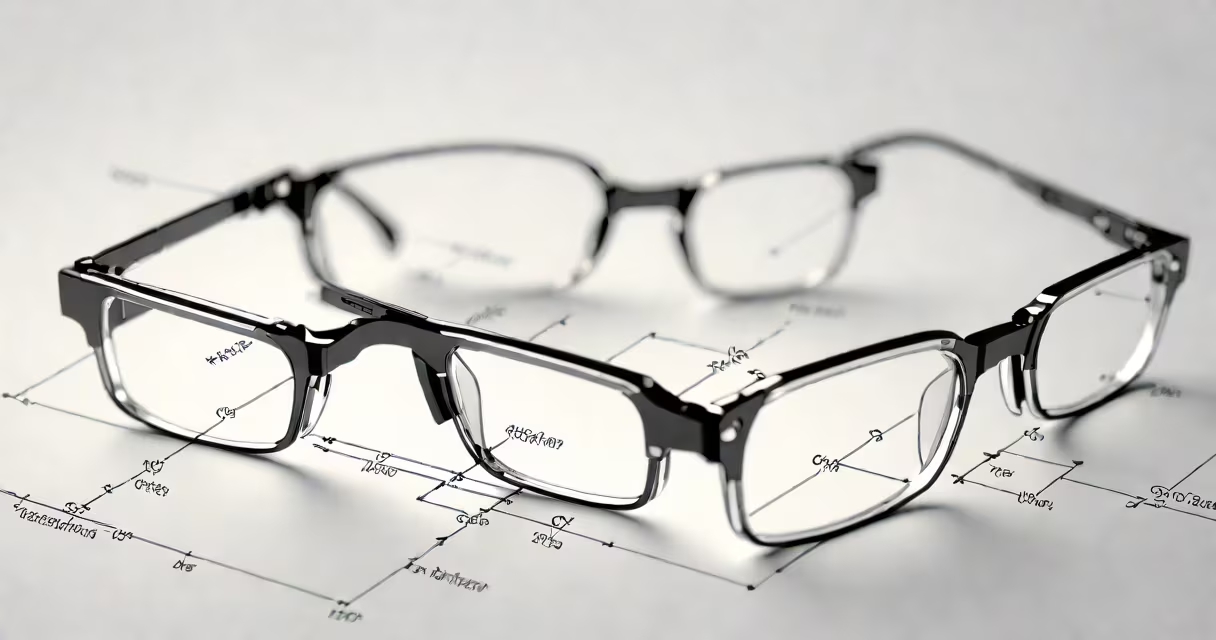
Single vision glasses correct either near or distance vision using one lens power throughout the entire lens. They are prescribed for people who need help seeing at one specific distance-either far away or up close-but not both.
These lenses have a uniform prescription across their entire surface. Unlike progressive or bifocal lenses, they don't include multiple zones for different distances. A person with myopia (nearsightedness) gets single vision lenses to see distant objects. Someone with hyperopia (farsightedness) uses them to focus on nearby tasks like reading.
According to the American Optometric Association, single vision lenses are the most common type of corrective eyewear, used by approximately 60% of adults with refractive errors. They are manufactured with precise optical alignment to minimize distortion and ensure accurate vision correction.
When light enters the eye, it must bend properly to land on the retina. If the eyeball is too long or too short, or the cornea isn't curved correctly, images blur. Single vision lenses compensate for this by altering the path of incoming light.
For distance correction, the lens is thinner at the edges and thicker in the center-this is a concave lens for myopia. For near vision, the lens is thicker at the edges and thinner in the center-a convex lens for hyperopia. The strength of the lens is measured in diopters, ranging from -1.00 to +10.00 or higher depending on the severity of the condition.
A patient with -3.50 diopters of myopia wears single vision lenses that diverge light slightly before it reaches the eye. This shifts the focal point from behind the retina to directly on it, restoring clear distance vision. The same principle applies in reverse for farsightedness.
There are two primary types of single vision glasses based on the visual task they support:
| Use Case | Lens Type | Prescription Range | Typical User |
|---|---|---|---|
| Distance Vision | Concave (minus power) | -0.50 to -10.00 D | People with myopia |
| Near Vision | Convex (plus power) | +0.50 to +6.00 D | People with hyperopia or presbyopia |
These lenses are often worn during daily activities such as driving, watching TV, or working on a computer. They are also standard for schoolchildren diagnosed with nearsightedness, especially in regions with high rates of myopia progression-such as East Asia, where prevalence exceeds 80% among teenagers.
Some people use single vision lenses for computer work only. These are called "computer glasses" and typically have a mild plus power (+0.75 to +1.50 D) to reduce eye strain during prolonged screen use. They differ from regular reading glasses because they're optimized for intermediate distances-about 20 to 26 inches from the eyes.
Many assume single vision glasses are only for older adults. That's incorrect. Myopia often begins in childhood and requires early correction. The World Health Organization reports that uncorrected myopia affects over 1 billion people globally, with nearly half under age 15.
Another misconception is that single vision lenses cause dependency. This is false. Wearing corrective lenses doesn't weaken the eyes. The eye muscles don't grow weaker from wearing glasses-vision changes occur due to genetic or environmental factors, not lens use.
A key distinction: single vision lenses do not correct astigmatism unless combined with cylindrical power. If a prescription includes both spherical and cylindrical components (e.g., -2.00 -1.00 x 90), the lens is no longer single vision-it becomes a toric lens, which is a separate category.
Consider Maria, a 28-year-old graphic designer with -2.25 diopters of myopia. She visits her optometrist and receives a prescription for single vision lenses. Her lenses are made from high-index plastic to reduce thickness and weight. She chooses blue-light filtering coating to reduce glare from her dual-monitor setup.
After two weeks of wear, she notices improved clarity when checking emails and fewer headaches during long sessions. Her vision score improves from 20/40 to 20/20 at distance. She wears the same pair for all outdoor activities and meetings-no need to switch between glasses.
This illustrates a core benefit: consistency. With a single lens power, users avoid the adjustment period required for multifocal lenses. There's no "jump" effect when looking through different zones, which reduces dizziness and disorientation.
They are not the same as progressive lenses, which combine distance, intermediate, and near corrections in one lens. Progressive lenses require careful fitting and adaptation. They are not suitable for everyone-especially those with balance issues or frequent head movement.
Single vision glasses also aren't designed for people with binocular vision problems like convergence insufficiency. Those conditions may require vision therapy or prism correction, which goes beyond basic refractive error correction.
Finally, they are not interchangeable with reading glasses. Reading glasses are typically +1.00 to +3.00 D and intended solely for close-up tasks. Using them for driving or computer work causes blurry distance vision and increases risk of accidents.
I once built a pair of single vision glasses for a friend with mild hyperopia. We used polycarbonate lenses with anti-reflective coating. After testing them at home, he reported clearer text on his phone and less squinting while reading. The simplicity of the design made it easy to adjust to-within 24 hours, he stopped removing the glasses to check his watch.
This mirrors clinical findings: patients adapt faster to single vision lenses than to multifocal designs. A 2021 study published in Optometry and Vision Science found that 87% of new wearers preferred single vision lenses over bifocals after six months, citing comfort and reduced cognitive load.