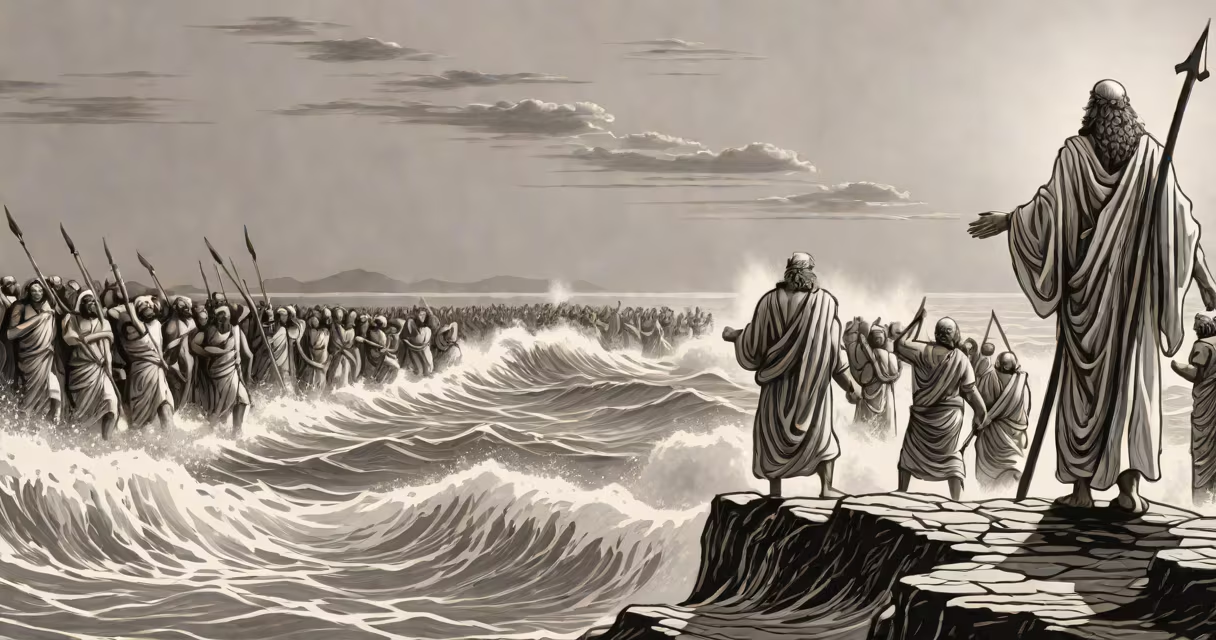
Moses is a central figure in the Hebrew Bible and Christian Old Proof, portrayed as the divinely appointed leader who liberated the Israelites from Egyptian slavery and received the Ten Commandments at Mount Sinai. He embodies prophetic authority, covenant mediation, and divine obedience.
The narrative of Moses spans Exodus, Leviticus, Numbers, and Deuteronomy. His life begins with concealment in a basket among the reeds of the Nile, a detail echoing themes of divine protection and hidden destiny. Pharaoh's daughter finds him, names him Moses-derived from Hebrew *mashah*, meaning "to draw out"-referring to his rescue from the water. This etymology is not coincidental; it foreshadows his future role in delivering God's people from bondage.
Moses' function is not merely political or military. He acts as God's mouthpiece, speaking directly with the divine presence. When God appears in the burning bush, He says, "I am who I am," and commands Moses to lead the Israelites out of Egypt. The name "Moses" thus carries dual meaning: drawn from the river, and called by God. This duality underscores his role as both savior and servant.
Moses operates as a bridge between God and humanity. He receives laws, mediates covenants, and performs miracles-parting the Red Sea, providing manna in the wilderness, and striking water from stone. These acts are not magic but signs of divine authority. They confirm that God is present and active in history, not distant or indifferent.
His leadership is tested repeatedly. The Israelites complain about food, water, and direction. Moses intercedes with God, often pleading for mercy. In Exodus 32, when they worship a golden calf, Moses breaks the tablets of the law in anger. He then ascends Mount Sinai again to receive a new set, showing that relationship with God requires both obedience and repentance.
He is not perfect. He strikes the rock twice in Numbers 20, violating God's command. As a result, God tells him he will not enter the Promised Land. This moment is important: even the most faithful leaders face consequences. It reinforces that holiness is not earned through performance but maintained through trust and humility.
Moses functions in several distinct capacities throughout the Bible:
| Role | Description | Key Example |
|---|---|---|
| Prophet | First person explicitly called a prophet in the Torah. Speaks God's word directly. | Deuteronomy 18:15-18: "A prophet like me will the Lord your God raise up..." |
| Lawgiver | Receives and transmits divine law. Author of the Pentateuch. | Exodus 20:1-17: The Ten Commandments. |
| Mediator | Intercedes for the people. Acts as go-between during covenant-making. | Exodus 32:30-32: "Let me bear the sin..." |
| Leader | Guides the nation through the wilderness. Maintains unity under trial. | Numbers 11:11-15: "Why have you burdened me?" |
These roles are not separate; they intersect. His prophethood enables lawgiving. His intercession stems from his role as mediator. His leadership is rooted in divine commission, not personal ambition.
Moses is not the author of the entire Pentateuch. While tradition attributes the first five books to him, modern scholarship identifies multiple sources (J, E, D, P) written over centuries. The Torah reflects editing and redaction, not a single authorship. This doesn't diminish Moses' significance-it reframes it. He is the foundational figure, not necessarily the writer.
Another misconception: Moses is not a messianic figure in the Jewish sense. He does not conquer Canaan. He dies at the edge of the land he led the people toward. In contrast, the Messiah is expected to complete the conquest and establish peace. Yet Jesus references Moses in John 5:46: "If you believed Moses, you would believe me." This shows Moses as a precursor to Christ-not a replacement.
A lesser-known point: Moses is never described as a priest. Aaron, his brother, is the first high priest. Moses serves as a prophet and leader, not a ritual officiant. This distinction matters. The priestly line is separate from the prophetic. Moses' authority comes from direct revelation, not lineage or sacrifice.
In Exodus 3:1-4:17, God calls Moses from the burning bush. The fire burns but does not consume. This symbolizes God's presence-holy, unapproachable, yet safe. When Moses asks, "Who shall I say sent me?" God replies, "I AM WHO I AM." This moment establishes Moses' mission: to speak God's name, not just deliver people, but reveal God's nature.
God gives Moses signs to prove his authority: turning his staff into a snake, making his hand leprous and then healing it. These are not tricks-they are demonstrations of divine power. When Pharaoh refuses to release the people, God sends plagues. The tenth plague, the death of the firstborn, leads to the Passover ritual, which becomes central to Jewish identity.
Moses' response to God's call is hesitation. "Who am I to go to Pharaoh?" he asks. God replies, "I will be with you." This exchange is critical. Moses is not chosen because he is capable. He is chosen despite his doubt. His weakness makes room for God's strength.
I once taught a group of students the story of Moses at a summer camp. One boy, aged 12, asked, "Why didn't Moses just fight Pharaoh?" I explained that violence wasn't the solution. God delivered through transformation, not force. That night, he wrote a poem titled "Moses Didn't Fight-He Listened." The insight stuck. It revealed how deeply the narrative resonates beyond scripture-it teaches patience, listening, and trust in unseen power.
This story continues to influence modern ethics. Civil rights leaders like Martin Luther King Jr. referenced Moses in speeches. "I've seen the promised land," he said, echoing Moses' view from the mountain. The metaphor of liberation remains potent in movements for justice.