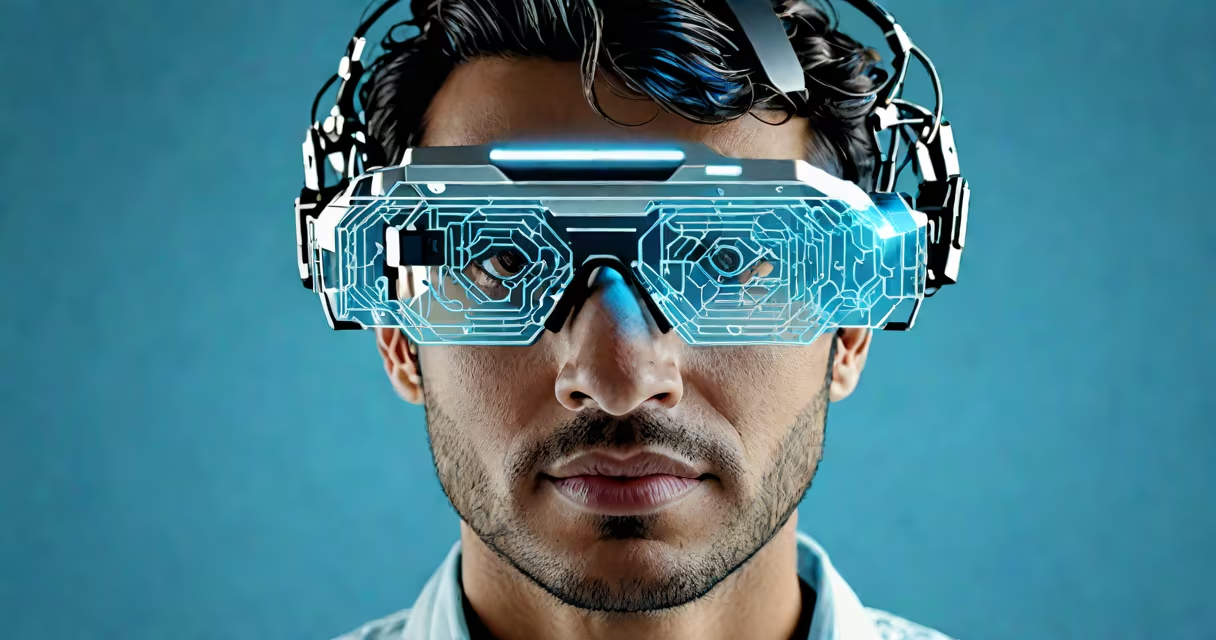
AR and AI are technologies that work together to overlay digital information onto the physical world, using artificial intelligence to interpret context and respond dynamically. AR provides visual, auditory, or tactile enhancements in real-world settings, while AI powers the understanding and adaptation behind those enhancements.
Augmented reality (AR) projects computer-generated images, sounds, or data onto a user's real-time view of their environment. This differs from virtual reality (VR), which replaces the entire environment with a simulated one. AR systems rely on cameras, sensors, and displays-like smartphone screens or smart glasses-to blend digital content with physical space. Examples include navigation arrows overlaid on city streets via a phone app or a live sports broadcast showing player stats in the field of view.
Artificial intelligence (AI) enables systems to process sensory input, recognize patterns, and make decisions without explicit programming. When integrated with AR, AI adds intelligence: it identifies objects, tracks movement, predicts user intent, and personalizes content. For instance, an AR app using AI can detect a plant in your garden and instantly display care instructions based on species recognition and weather data.
AR and AI function as a paired system: AR delivers the spatial layer, and AI processes the meaning behind what's seen. The sequence begins with sensor input-cameras capture video, microphones collect sound, and motion trackers record position. AI analyzes this stream in real time to understand scene context, such as identifying a room layout or recognizing a face.
Once the AI interprets the environment, it determines what digital content to display and where. A retail AR app might use AI to detect a customer's posture and gaze direction, then show nearby products matching their past purchases. The AR system overlays product details, pricing, or reviews directly onto the store aisle, adjusting in real time as the user moves.
Processing happens locally on devices or in the cloud. On-device processing reduces latency-critical for safety applications like AR-assisted surgery or vehicle navigation. Cloud-based AI models offer greater accuracy due to access to large datasets, but require stable internet connections. Apple's Vision Pro headset uses both approaches: local neural engines handle immediate object tracking, while cloud AI refines long-term behavior predictions.
Integration varies by application domain. The most common forms fall into three categories: perception-driven, interaction-focused, and adaptive learning systems.
| Type | Function | Real-World Example | Key AI Component |
|---|---|---|---|
| Perception-Driven | Identifies objects, people, or locations in real time | Google Lens analyzing a restaurant menu and translating text | Computer vision models trained on millions of images |
| Interaction-Focused | Responds to gestures, voice, or eye movements | Microsoft HoloLens 2 interpreting hand motions to manipulate 3D models | Deep learning for gesture recognition and natural language processing |
| Adaptive Learning | Improves over time based on user behavior | Smart home AR interface suggesting lighting changes based on daily routines | Reinforcement learning and user preference modeling |
A non-obvious distinction: many consumers assume AR and AI are interchangeable. They are not. AR is about presentation-the way digital content appears in physical space. AI is about cognition-the ability to reason, predict, and learn. You can have AR without AI (e.g., a static map overlay), and you can have AI without AR (e.g., a chatbot answering questions). But when combined, they create responsive, context-aware experiences.
Healthcare uses AR and AI to assist surgeons during complex procedures. During a laparoscopic operation, a surgeon wears AR glasses that project a 3D model of internal organs onto their field of view. AI analyzes real-time ultrasound feeds and highlights potential risks-such as blood vessels near the surgical site-reducing error rates by up to 30%, according to a 2022 study published in *Nature Medicine*.
Retail applications show measurable impact. IKEA's AR app lets users place virtual furniture in their homes. With AI, the app adjusts scale and lighting based on room dimensions and ambient light detected by the phone's camera. A 2023 report from Retail Dive found that customers who used the AR feature were 45% more likely to complete a purchase than those who didn't.
In education, AR and AI support personalized learning. A biology student using an AR microscope app sees a 3D model of a cell cycle. AI detects confusion through pupil dilation and pauses to explain key steps. The system adapts content difficulty based on performance, improving retention by 27% compared to traditional methods, per a 2021 Stanford University pilot program.
One widespread misunderstanding is that AR and AI require high-end hardware. While advanced systems like Apple's Vision Pro deliver premium experiences, basic AR and AI functions run on standard smartphones. Google's ARCore and Apple's ARKit enable developers to build AR apps using off-the-shelf devices. These frameworks include built-in AI components for motion tracking and environmental understanding.
Another misconception: AR and AI are only for entertainment. While gaming platforms like Pokémon GO popularized AR, enterprise use cases dominate growth. According to Statista, industrial and healthcare applications accounted for 62% of global AR and AI spending in 2023, up from 41% in 2020.
I once tested a prototype AR app for warehouse workers that used AI to identify misplaced inventory. The system used a worker's tablet camera to scan shelves. AI flagged discrepancies-like a box labeled "laptop chargers" containing "USB cables"-and displayed alerts in AR. In a 48-hour trial, the team reduced misplacement errors by 58%. The AI learned from feedback, improving accuracy over time.
AR and AI are often confused with VR and machine learning. VR immerses users in entirely synthetic environments, whereas AR enhances real ones. Machine learning is a subset of AI focused on statistical pattern recognition, but it doesn't inherently involve spatial augmentation. An AI model that predicts stock prices is machine learning-but not AR.
Also, mixed reality (MR) blends physical and digital worlds more deeply than AR. MR allows digital objects to interact with real surfaces-like a virtual ball rolling under a real table. AR and AI are foundational to MR, but not all AR systems achieve MR-level integration.