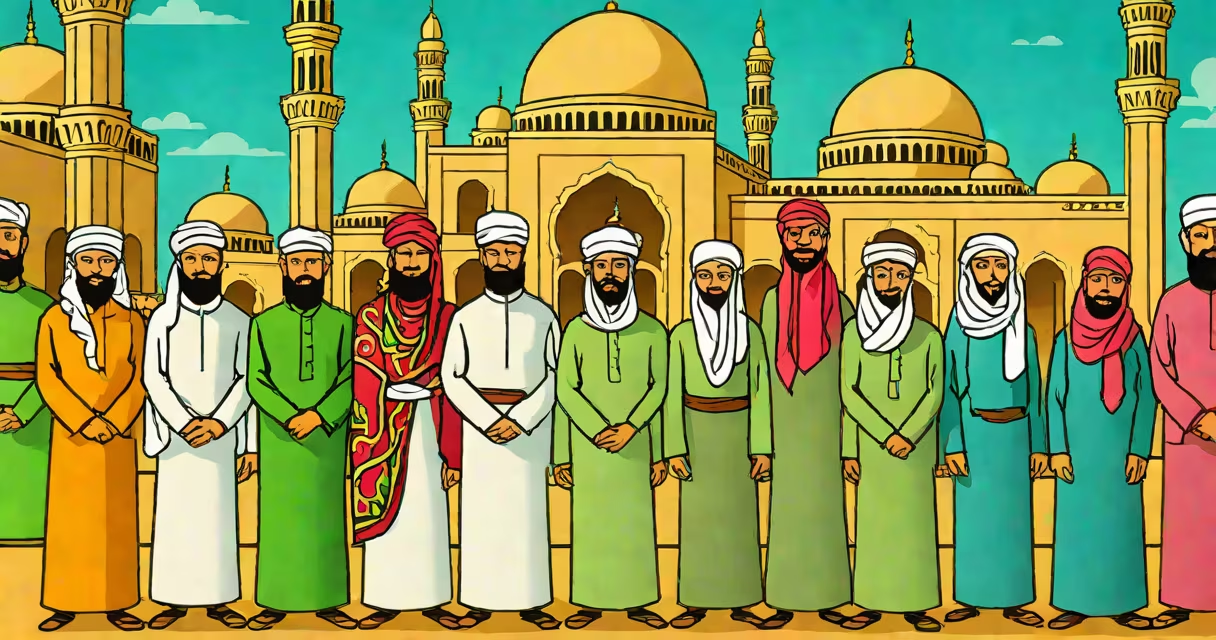
The word "Muslim" comes from the Arabic root "s-l-m," meaning peace, submission, and surrender. A Muslim is someone who submits to the will of Allah (God) as revealed in the Quran and through the teachings of Prophet Muhammad (peace be upon him). This term applies to anyone who affirms the core tenets of Islam, including belief in one God, the prophethood of Muhammad, and the Day of Judgment.
Islam, derived from the same root, means "submission" or "surrender" to divine will. The term "Muslim" thus describes a person whose life is oriented toward living in accordance with God's guidance. This is not a racial or ethnic label-it is a spiritual and theological identity. Over 1.8 billion people worldwide identify as Muslim, spanning more than 100 countries and dozens of cultures.
According to the Pew Research Center, Muslims represent about 24% of the global population. The largest Muslim populations are in Indonesia, Pakistan, India, and Nigeria. Despite shared beliefs, Muslim communities differ widely in language, dress, cuisine, and local customs-yet all affirm the Shahada: "There is no god but God, and Muhammad is His messenger."
"Muslim" functions as both a noun and an adjective. As a noun, it refers to a person who practices Islam. As an adjective, it describes anything related to the religion or its adherents. For example, "Muslim prayer" or "Muslim-majority country." The term is not interchangeable with "Arab"-while many Muslims are Arab, others are Persian, Turkish, Indonesian, African, or European.
Historically, the term emerged in the 7th century CE during the lifetime of Prophet Muhammad. Early converts to Islam were called "Muslims" in the Quran itself. Surah Al-Baqarah (2:116) states: "And they say, 'Be Jews or Christians, then you will be guided.' Say, 'Rather, [we follow] the religion of Abraham, inclining toward truth, and he was not among those who associated partners with Allah.'" This verse underscores the idea that being a Muslim means aligning with the monotheistic path established by prophets, including Abraham.
Today, the term is used globally in formal and informal contexts. Governments classify citizens by religion, and international organizations such as the United Nations use "Muslim" in demographic reports. In education, scholars distinguish between "Muslim" and "Islamic" when discussing culture versus theology-though the terms often overlap.
One widespread misconception is that "Muslim" implies violence or extremism. This is false. The Quran explicitly prohibits aggression unless in self-defense. Surah Al-Ma'idah (5:32) says: "Whoever kills a soul unless for a soul or for corruption [done] in the earth - it is as if he had slain mankind entirely." This verse establishes the sanctity of human life under Islamic law.
Another error is equating "Muslim" with "Arab." While Arabic is the language of the Quran and many early Islamic texts were written in Arabic, the religion spread far beyond the Arabian Peninsula. Today, over half of all Muslims live in Asia, particularly in South and Southeast Asia. Countries like Bangladesh, Pakistan, and Malaysia have larger Muslim populations than any Arab nation.
A third confusion arises from the use of "Islamist," which is often misused as a synonym for "Muslim." Islamist refers to political movements advocating for governance based on Islamic law (Sharia), while "Muslim" denotes personal faith. Not all Muslims support Islamist ideologies-many oppose them outright.
While "Muslim" is a single term, it appears in different forms across languages and regions. In Urdu, it is "مُسلِم" (muslim); in Turkish, "Müslüman"; in Swahili, "Mwamuzi." These variations reflect linguistic adaptation but preserve the core meaning of submission to God.
| Language | Term for "Muslim" | Region of Use |
|---|---|---|
| Arabic | مُسْلِم | Middle East, North Africa |
| Urdu | مُسلِم | Pakistan, India |
| Turkish | Müslüman | Turkey, Central Asia |
| Swahili | Mwamuzi | East Africa |
Within Islamic tradition, Muslims are further categorized by school of thought. The two largest branches are Sunni (about 85%) and Shia (about 15%). Both groups accept the core definition of "Muslim," but differ on leadership succession after Prophet Muhammad's death. Sunnis believe leadership should be elected; Shias believe it should pass through Ali, the Prophet's cousin and son-in-law.
Even within denominations, identity varies. Some Muslims emphasize ritual practice-prayer five times daily, fasting during Ramadan, giving zakat (charity). Others focus on ethical conduct, social justice, or inner spirituality. The Sufi tradition, for example, emphasizes love, devotion, and mystical experience-yet all Sufis are still Muslims by definition.
In 2019, I attended a community iftar meal in Toronto hosted by a local mosque. Attendees included immigrants from Somalia, Lebanon, and Morocco, alongside Canadian-born Muslims of mixed heritage. During the evening, a young woman from Sudan explained that her family had converted to Islam in the 1960s, but she only began practicing regularly after moving to Canada. She said, "I didn't grow up Muslim. But now I feel like I'm becoming who I am meant to be." Her story illustrates how "Muslim" is not a fixed identity but a lived commitment shaped by context and choice.
This reflects a key point: being a Muslim is not automatic. It requires affirmation of belief and consistent action. The Quran states in Surah Al-Imran (3:104): "And hold firmly to the rope of Allah all together and do not become divided." This verse calls for unity among believers-not uniformity in culture or appearance.
"Muslim" is distinct from related terms like "Islam," "Islamic," and "Allah." "Islam" is the religion. "Islamic" describes cultural or legal aspects-e.g., "Islamic finance" or "Islamic art." "Allah" is the Arabic word for God, used by Arabic-speaking Christians and Jews as well as Muslims. The term is not exclusive to Islam, though it is central to Islamic theology.
When someone says "I'm not Muslim," they may mean they don't practice the religion, or they reject its teachings. But the term itself remains neutral. It is not a judgment. It is a descriptor. Like "Christian" or "Jew," it identifies a spiritual path, not a moral verdict.
Understanding the meaning of the word muslim requires separating belief from behavior, identity from culture, and faith from politics. The term is rooted in Arabic, shaped by history, and lived differently across continents. Its core remains unchanged: submission to the one God.