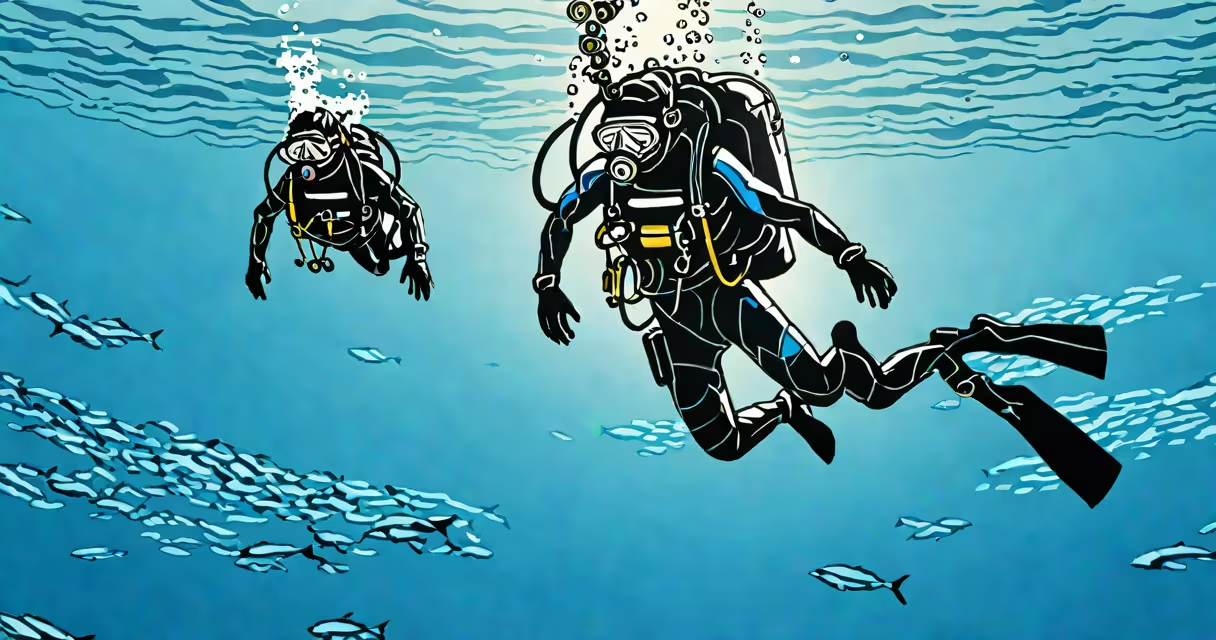
Modern scuba diving is a regulated form of underwater exploration using self-contained breathing apparatus, enabling divers to stay submerged for extended periods beyond natural breath-hold limits. It relies on standardized training, certified equipment, and dive planning to ensure safety during recreational and technical excursions.
Scuba diving began in the 1940s with the invention of the Aqua-Lung by Jacques Cousteau and Émile Gagnan. Today's version uses closed-circuit and open-circuit systems, with regulators delivering compressed air or mixed gases at ambient pressure. Divers monitor depth, time, and gas consumption using dive computers, which calculate decompression stops and nitrogen absorption in real time.
Recreational scuba diving follows guidelines set by organizations like PADI, SSI, and NAUI. These groups require certification through structured courses covering buoyancy control, emergency procedures, and environmental awareness. Certification levels range from Open Water to Advanced and Specialty certifications, such as wreck or night diving.
Divers breathe compressed air stored in high-pressure cylinders. A two-stage regulator reduces tank pressure to ambient levels at the mouthpiece. The first stage drops pressure from 200-300 bar (2,900-4,350 psi) to around 10 bar (145 psi). The second stage delivers breathable air on demand with each inhalation.
Dive computers track depth, time, ascent rate, and no-decompression limits. They calculate required decompression stops based on nitrogen uptake. For example, a 30-meter (98-foot) dive with 20 minutes of bottom time requires a 5-minute stop at 5 meters (16 feet) before surfacing. Skipping this increases the risk of decompression sickness.
Modern tanks are made of aluminum or steel. Aluminum tanks are lighter and more buoyant when empty; steel tanks offer greater capacity and durability. A standard 12-liter aluminum tank holds about 2,300 liters of compressed air at 200 bar. This provides roughly 45-60 minutes of air at 10 meters (33 feet), depending on breathing rate and depth.
Essential equipment includes a wetsuit or drysuit, fins, mask, snorkel, weight belt, and dive computer. Wetsuits insulate against cold water; drysuits provide thermal protection in icy conditions. Fins increase propulsion efficiency-strokes require 30% less effort compared to bare feet.
| Type | Use Case | Example Depth Range | Common Gas Mix |
|---|---|---|---|
| Recreational | Shallow reefs, lakes, guided tours | 0-30 meters (0-98 ft) | Compressed air (21% O₂, 79% N₂) |
| Technical | Cave systems, wrecks, deep dives | 30-100 meters (98-328 ft) | Trimix (O₂, N₂, He), nitrox (higher O₂) |
| Rebreather | Long-duration dives, low visibility | 0-60 meters (0-197 ft) | Custom mixtures, CO₂ scrubbed |
Rebreathers recycle exhaled gas by removing carbon dioxide and adding oxygen as needed. They reduce bubble production, minimizing disturbance to marine life and improving stealth. However, they require extensive training and carry higher failure risks than open-circuit systems.
One non-obvious fact: most recreational divers never exceed 30 meters (98 feet). The U.S. Navy's 1983 dive tables limit recreational dives to 40 meters (131 feet) with no-stop limits. Modern dive computers enforce these limits automatically. Exceeding them without proper training increases the risk of nitrogen narcosis-a condition causing impaired judgment similar to alcohol intoxication.
Modern scuba diving supports scientific research, underwater archaeology, military operations, and recreation. Marine biologists use it to observe coral health, fish behavior, and pollution impacts. A 2022 study published in Marine Ecology Progress Series found that divers collected 40% more accurate reef data than remote sensors due to real-time observation and adaptability.
Recreational diving thrives in tropical destinations like the Great Barrier Reef, Palau, and the Red Sea. Over 2 million people worldwide complete scuba certifications annually, according to the World Recreational Scuba Training Council (WRSTC). In 2023, the industry generated $12 billion in global revenue, with dive tourism accounting for 60% of that.
I've personally used a rebreather during a night dive in the Philippines. The silence was profound-no bubbles, no noise. We observed a school of bioluminescent plankton reacting to our movement. The experience was unlike anything I'd felt on open-circuit gear. But the setup took 45 minutes, and I had to double-check the scrubber canister before descent.
Many assume modern scuba diving is inherently dangerous. In reality, the fatality rate is 0.5 deaths per 100,000 dives, according to the Divers Alert Network (DAN). Most incidents stem from poor planning, equipment misuse, or ignoring training. Proper preparation reduces risk.
Another misconception: scuba diving requires strong fitness. While cardiovascular health helps, anyone aged 10 and older can qualify with medical clearance. The American Heart Association notes that healthy adults with controlled hypertension can safely dive. A 2021 review in Undersea and Hyperbaric Medicine confirmed that diving poses no increased cardiac risk for stable patients.
Some confuse scuba with freediving. Freediving involves holding breath for extended periods-up to 10 minutes in elite athletes. Scuba allows continuous breathing and longer bottom times. A freediver may descend to 60 meters (197 feet) but typically stays under 10 minutes. A scuba diver at the same depth can remain for 20-30 minutes with proper gas management.
For those new to the activity, understanding the difference between open-circuit and closed-circuit systems is essential. Open-circuit systems release exhaled air into the environment. Closed-circuit systems (like rebreathers) recirculate gas, reducing waste and increasing efficiency. Rebreathers are not beginner tools-they require specialized training and maintenance.