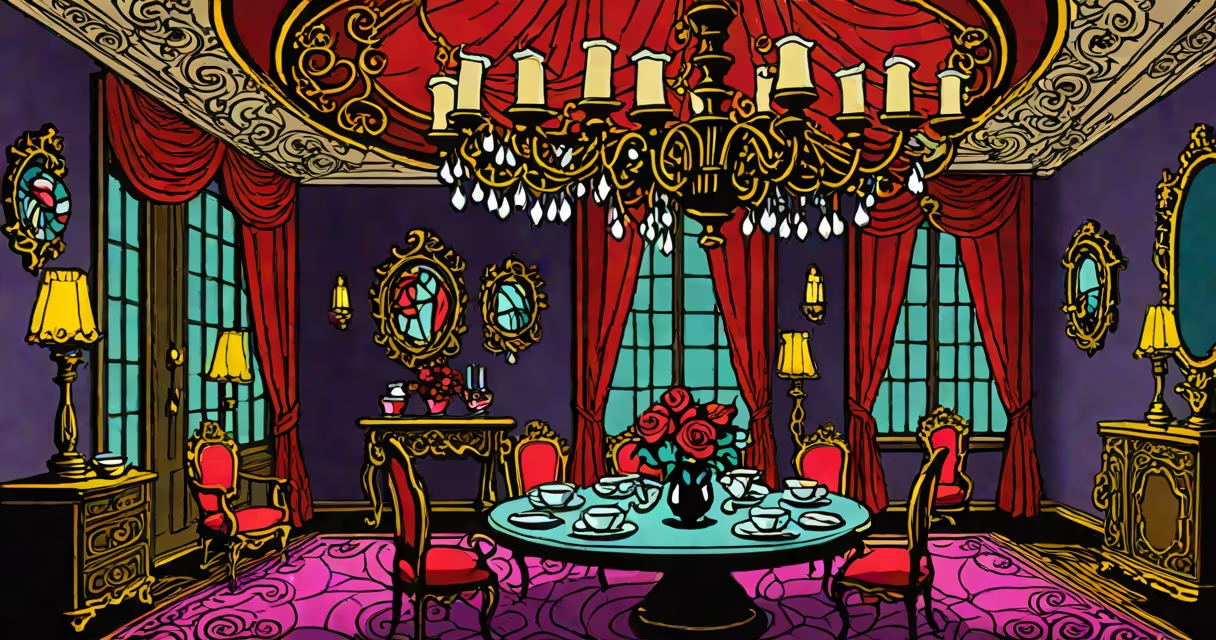
Grim Twisted Wonderland is a visual and thematic aesthetic that merges gothic horror, surreal fantasy, and distorted versions of classic children's stories into immersive, often unsettling environments. It draws from literary and artistic traditions rooted in psychological unease, subverting innocence with decay, asymmetry, and symbolic dread.
This aesthetic emerged from online art communities and gaming culture, particularly through the Japanese multimedia project *Grim Twisted Wonderland* (originally released in 2016). The project features a fictional area populated by anthropomorphic animals and mythical creatures trapped in a perpetual, dreamlike limbo. Its visuals combine Victorian-era architecture, decaying gardens, and grotesque symbolism-reminiscent of Edward Gorey's illustrations and Tim Burton's filmography-but with a heavier emphasis on emotional dissonance and narrative ambiguity.
Unlike straightforward horror or fantasy genres, Grim Twisted Wonderland thrives on contradiction: beauty and rot coexist. A ballroom may feature crystal chandeliers draped in cobwebs, or a nursery filled with toys that stare with too many eyes. This duality makes it distinct from both traditional gothic design and standard dark fantasy. It is not about fear for fear's sake-it's about unease born from familiarity warped beyond recognition.
The core mechanism of Grim Twisted Wonderland lies in its use of symbolic distortion. Everyday objects-teacups, mirrors, music boxes-are altered to suggest psychological fracture. A mirror might reflect a version of the viewer with hollow eyes. A music box plays a melody that slowly shifts into dissonance. These aren't random horrors-they're metaphors for anxiety, memory loss, or identity collapse.
Color palettes reinforce mood. Dominant tones include bruised purples, ash gray, blood red, and sickly green. Light sources are low and uneven-candles, flickering lanterns, or bioluminescent fungi. Shadows stretch unnaturally, and perspective often bends in ways that violate natural geometry. These choices create a sense of spatial instability, mimicking the feeling of being trapped in a dream that resists logic.
A key element is the use of "broken" symmetry. While classical gothic design relies on balanced, imposing structures, Grim Twisted Wonderland introduces imbalance-crooked doorways, staircases that lead nowhere, rooms that appear larger on the inside. This reflects internal chaos rather than external threat. The environment doesn't attack you-it confuses you.
Grim Twisted Wonderland appears across multiple formats, each emphasizing different aspects of the aesthetic:
| Type | Key Features | Example |
|---|---|---|
| Art & Illustration | High contrast, detailed linework, emotionally charged figures | Character designs from the original game's official artbook |
| Interior Design | Distressed furniture, mismatched textures, curated decay | A bedroom with a canopy bed made of rusted metal and dried flowers |
| Costume & Fashion | Victorian silhouettes with torn lace, oversized accessories, theatrical makeup | Wearing a corset layered with frayed ribbon and artificial teeth sewn into the collar |
| Performance & Stage | Immersive sets, controlled lighting, choreographed movement | A live theater piece where actors move in slow motion through a forest of broken mannequins |
Each form uses the same foundational principles: emotional resonance through visual metaphor, rejection of clean lines, and an embrace of melancholy beauty. The aesthetic avoids pure escapism-it demands engagement with discomfort.
Grim Twisted Wonderland is most visible in niche creative spaces. It's a staple at underground art fairs, cosplay conventions, and themed events like "Midnight Masquerade" nights in cities such as Tokyo, Berlin, and Los Angeles. It also influences fashion brands like Comme des Garçons' 2023 "Requiem" collection, which featured garments resembling burial shrouds stitched with floral motifs and glass eyes.
Its popularity stems from a cultural shift toward introspective, emotionally complex aesthetics. According to the Vogue editorial team, "The rise of 'dark whimsy' reflects a generation's desire to confront inner turmoil through stylized narratives." This aligns with research from the Psychology Today journal, which notes that people increasingly turn to symbolic art forms to process anxiety and existential fatigue-especially in post-pandemic contexts.
Commercial applications are growing. Retailers like Urban Outfitters have carried limited-edition decor lines inspired by the aesthetic, including "weeping wall sconces" and "dolls with removable limbs." These items sell out within hours due to their narrative weight and craftsmanship.
Many confuse Grim Twisted Wonderland with generic "goth" or "dark fantasy" themes. But while those styles emphasize darkness for atmosphere, Grim Twisted Wonderland centers on psychological tension. It's not about vampires or demons-it's about the mind unraveling in a space that feels familiar yet alien.
Another misconception is that it's purely fictional or internet-born. In reality, its roots trace back to early 20th-century surrealist movements. Artists like Leonora Carrington and Remedios Varo created dreamscapes with similar tonal qualities-distorted domestic spaces, hybrid creatures, and ambiguous moral frameworks. The modern iteration simply digitizes and distributes these ideas through social media.
A less obvious distinction: the aesthetic is not inherently anti-fun. Despite its grim tone, it invites playfulness. One character in the original game, a fox named Lullaby, sings lullabies that sound like laments-but his delivery is cheerful. This contrast is intentional. It mirrors how trauma can coexist with joy, especially in childhood memories.
In 2022, a New York-based artist named Mira Chen transformed a 12-foot by 15-foot apartment unit into a full-scale installation titled *The Waiting Room*. She used reclaimed wood, broken mirrors, and hand-carved porcelain figures. The centerpiece was a grandfather clock with no hands, its face replaced by a child's drawing of a smiling sun. The walls were covered in layers of faded wallpaper, peeling to reveal older patterns beneath.
Chen explained her intent: "I wanted to make a place where someone could feel safe-and then realize they weren't." Visitors reported feelings of nostalgia mixed with unease. One wrote, "I sat on the floor for 45 minutes. I didn't want to leave. I didn't want to stay." This response exemplifies the aesthetic's power: it doesn't entertain-it lingers.
When I visited the exhibit, I noticed a small music box tucked under a bench. When wound, it played a fragment of "Twinkle, Twinkle Little Star"-but slowed down to half-speed and pitch-shifted into minor. The effect wasn't scary. It was sad. And that's the point.
Grim Twisted Wonderland is not a genre. It's a mode of perception-one that sees wonder in decay and beauty in the broken. It challenges viewers to accept that meaning isn't always clear, and peace isn't always quiet. For those drawn to its haunting elegance, it offers more than decoration-it offers a way to see the world differently.