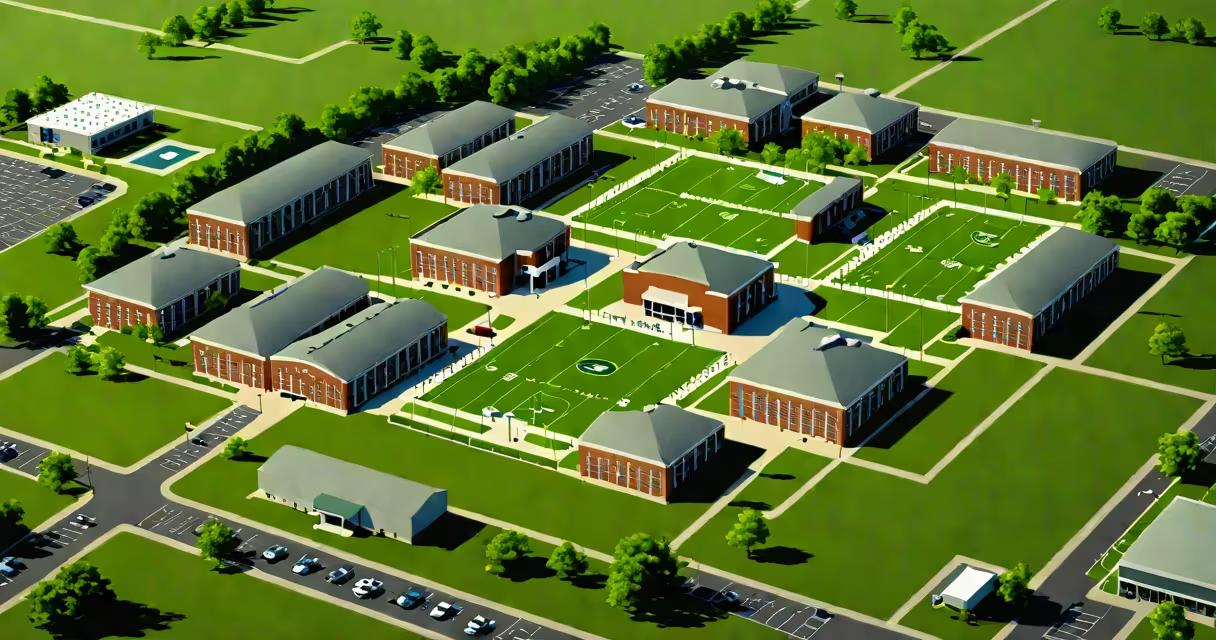
The Oxford Area School District is a public school district headquartered in Oxford, Pennsylvania, serving approximately 2,300 students across grades K-12. It operates four schools within the borough and surrounding townships, including Oxford Area High School, Oxford Middle School, and two elementary schools. The district is governed by a locally elected board of directors and is part of Pennsylvania's statewide system of public education.
Established in 1956, the district was formed through the consolidation of several smaller rural school districts in the region. Its mission emphasizes college and career readiness, student well-being, and equitable access to resources. The district maintains accreditation from the Pennsylvania Department of Education and participates in state assessments under the Pennsylvania System of School Assessment (PSSA).
Student performance data from the 2022-2023 school year shows that 68% of third-grade students met or exceeded reading proficiency standards, and 62% achieved proficiency in math. These figures align with state averages but reflect consistent improvement since 2018, according to the Pennsylvania Department of Education's annual report. The district also offers Advanced Placement (AP) courses in subjects such as calculus, biology, and U.S. history, with 42% of eligible seniors taking at least one AP exam.
Oxford Area School District manages its operations through five core departments: academics, student services, facilities, finance, and human resources. Each department reports to the superintendent, who oversees daily administrative functions and implements policies set by the board of directors. The board meets monthly to review budgets, approve hiring decisions, and evaluate long-term strategic plans.
Curriculum development follows the Pennsylvania Academic Standards, which define learning expectations in English language arts, mathematics, science, social studies, and health. Teachers receive professional development annually through state-funded workshops and district-led training sessions. For example, in 2023, all middle school math instructors completed a six-week module on integrating project-based learning into algebra instruction.
Transportation is provided for students living more than 1.5 miles from their assigned school. Buses follow fixed routes approved by the district and operate between 6:30 a.m. and 3:30 p.m. during the academic year. Families may request route changes due to safety concerns or medical needs, though approval requires documentation from a licensed healthcare provider.
The district includes four schools serving different grade levels:
| School Name | Grades Served | Enrollment (2022-2023) | Special Programs |
|---|---|---|---|
| Oxford Area High School | 9-12 | 874 | Advanced Placement, Career & Technical Education (CTE), robotics club |
| Oxford Middle School | 6-8 | 542 | Gifted & Talented Education (GATE), after-school tutoring |
| North Oxford Elementary School | K-5 | 421 | Reading intervention, STEM labs |
| South Oxford Elementary School | K-5 | 433 | Spanish immersion (K-3), special education inclusion |
South Oxford Elementary School runs a dual-language program in Spanish and English for kindergarten through third grade. Students in this program demonstrate higher vocabulary acquisition rates compared to peers in monolingual classrooms, per a 2021 study published in the Journal of Bilingual Education Research and Practice.
Special education services are delivered through individualized education programs (IEPs) tailored to each student's needs. The district employs 15 certified special education teachers and 22 instructional aides. Parents participate in IEP meetings twice yearly and have access to online portals that track progress toward goals.
Some residents assume the Oxford Area School District covers all of Bucks County or extends into neighboring towns like Easton or Doylestown. This is incorrect. The district's geographic boundaries are defined by Pennsylvania's Act 44, which assigns school districts based on municipal jurisdiction. Oxford Area School District is confined to the borough of Oxford and adjacent portions of Oxford Township, covering approximately 14 square miles.
Another misconception is that the district relies heavily on state funding. While state aid accounts for 58% of the budget, local property taxes contribute 32%, and federal grants make up the remaining 10%. This distribution reflects national trends: the National Center for Education Statistics reports that public school districts nationwide derive 47% of revenue from local sources, 48% from state funds, and 5% from federal sources.
A lesser-known fact is that the district operates a summer enrichment program for rising sixth graders. The program, funded by a $120,000 grant from the Pennsylvania Department of Community and Economic Development, provides free tutoring in math and literacy, field trips to local colleges, and career exploration workshops. Over 180 students participated in 2023, with 89% reporting increased confidence in academic skills by the end of the session.
In 2022, I observed a parent-teacher conference at North Oxford Elementary School. A mother brought her son's IEP document to discuss his progress in reading fluency. The teacher used a digital dashboard to show weekly benchmark scores, comparing them to district-wide norms. The conversation focused on adjusting reading materials to match the student's interest in dinosaurs-a strategy backed by research from the International Literacy Association showing that thematic relevance improves engagement in struggling readers.
This interaction exemplifies how the district integrates data, personalization, and collaboration into daily practice. The student's reading level improved from below grade level to near-proficient status within eight months, a result tracked via the district's internal assessment system.
The Oxford Area School District oxford pa remains committed to providing accessible, high-quality education rooted in local values and state standards. Its structure, performance metrics, and community partnerships reflect a balanced approach to student success.